P0300 Code: Random Misfire Detected – Meaning, Causes, Symptoms & Fixes
In This Guide
- What the P0300 Code Means
- Symptoms of the P0300 Code
- Common Causes of P0300
- How to Diagnose P0300
- How to Fix the P0300 Code
- P0300 Repair Costs
- DIY vs Mechanic Verdict
- Can You Drive With a P0300 Code?
- P0300 on Popular Vehicles
- P0300 vs P0301: What Is the Difference?
- Video Walkthrough
- Frequently Asked Questions
One-line meaning: P0300: Random or Multiple Cylinder Misfire Detected.
What the P0300 Code Means
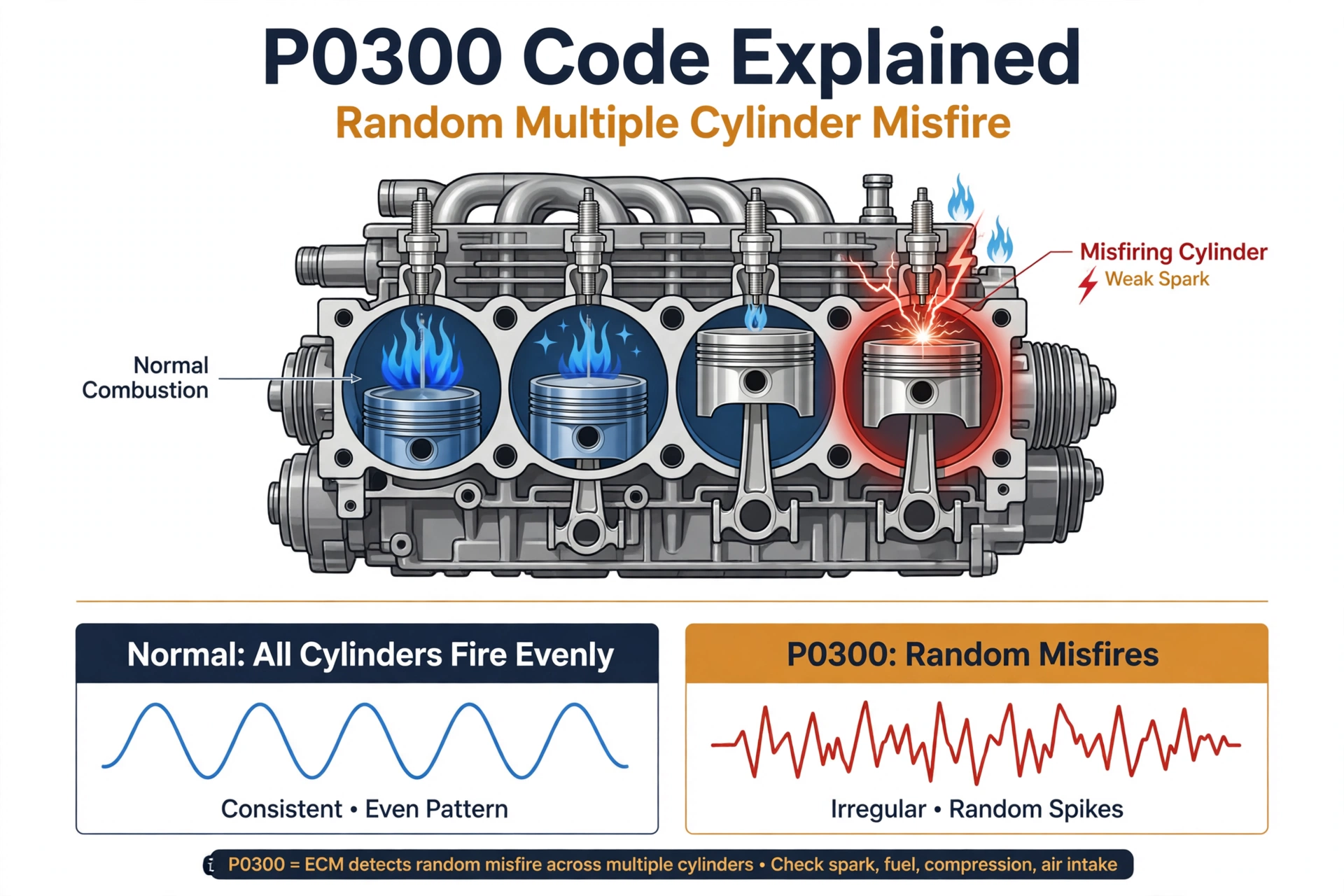
When your scanner shows the p0300 engine code, it means your car’s computer has detected misfires happening randomly across multiple cylinders, rather than in one specific cylinder. To understand the p0300 code, it helps to know what a misfire actually is. Inside each cylinder, a precise mix of air and fuel is compressed and then ignited by the spark plug. That controlled explosion pushes the piston down and keeps the engine turning smoothly. When a cylinder fails to fire properly, even for a fraction of a second, the engine briefly loses power on that cylinder. The computer watches crankshaft speed very closely, and when it notices the tiny hiccup in rotation that a missed combustion causes, it logs a misfire.
The engine code p0300 is different from codes like P0301 through P0312, which point to one exact cylinder. A p0300 random misfire code tells you the problem is spread around, which usually means the root cause is something the whole engine shares: the fuel supply, the air intake, the ignition system as a whole, or engine timing. That shared-system angle is actually helpful, because it narrows your diagnosis toward components that affect every cylinder at once.
One more thing the definition implies: the computer only sets the p0300 misfire code when misfires happen often enough to matter. An occasional single missed combustion will not trigger it. So when you see this code, the misfiring is real, repeated, and worth diagnosing promptly.
Symptoms of the P0300 Code
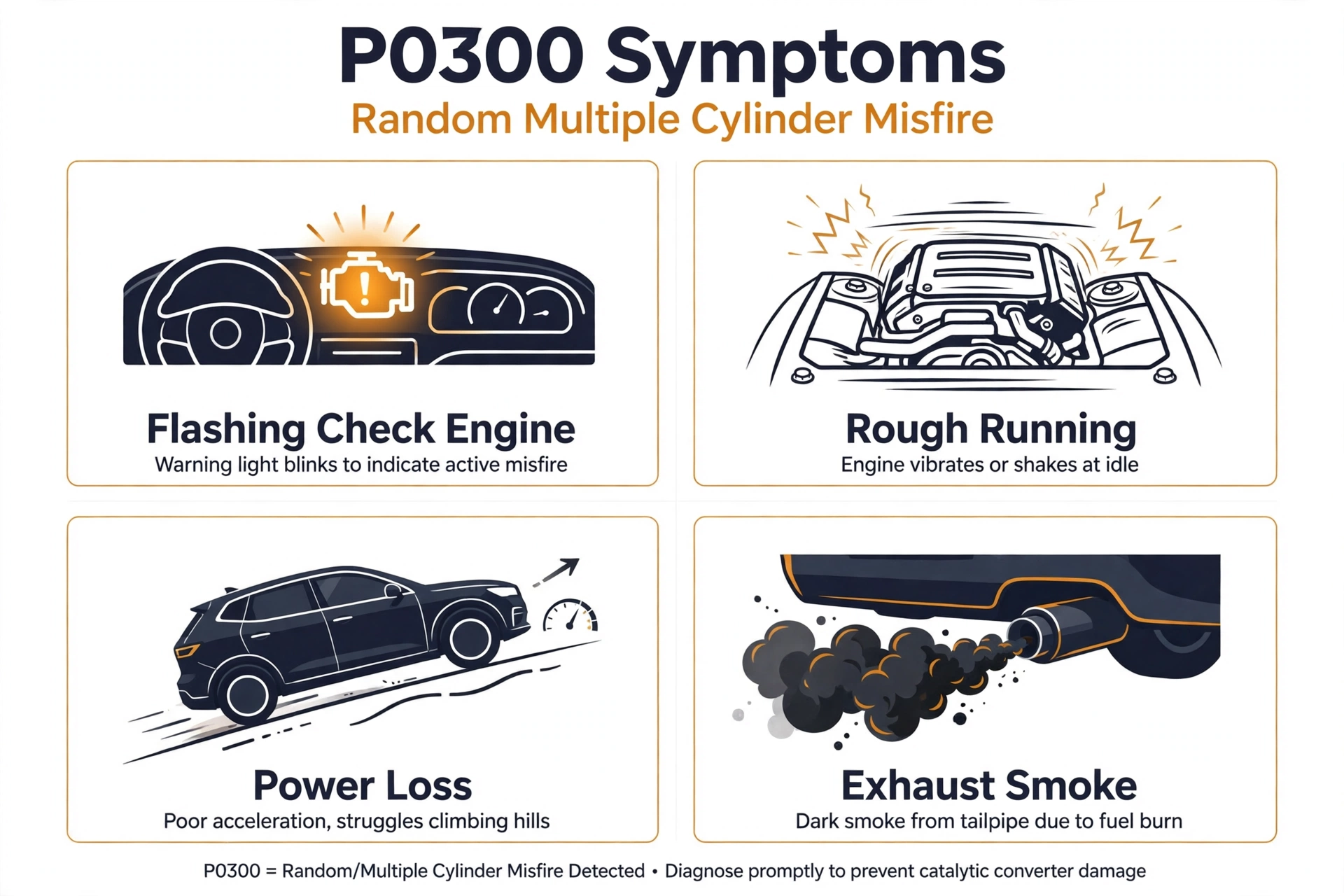
The symptoms of a check engine light code p0300 range from mildly annoying to impossible to ignore. Here is what drivers most often notice:
- Rough idle. The engine shakes or vibrates noticeably at stoplights. This is the single most reported symptom of the p0300 code.
- Hesitation or stumbling under acceleration. The car feels like it momentarily loses power when you press the gas, then catches up.
- Flashing check engine light. A steady light means misfires are occurring; a flashing light means a severe misfire is happening right now and raw fuel may be reaching the catalytic converter.
- Reduced fuel economy. Misfiring cylinders waste fuel, so you will find yourself filling up more often than usual.
- Hard starting. The engine cranks longer than normal before catching, especially on cold mornings.
- Engine surging. RPMs rise and fall on their own at idle, as the computer struggles to compensate for the missed combustions.
- Lack of power. The car feels sluggish, particularly going uphill or merging onto highways.
If your check engine code p0300 came with a flashing light, treat it as urgent. A flashing light is the computer’s way of warning you that catalytic converter damage is actively occurring.
Common Causes of P0300
The p0300 code has a well-known lineup of suspects. In rough order of how often they are the actual culprit:
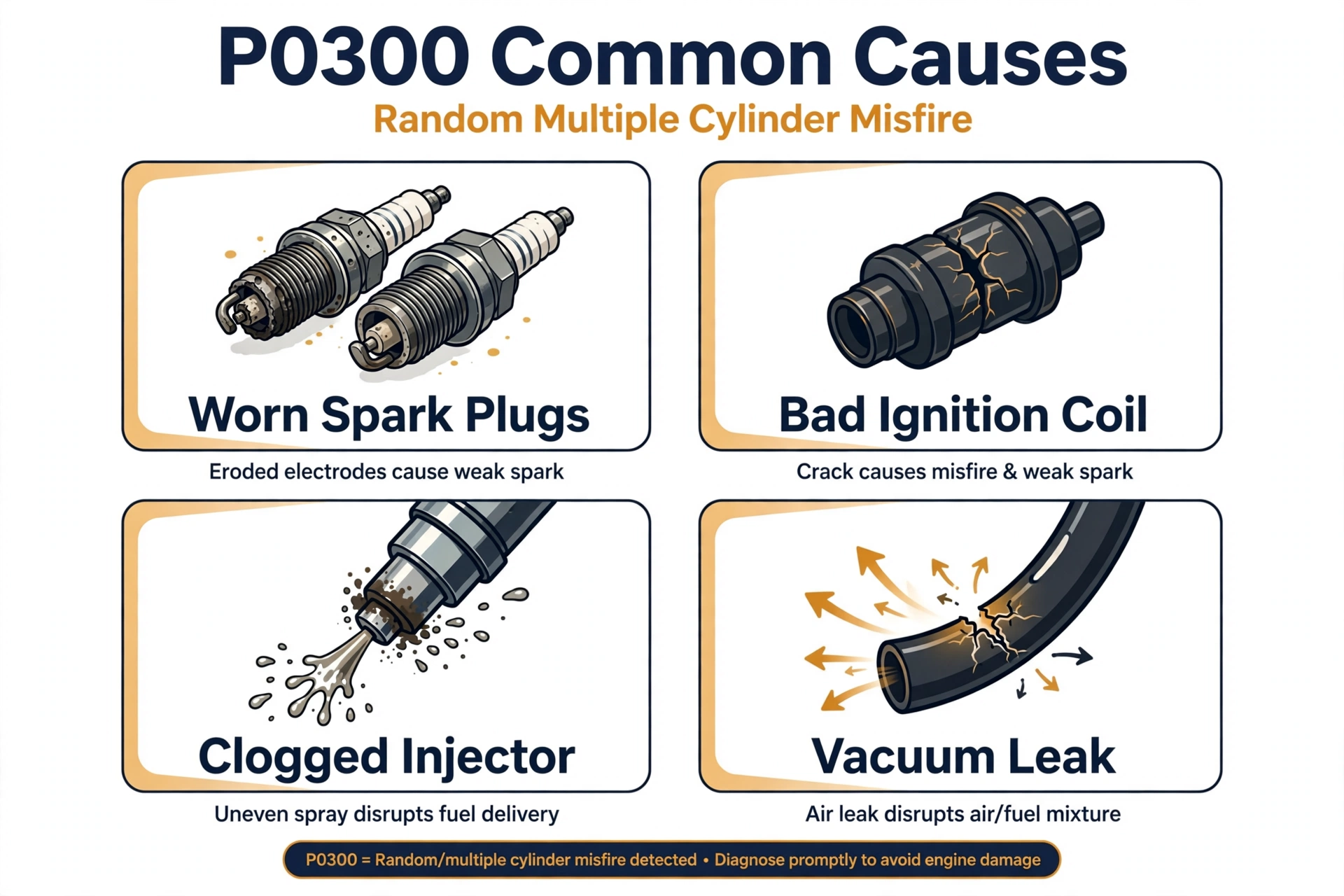
- Worn spark plugs. The number one cause. Plugs with rounded electrodes, excessive gap, or heavy carbon deposits fail to spark reliably. If your plugs are past their service interval, start here.
- Failing ignition coils or coil boots. A weak coil produces a weak spark. Cracked coil boots let spark energy leak to ground instead of reaching the plug.
- Vacuum leaks. Cracked hoses, leaking intake manifold gaskets, or a bad brake booster hose let unmetered air into the engine. The lean mixture misfires, especially at idle. This is the most common cause when the misfire is worst at idle but smooths out at higher RPM.
- Dirty or failing fuel injectors. An injector that dribbles instead of spraying a fine mist starves its cylinder of properly atomized fuel.
- Low fuel pressure. A weak fuel pump or clogged fuel filter cannot deliver enough fuel to all cylinders under load.
- Faulty mass airflow (MAF) sensor. A dirty MAF sensor under-reports incoming air, so the computer delivers too little fuel and the mixture runs lean across all cylinders.
- EGR valve stuck open. Exhaust gas recirculating at the wrong time (especially at idle) dilutes the mixture and causes random misfires.
- Low engine compression. Worn piston rings, leaking valves, or a blown head gasket reduce compression. This is less common but serious, and it affects the mechanical ability of the cylinder to fire.
- Incorrect cam or crank timing. A stretched timing chain or a jumped timing belt throws valve timing off across the engine.
How to Diagnose P0300
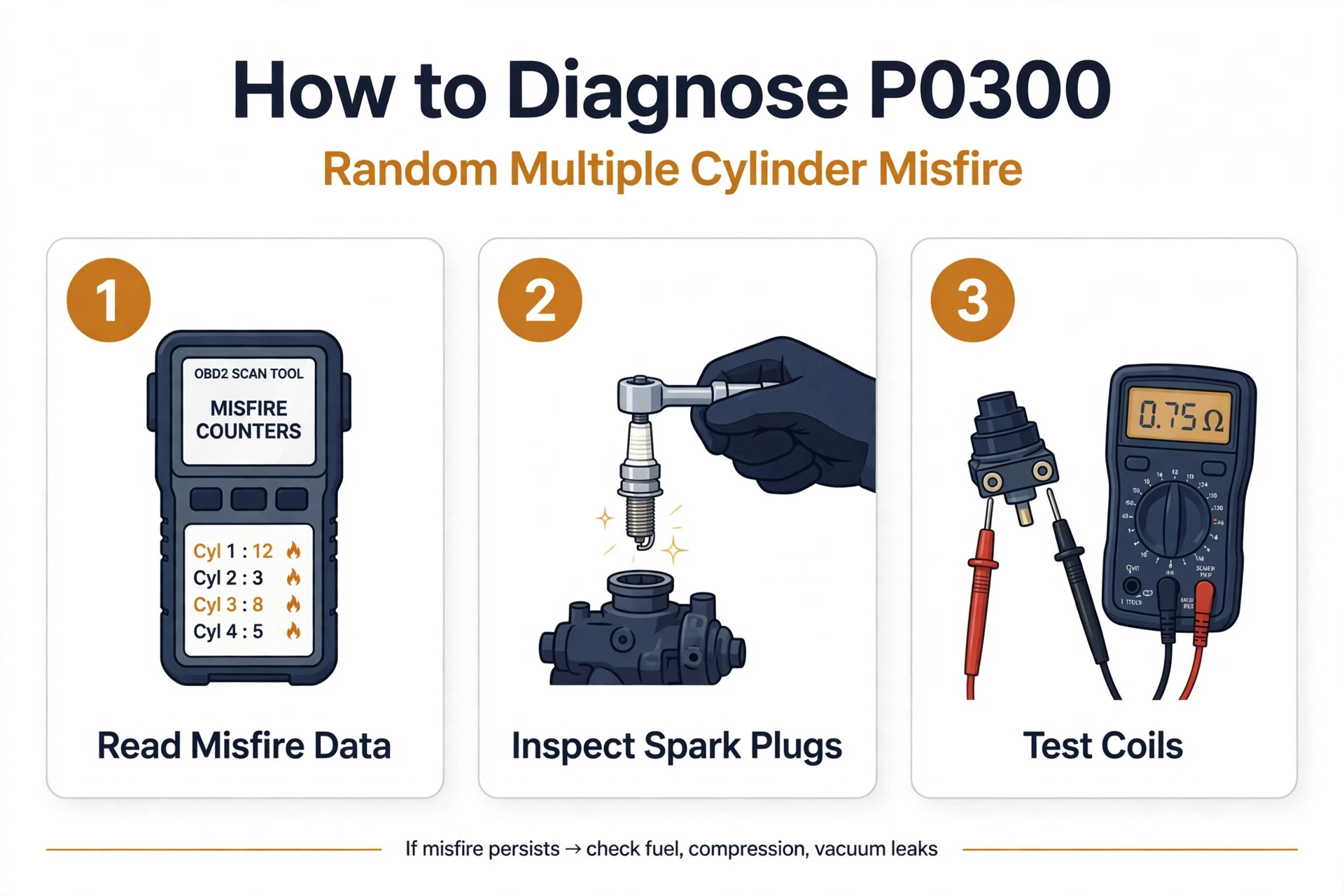
Diagnosing the p0300 engine code is about narrowing down, not guessing. Follow this order:
- Read all codes and freeze-frame data. Check whether companion codes are present. A p0300 code paired with P0171 (lean) points strongly at a vacuum leak or fuel delivery issue. Note the freeze-frame RPM, load, and coolant temperature from when the code set.
- Check per-cylinder misfire counters. Most decent scanners show live misfire counts per cylinder. If counts are spread evenly, suspect plugs, fuel, or a vacuum leak. If they cluster on one bank of a V engine, suspect a bank-specific intake gasket leak.
- Inspect the spark plugs. Pull two or three plugs and read them. Rounded electrodes, oil fouling, or heavy deposits mean a full set replacement is the smart first repair. Check the coil boots for cracks while you are in there.
- Test for vacuum leaks. With the engine idling, listen for hissing around the intake manifold, vacuum hoses, and brake booster line. Carefully spray carburetor cleaner around gasket seams; if the idle changes when you hit a spot, you have found the leak.
- Check fuel trims and fuel pressure. In live data, strongly positive long-term fuel trims mean the engine is compensating for a lean condition. Test fuel pressure against your engine’s specification to rule out a weak pump or clogged filter.
- Inspect the MAF sensor. A contaminated MAF sensor is a classic cause of lean random misfires. Cleaning it with MAF-specific cleaner takes ten minutes and costs almost nothing.
- Compression test if the basics check out. If plugs, coils, fuel pressure, and the intake all check out, run a compression or leak-down test. Low readings point to valves, rings, or head gasket issues that need a shop.
How to Fix the P0300 Code
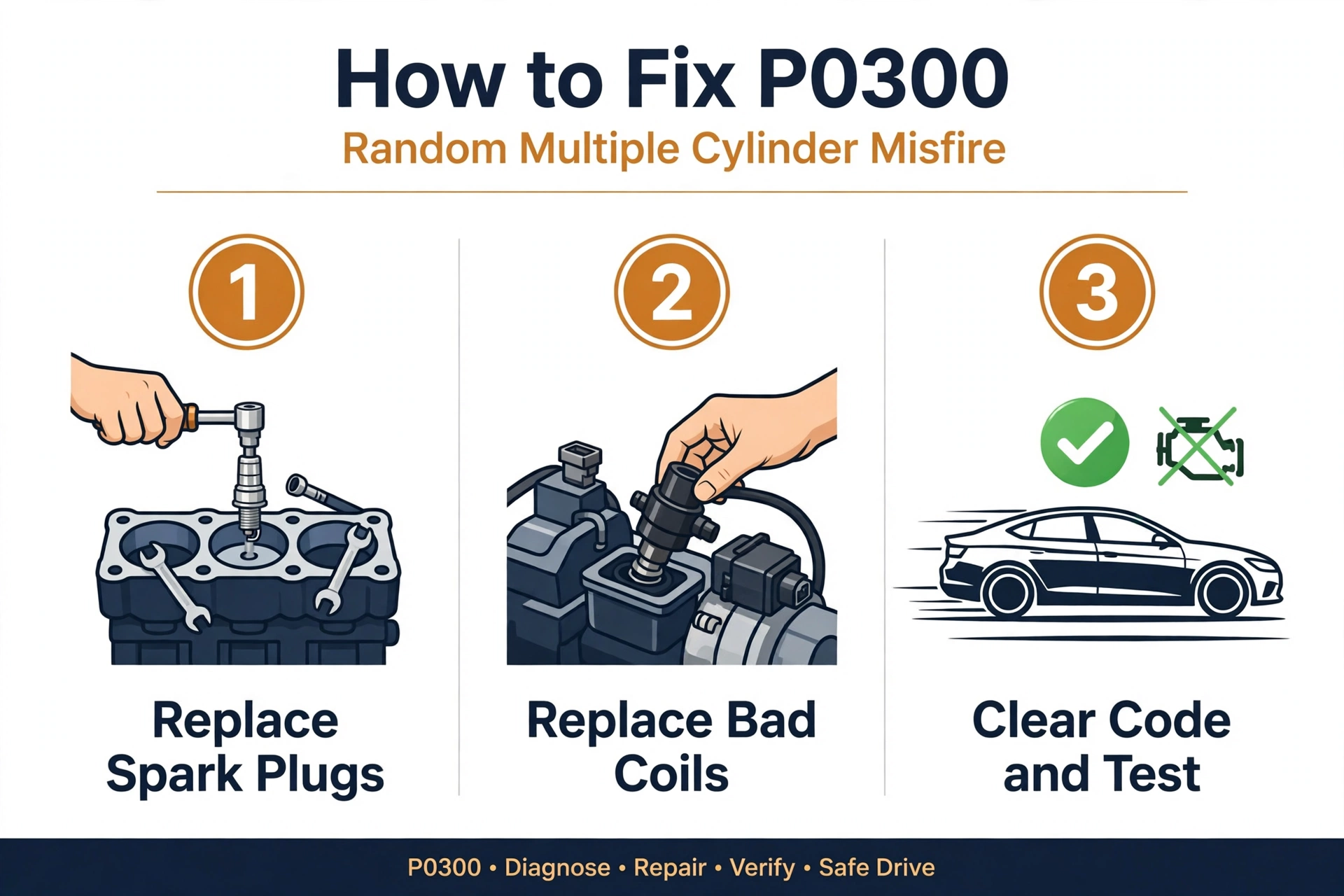
The right fix for the engine code p0300 depends entirely on what your diagnosis found. Here are the fixes matched to causes:
- Replace the spark plugs. If plugs are worn or overdue, replace the full set (not just one). Use the exact plug type your manufacturer specifies and gap them correctly.
- Replace faulty ignition coils or boots. Swap any coil that tests weak, plus any cracked boots. On many engines, replacing boots with the plugs is cheap insurance.
- Repair vacuum leaks. Replace cracked hoses, failed intake gaskets, or a leaking brake booster hose. Small hose fixes cost almost nothing in parts.
- Clean or replace fuel injectors. Try a quality fuel system cleaner first for mildly dirty injectors. A truly failed injector needs replacement.
- Replace the fuel filter or fuel pump. If fuel pressure tests low, a clogged filter is the cheap fix; a weak pump is the expensive one.
- Clean the MAF sensor. Use only MAF-specific cleaner, never carb cleaner, which can damage the sensing element.
- Replace a stuck EGR valve. If the EGR is stuck open, especially causing idle misfires, replacement restores proper operation.
- Address compression issues. Valve jobs, ring replacement, or head gasket repair are major mechanical work for a professional shop.
After any repair, clear the code with your scanner and drive normally. The p0300 code should stay off through several drive cycles if the fix worked.
P0300 Repair Costs
How much it costs to fix a p0300 engine code depends on which cause turns out to be yours. Here are realistic ranges:
| Repair | Cost Range |
|---|---|
| Spark plug replacement (full set) | $80 – $250 |
| Ignition coil replacement (per coil) | $70 – $250 |
| Coil boots (set) | $20 – $60 |
| Vacuum hose replacement | $20 – $150 |
| Intake manifold gasket | $200 – $600 |
| Fuel injector cleaning | $50 – $150 |
| Fuel injector replacement (per injector) | $150 – $400 |
| Fuel pump replacement | $400 – $800 |
| MAF sensor cleaning | $10 – $15 (DIY) |
| MAF sensor replacement | $100 – $300 |
| EGR valve replacement | $150 – $400 |
| Compression-related engine repair | $1,000 – $3,500+ |
The typical total for a check engine light code p0300 falls between $100 and $1,000. A plugs-and-coils fix sits at the low end; fuel system or internal engine work pushes it higher. Labor climbs on V6 and V8 engines where the intake manifold or rear bank must come off to reach the parts, so always confirm the cause before authorizing big work.
DIY vs Mechanic Verdict
DIY it if: the cause is spark plugs, coil boots, a visible vacuum hose, or a dirty MAF sensor. These are all doable at home with basic hand tools, a spark plug socket, and a torque wrench. Most p0300 code cases are solved at this level.
See a mechanic if: you need fuel pressure testing, a compression or leak-down test, or the misfire persists after fresh plugs and no obvious leaks. Chasing an intermittent lean condition or internal engine wear takes gauges and experience most DIYers do not have. Also see a shop if the check engine light is flashing, since converter damage may already need assessment.
Verdict: Start DIY with plugs and a visual inspection. If that does not solve it, pay for a professional diagnosis (usually $100 to $150) rather than replacing parts on guess. A proper diagnosis is almost always cheaper than the wrong part.
Can You Drive With a P0300 Code?
It depends on whether the check engine light is steady or flashing. With a steady light and mild symptoms, you can drive gently to a shop, but get it diagnosed soon because misfires tend to worsen. With a flashing light, stop driving. A flashing light means a severe misfire is actively dumping raw fuel into the catalytic converter, which can overheat and melt the converter’s internals, turning a $200 plug job into a $1,500 converter replacement. Ease off the throttle, pull over when safe, and have the car towed or diagnosed before driving further.
P0300 on Popular Vehicles
- Chevy (Silverado, Tahoe, Suburban): The p0300 code chevy is one of the most searched variants, and for good reason. On Chevrolet trucks and SUVs, the p0300 chevy silverado often traces to worn plugs past their interval or a failing coil on the hard-to-reach rear bank. The p0300 code chevrolet pattern is similar across the Silverado, Tahoe, and Suburban: start with plugs and coils before suspecting anything exotic. Whether you search it as p0300 chevrolet or p0300 chevy code, the diagnostic path is the same.
- Nissan, Dodge, Ford, Toyota, Jeep: A p0300 nissan (Altima, Rogue, Sentra) frequently involves ignition coils, which are a known weak point on several Nissan four-cylinders. If you have a p0300 dodge ram 1500, check the coils and also the intake manifold bolts, which can loosen over time and create small vacuum leaks. For a p0300 ford (especially F-150), coil-on-plug failures are the classic culprit. The p0300 toyota and p0300 jeep patterns lean toward overdue spark plugs and vacuum hoses hardened by heat and age. A p0300 dodge with high miles deserves a compression check sooner rather than later, since the 4.7L and 5.7L engines can develop valve seat issues.
- GM scanners (p0300-00): The chevy engine code p0300 sometimes appears as p0300-00 engine misfire detected on professional scanners, which is the same code with a status byte appended. Do not let the extra digits confuse you; the diagnosis is identical.
P0300 vs P0301: What Is the Difference?
Both are misfire codes, but they point in different directions. P0300 means random or multiple cylinders are misfiring, which suggests a shared-system cause like fuel delivery, a vacuum leak, or worn plugs across the engine. P0301 means cylinder 1 specifically is misfiring, which points at that cylinder’s plug, coil, injector, or compression. If your scanner shows a p0300 code plus a P0301, focus on cylinder 1 first; fixing it often clears the P0300 as well. For more on single-cylinder misfires, see our misfire trouble codes guide.
Related Codes
- P0301 – P0312: Cylinder-specific misfire codes that point to one exact cylinder
- P0171 / P0174: System Too Lean codes that can cause random misfires
- P0420: Catalyst System Efficiency Below Threshold (Bank 1)
Video Walkthrough
Watch 1A Auto walk through P0300 ignition coil diagnosis step by step, including how to tell a bad coil from a bad plug.
Frequently Asked Questions
What does the P0300 code mean?
The p0300 code means “Random or Multiple Cylinder Misfire Detected.” Your engine computer has detected misfires occurring across multiple cylinders rather than one specific cylinder, which usually points to a shared-system cause like ignition, fuel delivery, or a vacuum leak.
What is the most common cause of a P0300 code?
Worn spark plugs are the most common cause of the p0300 engine code, followed by failing ignition coils and vacuum leaks. If your plugs are past their service interval, replacing the full set fixes a large share of P0300 cases.
Can I drive with a P0300 code?
With a steady check engine light, drive gently to a shop soon. With a flashing light, stop driving immediately. A flashing light means raw fuel is reaching the catalytic converter and can destroy it, turning a cheap fix into a very expensive one.
How much does it cost to fix P0300?
Most engine code p0300 repairs run $100 to $1,000. Spark plugs ($80 to $250) and ignition coils ($70 to $250 each) are the common low-end fixes. Fuel injectors, intake gaskets, or compression repairs push costs higher.
Will the P0300 code clear itself?
If the misfire was a one-off from bad fuel or moisture, the light may go out on its own. But a genuine repeating check engine code p0300 almost always returns until the root cause is fixed, so do not ignore it.
Can a vacuum leak cause P0300?
Yes. A vacuum leak lets unmetered air into the engine, creating a lean mixture that misfires across multiple cylinders. This is especially likely when the misfire is worst at idle and smooths out at higher RPM.
Can bad gas cause a P0300 code?
Contaminated or very low-quality fuel can cause temporary misfires that set the p0300 random misfire code. If the code appeared right after filling up at an unfamiliar station, try a tank of quality fuel from a top-tier brand and see if it clears.
Conclusion
The p0300 code is your engine’s way of saying multiple cylinders are misfiring and the cause is something they all share. In most cases that means spark plugs, ignition coils, or a vacuum leak, all of which are affordable fixes when caught early. The key rules: do not ignore a flashing check engine light, diagnose before replacing parts, and start with the simple stuff. Handle it promptly and a p0300 engine code is one of the more straightforward check engine lights you will ever deal with.
About the author: Written by the OBD2 Code Hub editorial team. This guide is for informational purposes. If you are unsure about any repair, consult a qualified mechanic.