OBD2 CODE HUB · FUEL & AIR GUIDE
Fuel & Air Trouble Codes
Fuel system OBD2 codes explained in plain English — lean and rich mixture faults, airflow sensor failures, and exactly what to check first.
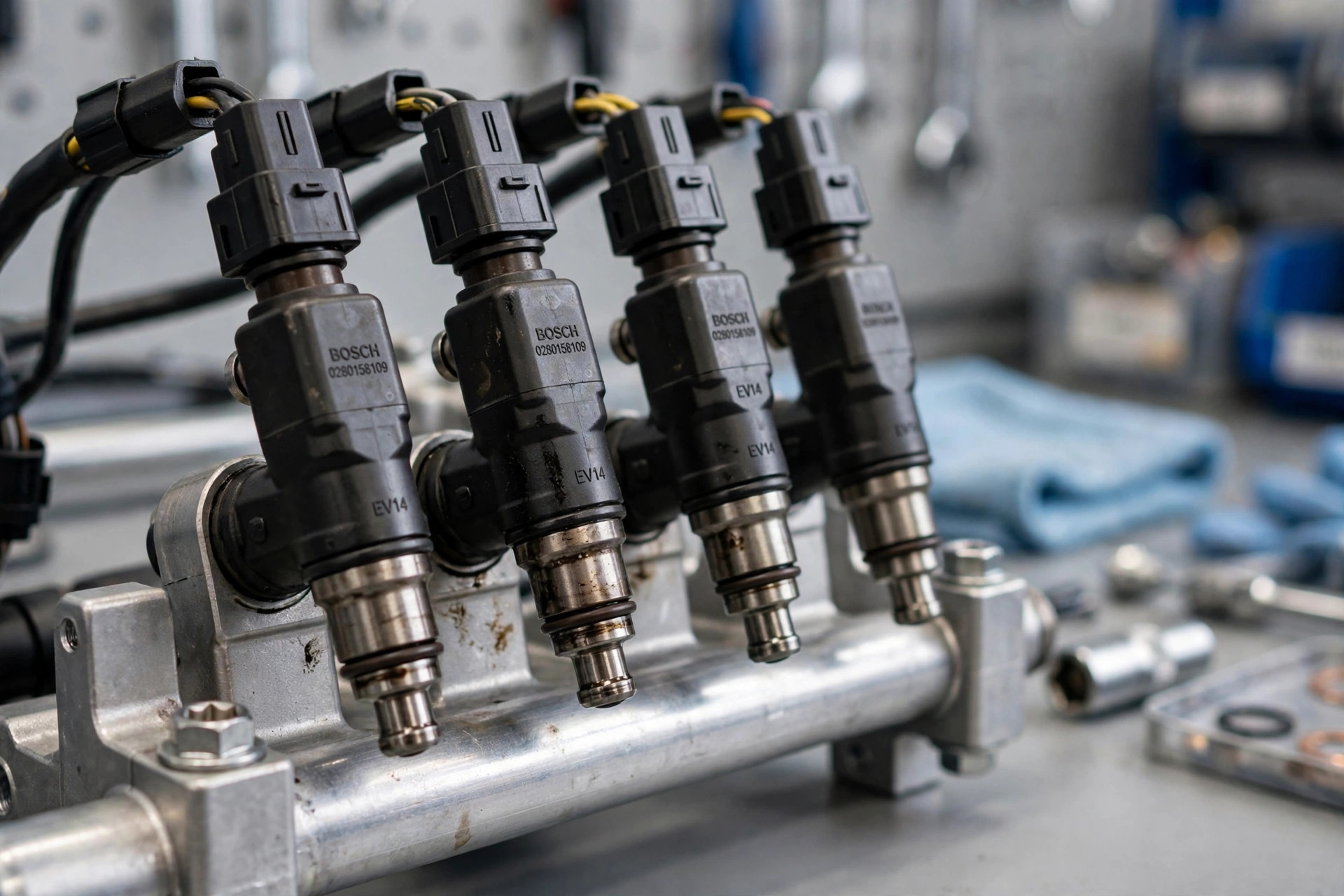
What are fuel and air trouble codes? Fuel system OBD2 codes are diagnostic trouble codes in the P0100–P0299 range that flag faults in how your engine measures incoming air, delivers fuel, and balances the two. The headliners are the lean codes P0171 and P0174, which mean the engine is running on too much air or too little fuel. Everything in this family revolves around a single number: the air-fuel ratio.
The 14.7:1 balancing act: how fuel and air management works
Think of your engine as an air pump that happens to burn gasoline. For every gram of fuel it injects, it needs about 14.7 grams of air — the stoichiometric ratio, the chemically perfect balance where all the fuel and all the oxygen are consumed together. The engine computer (ECM or PCM) chases this ratio hundreds of times per second, lengthening or shortening each fuel injector’s pulse to match the air it measures coming in.
Its report card is called fuel trim. Short-term fuel trim reacts instantly to what the oxygen sensors report; long-term fuel trim is the learned correction it carries from drive to drive. Trims hovering within ±10% are perfectly normal — the system breathing as designed. But when trims climb past about +25% (the computer adding fuel to cover a lean condition) or sink below −25%, the computer admits it can no longer compensate and stores a fuel system OBD2 code.
All of this happens in “closed loop,” the mode where the computer dithers the mixture slightly rich, then slightly lean, using the upstream oxygen sensor as its eyes. When any link in that feedback chain lies — a dirty mass airflow sensor underreporting the air, a vacuum leak sneaking in air the sensor never saw, a tired fuel pump starving the injectors — the ratio drifts, the trims max out, and your check engine light comes on.
What the P0100–P0299 code family covers
Fuel and air codes occupy the P0100–P0299 band of the powertrain family, and each sub-range watches one part of the mixture equation:
- P0100–P0104: mass airflow (MAF) sensor circuit faults
- P0105–P0109: manifold absolute pressure (MAP) and barometric pressure sensors
- P0110–P0114: intake air temperature sensor
- P0130–P0167: oxygen sensors and their heater circuits
- P0170–P0179: fuel trim and mixture faults — home of the famous lean and rich codes
- P0180–P0194: fuel temperature and fuel rail pressure sensors
- P0200–P0299: fuel injector circuits, one code per cylinder plus circuit-wide faults
Notice the oxygen sensors sitting in this family: they are the referees of the mixture, which is why fuel trim faults and emissions faults are close cousins. When a mixture problem starts killing the catalytic converter, it crosses into the territory of our emissions trouble codes guide — same root cause, different victim.
Common fuel system OBD2 codes
These are the fuel system OBD2 codes repair shops see week in and week out. Each is listed as plain text with a one-line meaning — search yours on the homepage for the full diagnosis.
- P0101 — Mass airflow sensor circuit range or performance problem.
- P0102 — Mass airflow sensor circuit low input.
- P0107 — Manifold absolute pressure sensor circuit low input.
- P0113 — Intake air temperature sensor circuit high input.
- P0131 — Oxygen sensor circuit low voltage, Bank 1 Sensor 1.
- P0171 — System too lean, Bank 1: too much air or too little fuel.
- P0172 — System too rich, Bank 1: too much fuel or too little air.
- P0174 — System too lean, Bank 2.
- P0175 — System too rich, Bank 2.
- P0191 — Fuel rail pressure sensor circuit range or performance.
P0171 and P0174: the lean codes every driver eventually meets
P0171 (Bank 1 too lean) and P0174 (Bank 2 too lean) are the celebrities of this family — the two most-searched fuel system OBD2 codes in existence. “Bank” simply means one side of the engine: on a V6 or V8, Bank 1 is the side holding cylinder 1 and Bank 2 is the other; a four-cylinder has only Bank 1, so it can only ever set P0171.
When both banks report lean at the same time, suspect a cause they share: a vacuum leak downstream of the MAF sensor, a dirty MAF underreporting the incoming air, or low fuel pressure from a weak pump or clogged filter. When only one bank is lean, the fault is bank-specific — a lazy oxygen sensor, a dribbling injector, or an exhaust leak ahead of that bank’s upstream sensor pulling outside air into the exhaust stream and fooling the sensor.
The rich codes P0172 and P0175 are the mirror image: leaking injectors, a faulty fuel pressure regulator, a saturated EVAP canister purging raw fuel vapor, or a MAF sensor overreporting airflow. Rich codes waste fuel and can wash oil off cylinder walls; lean codes run hot and can burn valves. Neither should be ignored.
The usual suspects: common causes
Across thousands of repair orders, the same handful of faults causes the vast majority of fuel and air codes:
- Vacuum leaks — cracked intake boots, split hoses, or leaking intake manifold gaskets letting in unmetered air.
- A dirty or failing mass airflow sensor — oil mist from an over-oiled aftermarket air filter is a classic culprit.
- A weak fuel pump or clogged fuel filter starving the rail, especially under load.
- Dirty or clogged fuel injectors dribbling instead of atomizing the fuel.
- Exhaust leaks ahead of the upstream oxygen sensor, pulling in outside air and faking a lean reading.
- Lazy or dead oxygen sensors reporting a mixture that isn’t there.
- An EVAP purge valve stuck open, feeding the engine unmetered fuel vapor.
- A restricted air filter — rarely the sole cause of a lean code, but it accelerates MAF contamination.
Symptoms that point to the fuel and air system
Fuel and air faults announce themselves through driveability long before most drivers read the code:
- Rough or hunting idle, especially when the engine is cold.
- Hesitation or stumbling when you tip into the throttle.
- Surging at steady cruise, as the computer chases the mixture.
- Long cranking or hard starting.
- Fuel economy 10–25% worse than usual.
- A sulfur or rotten-egg smell from the exhaust (rich running overwhelming the converter).
- Stalling when coming to a stop.
Diagnosing fuel system OBD2 codes step by step
The pros work in this order, and it avoids the classic mistake of replacing the oxygen sensor when the sensor was telling the truth:
- Read fuel trims at idle and at 2,500 RPM. High positive trims at idle that shrink as RPM rises point to a vacuum leak; high trims at all speeds point to the MAF or fuel delivery; trims that worsen under load point to the pump or a clogged filter.
- Smoke-test the intake tract. A modest diagnostic charge that finds leaks your eyes can’t.
- Check fuel pressure against the factory spec with a gauge on the rail — pressure first, parts second.
- Inspect and clean the MAF sensor with dedicated MAF cleaner. Never touch the sensing wires, and never use brake cleaner.
- Graph the oxygen sensors. A healthy upstream sensor switches rapidly; a lazy one drifts.
- Check for exhaust leaks ahead of the upstream sensor — even a pinhole matters.
What repairs cost
Costs vary by vehicle and region, but these ranges cover the repairs behind most fuel system OBD2 codes:
- $10–$15: MAF sensor cleaner spray and a new air filter — the DIY first steps.
- $50–$150: replacement intake boot or vacuum hoses.
- $100–$250: a new oxygen sensor.
- $150–$300: a new mass airflow sensor.
- $300–$800: fuel injector cleaning or replacement.
- $400–$800: fuel pump replacement on most vehicles.
- $3,500+: high-pressure fuel system work on direct-injection engines in the worst cases.
DIY or see a mechanic?
This family is friendly to driveway diagnosis. Reading fuel trims with a basic Bluetooth scanner, cleaning the MAF sensor, replacing the air filter and cracked intake boots, and visually checking every vacuum hose are all solid DIY jobs that fix a large share of lean codes.
Hand it to a professional for smoke testing, fuel pressure diagnosis, injector flow testing, and anything involving the high-pressure side of a gasoline direct-injection system, where rail pressures can exceed 2,000 psi and demand specialist tools and safety procedures.
Fuel and air faults rarely travel alone. A lean mixture is a classic cause of misfires — our misfire and ignition trouble codes guide picks up that thread — and unmetered air sneaking past the throttle body plays havoc with idle quality, covered in idle and speed trouble codes. For the full map of every system, browse the complete engine codes list.
Frequently asked questions
P0171 means the engine computer has detected a lean air-fuel mixture on Bank 1 — too much air or too little fuel. Common causes include vacuum leaks, a dirty mass airflow sensor, low fuel pressure, or an exhaust leak ahead of the oxygen sensor. It’s one of the most common fuel system OBD2 codes, and diagnosis usually starts with checking fuel trims and smoke-testing the intake.
Short trips are usually fine, but don’t ignore these codes. A lean mixture runs hotter than normal, wastes fuel, and can cause misfires — and persistent misfires can destroy the catalytic converter, turning a $150 vacuum-hose repair into a $1,500 exhaust repair. Get lean codes diagnosed within a week or two, sooner if the engine runs rough or the check engine light flashes.
On V6 and V8 engines, both banks reporting lean at the same time points to a cause they share: a vacuum leak downstream of the mass airflow sensor, a dirty MAF sensor, or low fuel pressure affecting the whole rail. When only one bank sets a lean code, the fault is usually bank-specific — a leaking injector seal or a lazy oxygen sensor on that side.
Rarely on its own — a clogged filter restricts airflow, which would richen the mixture, not lean it. But debris from a neglected filter contaminates the mass airflow sensor, and a dirty MAF underreports the incoming air, which does cause lean codes. Replace the filter and clean the MAF sensor together; it’s the cheapest first step in lean-code diagnosis.
Have a fuel or air code on your scanner? Search any trouble code on the homepage to get its exact meaning, the most common causes, and what to check next.