OBD2 CODE HUB · EMISSIONS GUIDE
Emissions Trouble Codes
Emissions OBD2 codes explained in plain English — catalytic converter faults, EVAP leaks, EGR problems, oxygen sensor codes, and how to pass your emissions test.
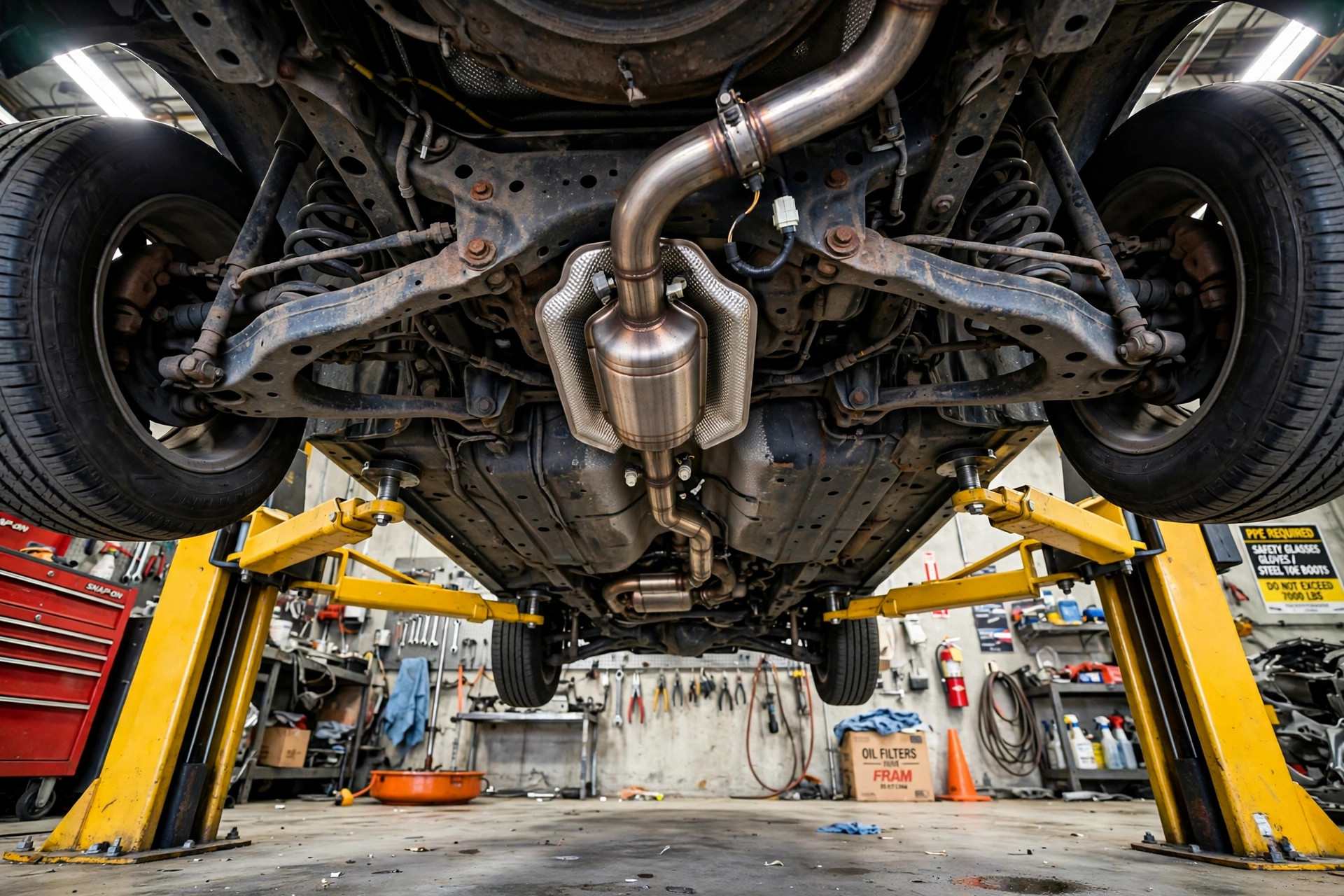
What are emissions trouble codes? Emissions OBD2 codes are diagnostic trouble codes in the P0400–P0499 range (plus related oxygen sensor and fuel-trim codes) that flag faults in the systems keeping your car’s exhaust clean. The catalytic converter, evaporative emissions (EVAP) system, exhaust gas recirculation (EGR) valve, and oxygen sensors all report here. These codes matter beyond the check engine light — in most states with inspection programs, an active emissions code is an automatic test failure.
Why your car has an emissions system (and why the computer watches it)
Burning gasoline is dirty chemistry. Even a healthy engine produces nitrogen oxides (NOx), carbon monoxide (CO), and unburned hydrocarbons (HC) — pollutants that smog up cities and harm lungs. Since 1996, every car’s OBD-II system has been legally required to watch the emissions hardware and flag any fault that could push tailpipe pollution past 1.5 times the federal limit. That’s the real job of emissions OBD2 codes: they’re the enforcement arm of clean-air law, built into your dashboard.
The system works through teamwork. The catalytic converter scrubs pollutants from the exhaust stream. The EVAP system traps fuel vapors so they can’t escape into the atmosphere. The EGR valve meters a little inert exhaust back into the intake to cool combustion and cut NOx. Oxygen sensors before and after the converter report whether the whole operation is actually working. When any link in that chain underperforms, the computer logs an emissions trouble code.
What the P0400–P0499 code family covers
Emissions codes occupy the P0400–P0499 band of the powertrain family under the SAE J2012 standard, with each sub-range watching one piece of the clean-air hardware:
- P0400–P0409: exhaust gas recirculation (EGR) system faults
- P0410–P0419: secondary air injection system faults
- P0420–P0439: catalytic converter efficiency faults — home of the famous P0420 and P0430
- P0440–P0449: evaporative emission (EVAP) control system faults
- P0450–P0459: EVAP pressure sensor and leak-detection faults
- P0460–P0499: auxiliary emissions controls, including the EVAP vent and purge valves
Oxygen sensor codes (P0130–P0167) technically live in the fuel-and-air family, but they do double duty here — the computer uses the downstream O2 sensors as its converter-efficiency referees, which is why O2 faults and catalyst codes so often appear together.
Common emissions OBD2 codes
These are the emissions OBD2 codes repair shops see week in and week out. Each is listed as plain text with its one-line meaning:
- P0401 — Exhaust gas recirculation flow insufficient detected.
- P0402 — Exhaust gas recirculation flow excessive detected.
- P0410 — Secondary air injection system malfunction.
- P0420 — Catalyst system efficiency below threshold, Bank 1.
- P0430 — Catalyst system efficiency below threshold, Bank 2.
- P0440 — Evaporative emission control system malfunction.
- P0441 — EVAP incorrect purge flow.
- P0442 — EVAP small leak detected.
- P0446 — EVAP vent control circuit malfunction.
- P0455 — EVAP gross leak detected (think gas cap).
P0420 and P0430: the catalytic converter codes every driver meets
P0420 is one of the most common trouble codes on the road — and one of the most misdiagnosed. It means the computer has decided the catalytic converter on Bank 1 isn’t scrubbing the exhaust efficiently enough. P0430 is the same verdict for Bank 2 on V6 and V8 engines. (Four-cylinder engines only ever set P0420, since they have just one bank.)
Here’s how the computer knows: it compares the upstream oxygen sensor (which sees raw exhaust) with the downstream sensor (which sees exhaust after the converter). A healthy converter smooths the downstream signal nearly flat. When the downstream waveform starts mirroring the upstream one, the converter isn’t converting — and P0420 sets.
The expensive mistake is replacing the converter first. Exhaust leaks ahead of the downstream O2 sensor pull in outside air and fake a failing-converter reading. A lazy or dead downstream oxygen sensor reports a converter problem that doesn’t exist. And an engine running rich — from misfires, leaking injectors, or a stuck thermostat — overwhelms the converter with fuel it can’t process. Diagnose before you replace: a $25 gasket or a $120 oxygen sensor beats a $1,000+ converter every time.
The EVAP system: chasing P0440, P0442, and the humble gas cap
The evaporative emissions system exists for a pollutant you’d never see: raw fuel vapor. It seals the fuel tank and charcoal canister, then periodically pressure-tests the whole network for leaks as small as 0.5 millimeters. When the test fails, you get an EVAP code.
Start with the embarrassingly simple: a loose, cracked, or missing gas cap is the single most common cause of P0440 and P0442. Tighten it until it clicks, drive a few cycles, and the code often clears itself. If it doesn’t, the usual suspects are the EVAP purge valve stuck open or closed, the vent valve (P0446/P0449), a cracked charcoal canister, or a rotted vapor hose. Smoke-testing the EVAP system — pumping harmless smoke through it and watching where it escapes — finds these leaks in minutes.
EGR, secondary air, and oxygen sensors
The EGR valve meters a small dose of inert exhaust gas back into the intake, cooling combustion just enough to slash nitrogen oxide output. Carbon buildup is its nemesis: a valve coked stuck open causes a rough idle and stalling, while one stuck shut triggers P0401 (insufficient flow) and raises NOx. On many engines, removing and cleaning the valve restores it.
Secondary air injection (P0410–P0419) pumps fresh air into the exhaust on cold starts, helping the converter light off faster. Failed air pumps and rotted check valves are the usual failures — mostly a cold-start emissions issue, rarely a driveability one. And remember the oxygen sensors: they’re the referees for this whole system, so a lazy upstream sensor can skew fuel trim rich enough to set catalyst codes downstream.
Symptoms of emissions system faults
Here’s the tricky part: emissions faults often cause no symptoms you can feel. The car drives perfectly while polluting more than the law allows — which is exactly why OBD-II was mandated. Watch for:
- A steady check engine light with no change in how the car drives — the classic emissions-code presentation.
- A failed state emissions or inspection test, sometimes the first sign anything is wrong.
- A sulfur or rotten-egg smell from the exhaust, suggesting the converter is overwhelmed.
- Rough idle or stalling (stuck-open EGR valve).
- Slightly worse fuel economy from a rich-running condition behind a catalyst code.
- A fuel smell near the car, pointing to an EVAP leak.
Diagnosing emissions OBD2 codes step by step
Emissions diagnosis rewards patience over parts-swapping:
- For P0420/P0430, graph the upstream and downstream oxygen sensors first. If the downstream mirrors the upstream, suspect the converter — but check for exhaust leaks ahead of the sensor and test the sensor itself before condemning the cat.
- Rule out engine-running faults behind catalyst codes: fix misfires, rich fuel trim, and coolant-temperature issues first, since they destroy converters from the inside.
- For EVAP codes, check the gas cap, then command the purge and vent valves with a scan tool while listening for their clicks.
- Smoke-test the EVAP system when the leak won’t reveal itself — the smoke shows exactly where vapor escapes.
- For EGR codes, remove and inspect the valve for carbon packing; check the passages in the intake manifold too.
- After repairs, complete a proper drive cycle before the inspection — monitors need specific driving conditions to run and pass.
What emissions repairs cost
Costs vary by vehicle and region, but these ranges cover the repairs behind most emissions OBD2 codes:
- $0–$25: a new gas cap — the cheapest fix in all of auto repair.
- $50–$150: EVAP purge or vent valve.
- $100–$250: a downstream oxygen sensor.
- $150–$400: EGR valve cleaning or replacement.
- $200–$600: charcoal canister or secondary air pump.
- $1,000–$2,500+: catalytic converter replacement, the repair everyone wants to avoid — which is why diagnosis comes first.
DIY or see a mechanic?
Gas caps, purge valves, and oxygen sensors are approachable driveway repairs on many vehicles. EGR cleaning is messy but doable. Smoke-testing EVAP leaks, welding exhaust leaks ahead of the converter, and replacing the catalytic converter itself are usually shop jobs — and converter replacement is worth a professional diagnosis first, given the cost.
One more caution: never clear an emissions code just to pass inspection. Monitors reset to “not ready,” inspectors check readiness, and you’ll fail anyway — after wasting the trip. Fix the fault, complete the drive cycle, then test.
Emissions faults often start elsewhere. Misfires dump raw fuel that melts converters from the inside — our misfire and ignition trouble codes guide covers that chain reaction — and diesel owners face a parallel emissions world of DPFs and SCR in the diesel and DPF trouble codes guide. For the full map of every system, browse the complete engine codes list.
Frequently asked questions
P0420 means “Catalyst System Efficiency Below Threshold (Bank 1).” The computer compares the upstream oxygen sensor (raw exhaust) with the downstream one (after the converter); when both read too similarly, the converter on bank 1 is no longer cleaning exhaust properly. Common causes include a worn catalytic converter, exhaust leaks ahead of the downstream sensor, a lazy O2 sensor, or engine-running faults like misfires. Diagnose sensors and leaks before condemning the converter.
Usually yes for short periods — P0420 rarely changes how the car drives, and it is not an emergency. But do not ignore it: whatever is hurting the converter (misfires, rich fuel trim, oil consumption) is still active and can turn a repairable situation into a destroyed converter. You will also fail a state emissions inspection with a stored catalyst code, so schedule diagnosis soon rather than later.
Yes — it is one of the most common causes of EVAP codes such as P0442 and P0455. The evaporative system seals the fuel tank; a loose, cracked, or missing cap lets fuel vapor escape, which the computer reads as a leak. Tighten the cap until it clicks and the code may clear itself after a few drive cycles. If the light stays on, inspect the cap’s seal and replace it before paying for deeper diagnosis.
This is the classic emissions-fault scenario — these codes rarely cause drivability symptoms. Scan for stored codes: P0420/P0430 point at the catalytic converter, P0440–P0455 at EVAP leaks, P0401 at EGR flow. Also check that all readiness monitors show “complete” — recently cleared codes reset monitors to “not ready,” which fails the test on its own. Fix the fault, complete a proper drive cycle so the monitors run, then retest.
Have an emissions code on your scanner? Search any trouble code on the homepage to get its exact meaning, the most common causes, and what to check next.