OBD2 CODE HUB · MISFIRE & IGNITION GUIDE
Misfire & Ignition Trouble Codes
Engine misfire codes explained in plain English — P0300 random misfires, cylinder-specific faults, ignition coil and spark plug failures, and exactly what to check first.
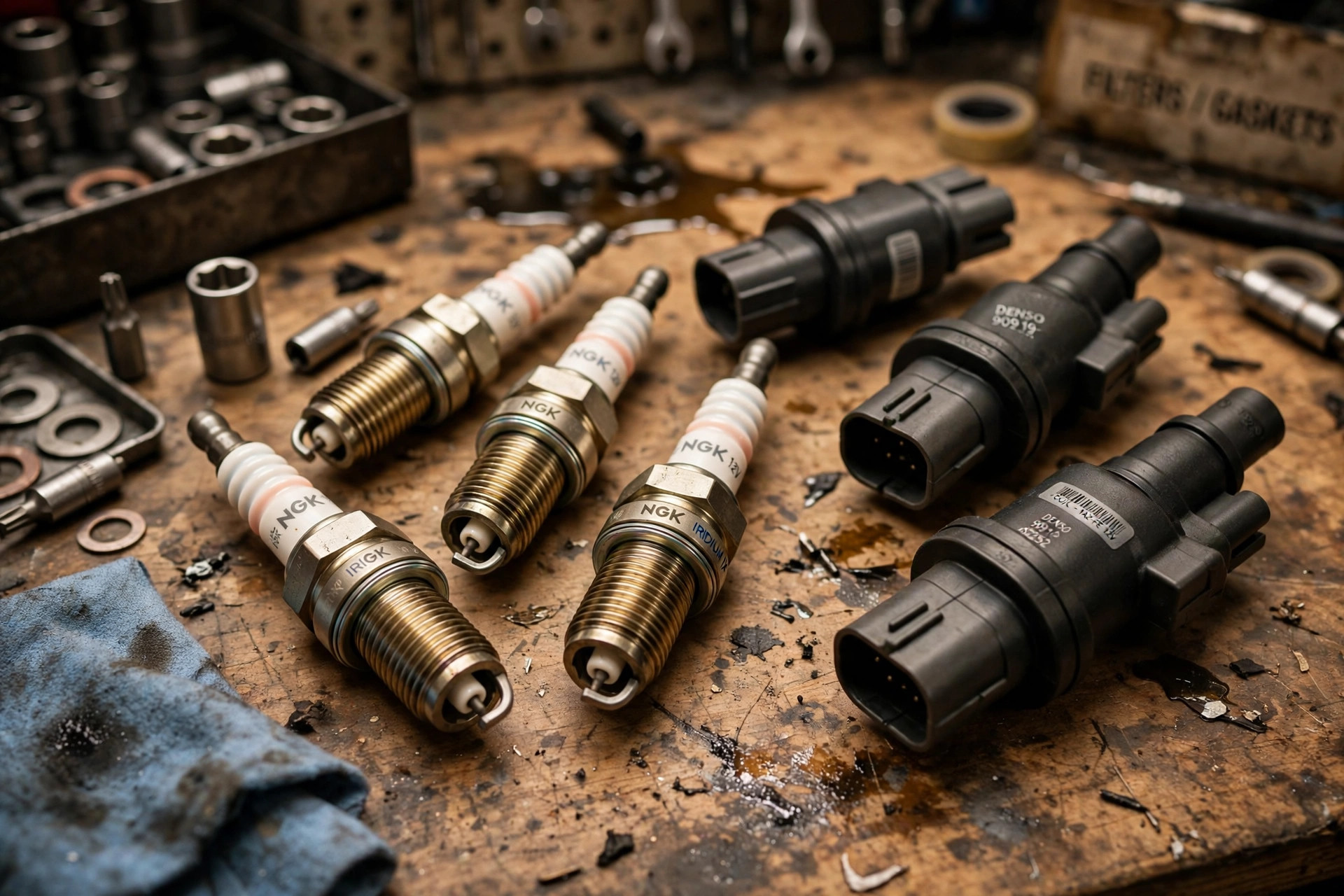
What are misfire and ignition trouble codes? Engine misfire codes are diagnostic trouble codes in the P0300–P0312 range that flag incomplete or absent combustion in one or more cylinders. A misfire means the air-fuel mixture in a cylinder failed to ignite properly — or didn’t ignite at all — so that cylinder contributes no power for that cycle. The result is the shaking, stumbling idle every driver recognizes, plus wasted fuel and raw hydrocarbons pouring into the exhaust. Because unburned fuel can overheat and destroy the catalytic converter within minutes, engine misfire codes deserve faster action than almost any other engine fault.
What a misfire actually is (and why your engine shakes)
Your engine is a team of cylinders taking turns pushing the crankshaft. In a four-cylinder at idle, each cylinder fires roughly 15 times per second; in a V8, about 30. When every cylinder pulls its weight, the power pulses blend into smooth rotation. When one cylinder misfires, its push goes missing — the crankshaft stumbles for a fraction of a revolution, and you feel it as a shake, a shudder, or a rhythmic stumble through the steering wheel and seat.
The engine computer watches for this constantly. It monitors the crankshaft position sensor, measuring tiny speed variations between each cylinder’s power stroke. When one cylinder’s contribution falls short often enough, the computer logs an engine misfire code and lights the check engine light. A few stray misfires per thousand cycles are normal on every engine; the code sets when the rate crosses the threshold that threatens emissions or driveability.
There are two flavors. A steady misfire on one cylinder — a constant shake at idle that smooths out slightly as RPM rises — usually points to that cylinder’s spark plug, coil, or injector. A random misfire that jumps around, felt as an intermittent stumble with no clear rhythm, usually points to something all cylinders share: fuel pressure, a vacuum leak, or a contaminated mass airflow sensor.
What the P0300–P0312 code family covers
Misfire and ignition codes live in the P0300–P0312 band of the powertrain family, defined by the SAE J2012 standard that keeps diagnostic trouble codes consistent across every carmaker. The structure is beautifully logical:
- P0300: random or multiple cylinder misfire — the computer sees misfires but can’t pin them on one cylinder
- P0301–P0308: cylinder-specific misfires, where the last digit names the cylinder (P0301 is cylinder 1, P0304 is cylinder 4, and so on)
- P0309–P0312: higher cylinder counts for V10 and V12 engines
- P0313–P0316: special cases — misfire with low fuel level, or misfire detected in the first 1,000 revolutions after startup
Dedicated ignition-coil circuit faults sometimes land in the P0350–P0362 range, but in practice, when drivers say “misfire codes,” they mean the P0300 series — and that’s what this guide covers.
Common engine misfire codes
These are the engine misfire codes repair shops see week in and week out. Each is listed as plain text with its one-line meaning:
- P0300 — Random or multiple cylinder misfire detected.
- P0301 — Cylinder 1 misfire detected.
- P0302 — Cylinder 2 misfire detected.
- P0303 — Cylinder 3 misfire detected.
- P0304 — Cylinder 4 misfire detected.
- P0305 — Cylinder 5 misfire detected.
- P0306 — Cylinder 6 misfire detected.
- P0307 — Cylinder 7 misfire detected.
- P0308 — Cylinder 8 misfire detected.
- P0316 — Misfire detected during the first 1,000 revolutions after startup, often a cold-start fuel issue.
P0300: the random misfire code every driver eventually meets
P0300 is the most common engine misfire code — and the most frustrating. It means the computer detected enough misfires to matter, but they weren’t concentrated on a single cylinder. There’s no one spark plug to replace, no one coil to swap. The fault is something the cylinders share.
The usual suspects for a P0300 random misfire, in rough order of likelihood: a vacuum leak leaning out the whole engine, a dirty mass airflow sensor under-reporting incoming air, low fuel pressure starving every injector equally, a clogged fuel filter, worn spark plugs across all cylinders on a high-mileage engine that’s never had a tune-up, or a stuck-open EGR valve diluting the mixture with exhaust at the wrong time.
The diagnostic trick is fuel trim. If trims read high positive (lean) on both banks, the engine is compensating for unmetered air or low fuel — chase the vacuum leak or check fuel pressure first. If trims look normal, the misfire is more likely ignition-related, and it’s time to evaluate plugs and coils as a set. Our fuel and air trouble codes guide walks through fuel trim reading in detail.
The usual suspects: common causes
Across thousands of repair orders, the same handful of faults causes the vast majority of misfires:
- Worn spark plugs — the single most common cause. Eroded electrodes demand more voltage than the coil can deliver, especially under load.
- Failed ignition coils or coil packs — a cracked coil leaks voltage to ground instead of firing the plug.
- Bad spark plug wires, on engines that still use them — resistance climbs with age until the spark can’t get through.
- Clogged or leaking fuel injectors — a dribbling injector wets the plug instead of atomizing the fuel.
- Low fuel pressure — a weak pump or clogged filter starves every cylinder, the classic P0300 random misfire setup.
- Vacuum leaks — unmetered air leans the mixture past what the computer can correct.
- A dirty mass airflow sensor — under-reports airflow, so the computer injects too little fuel for the air actually entering.
- A stuck-open EGR valve — floods the intake with inert exhaust gas at the wrong moment.
- Low compression — worn piston rings, leaking valves, or a blown head gasket. The mechanical causes, and the expensive ones.
Symptoms that point to misfires and ignition faults
Misfires announce themselves clearly — this is one code family you usually feel before you read:
- Rough, shaking idle — the classic sign, felt through the steering wheel and seat.
- A flashing check engine light — the urgent one. A flashing CEL means a severe misfire is dumping raw fuel into the exhaust right now and the catalytic converter is overheating. Slow down, reduce load, and get it checked immediately.
- Hesitation or bucking under acceleration, especially uphill or when passing.
- Hard starting or long cranking.
- Fuel economy noticeably worse than usual — unburned fuel is going straight out the tailpipe.
- A raw fuel smell from the exhaust.
- A failed emissions test, from excess hydrocarbon output.
Diagnosing engine misfire codes step by step
Work in this order and you’ll find the fault faster than throwing parts at it:
- Read the exact code. P0301–P0308 names the guilty cylinder — start there. P0300 means look at what the cylinders share.
- Inspect the spark plug from the misfiring cylinder. Its condition is a forensic report: oil-fouled, fuel-soaked, blistered white from heat, or physically damaged each tells a different story.
- Swap the coil to another cylinder, clear the code, and drive. If the misfire follows the coil, you’ve found it — a free test that beats guessing.
- Check fuel trims and hunt for vacuum leaks if the misfire is random or moves between cylinders.
- Test fuel pressure against the factory specification when a P0300 random misfire won’t resolve.
- Run a compression test if ignition and fuel both check out — this rules the mechanical causes in or out definitively.
- Scope the ignition pattern if you have access to a lab scope — it reveals a weakening coil before it fails outright.
What misfire repairs cost
Costs vary by vehicle and region, but these ranges cover the repairs behind most engine misfire codes:
- $10–$30 per spark plug; a full set on a four-cylinder typically runs $100–$300 installed.
- $50–$150 per ignition coil — and coil-on-plug designs make this a 15-minute DIY job on many engines.
- $100–$250 for a set of spark plug wires, where the engine still uses them.
- $150–$400 for fuel injector cleaning or a single injector replacement.
- $400–$800 for fuel pump replacement on most vehicles.
- $1,500–$3,000+ for mechanical causes such as valve work or a head gasket.
One expensive caution: a flashing check engine light ignored for even a few hundred miles can melt the catalytic converter’s internal substrate, turning a $30 spark plug into a $1,500 exhaust repair.
DIY or see a mechanic?
Spark plugs and coil packs are among the friendliest DIY repairs on any car: basic hand tools, no computer required, and the coil-swap test costs nothing. Cleaning the mass airflow sensor and hunting vacuum leaks are driveway-friendly too.
Hand it to a professional for compression testing, injector flow testing, oscilloscope diagnostics, and anything involving timing components. And if the check engine light is flashing, treat it as urgent either way — catalytic converter damage starts fast and doesn’t reverse.
Misfires rarely travel alone. A lean mixture is one of the most common misfire triggers — our fuel and air trouble codes guide covers the P0171/P0174 side of that story — and a shaking, stumbling idle overlaps with the idle and speed trouble codes guide. For the full map of every system, browse the complete engine codes list.
Frequently asked questions
P0300 means the engine computer detected misfires on multiple cylinders — or misfires jumping between cylinders — without one clear culprit. It’s called a “random misfire.” Common causes include vacuum leaks, low fuel pressure, a dirty mass airflow sensor, or worn spark plugs across all cylinders. Because no single cylinder is identified, diagnosis starts with what the cylinders share: air, fuel, and spark as systems.
A steady check engine light with a mild misfire can usually survive a careful drive to a shop. A flashing check engine light is different — it signals a severe misfire dumping raw fuel into the exhaust, which can overheat and destroy the catalytic converter within minutes. If the light flashes, slow down, avoid hard acceleration, and get it diagnosed promptly.
Often — worn spark plugs are the single most common misfire cause, and a fresh set cures a huge share of P0301–P0308 codes. But if the misfire persists after new plugs, the coil, injector, or a vacuum leak is the next suspect. The coil-swap test (moving the suspect coil to another cylinder to see if the misfire follows) tells you for free whether the coil is guilty.
A single-cylinder misfire is most obvious at idle, where each power stroke matters most and the engine has no momentum to mask the missing push. At higher RPM the firing events blur together and the shake fades — but the misfire is still there, still wasting fuel and still threatening the converter. Cylinder-specific codes (P0301–P0308) are the usual result.
Have a misfire code on your scanner? Search any trouble code on the homepage to get its exact meaning, the most common causes, and what to check next.