OBD2 CODE HUB · IDLE & SPEED GUIDE
Idle & Speed Trouble Codes
Idle air control codes explained in plain English — IAC valve faults, throttle position sensor errors, rough idle, surging, and stalling.
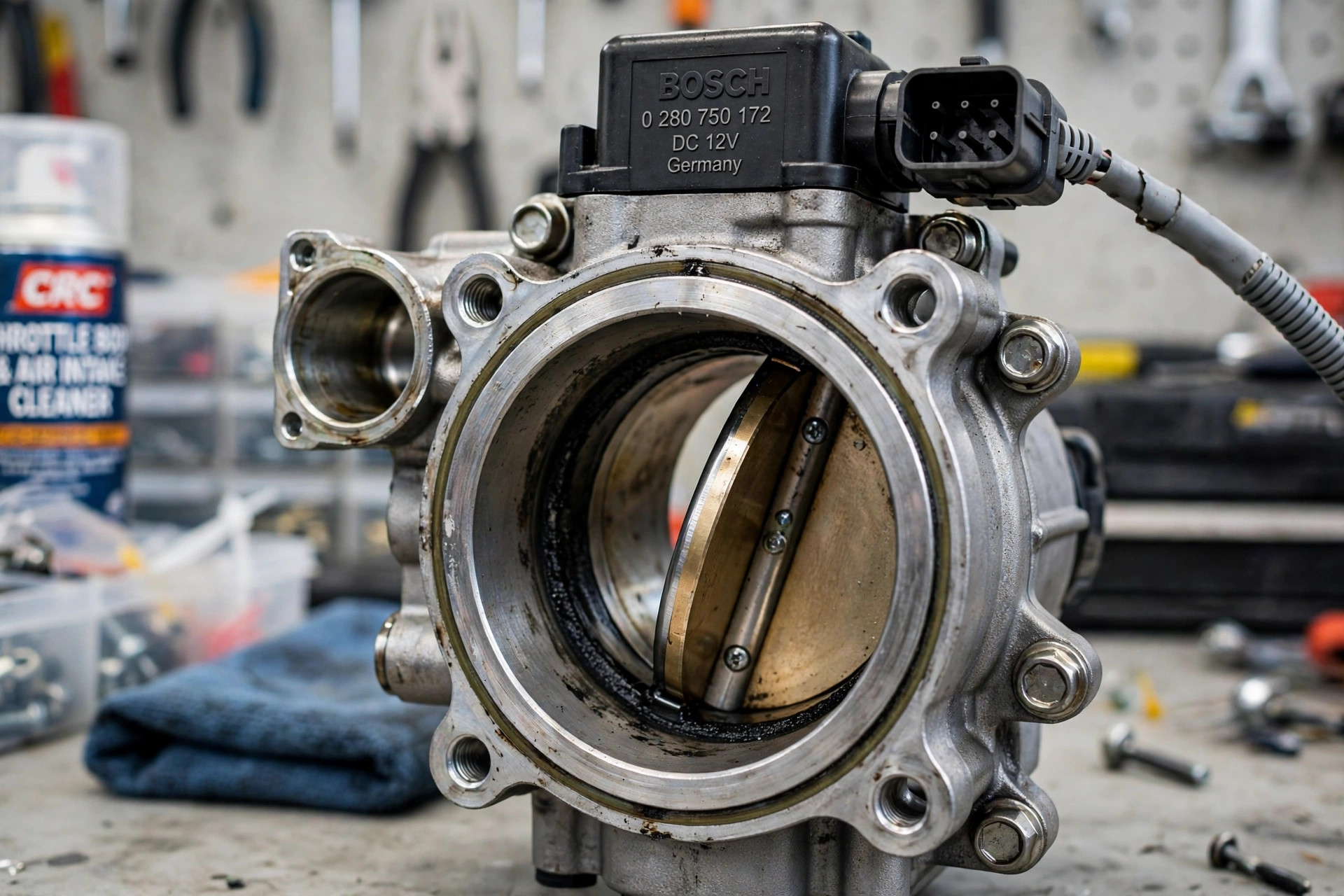
What are idle and speed trouble codes? Idle air control codes are diagnostic trouble codes covering the components that manage your engine’s idle and throttle response — the idle air control (IAC) valve, the throttle position sensor (TPS), and the electronic throttle body. When one of these parts misbehaves, you feel it instantly: the engine idles rough, surges up and down, stalls at stoplights, or drops into limp mode with reduced power.
Why your car needs computer-controlled idle
Left to itself, an engine would stall the moment you lift off the gas. At idle — foot off the pedal, car in gear or in park — the engine still needs a precise trickle of air to keep turning at roughly 600–900 RPM, varying with engine temperature, electrical load, and whether the air conditioning is running. On older cars a mechanical screw set the idle; on everything built since the mid-1990s, the engine computer manages it continuously.
It does this with two key players. The idle air control valve — a small stepper motor mounted on or near the throttle body — meters a bypass stream of air around the nearly closed throttle plate, opening and closing in tiny increments to hold the target idle speed. The throttle position sensor, a potentiometer on the throttle shaft, reports the exact throttle angle back to the computer dozens of times per second. Together with the mass airflow and crankshaft position sensors, they give the engine computer everything it needs to meter fuel and spark for a smooth, stable idle.
Modern drive-by-wire cars take it further: there is no cable between your foot and the throttle at all. An electronic throttle body with its own motor opens the plate on the computer’s command, blending your pedal input with idle strategy, traction control, and cruise control. More precision — but also more ways for idle and throttle codes to appear.
What the idle and throttle code families cover
Idle and speed codes live in two neighborhoods of the powertrain family under the SAE J2012 standard:
- P0120–P0129 and P0220–P0229: throttle position and accelerator pedal position sensor circuits
- P0500–P0504: vehicle speed sensor faults — your speedometer and cruise control depend on these
- P0505–P0509: idle air control system faults — the heart of this guide
- P0510: closed-throttle position switch
- P2100–P2138: electronic throttle actuator and throttle/pedal correlation faults
Common idle air control codes
Most of the codes drivers actually encounter sit in the P0120–P0123, P0222/P0223, and P0505–P0508 clusters — the throttle position sensor and the idle air control valve. These are the idle and throttle codes repair shops see most often, each listed as plain text:
- P0120 — Throttle/pedal position sensor “A” circuit malfunction.
- P0121 — Throttle/pedal position sensor “A” range/performance problem.
- P0122 — Throttle/pedal position sensor “A” circuit low input.
- P0123 — Throttle/pedal position sensor “A” circuit high input.
- P0222 — Throttle/pedal position sensor “B” circuit low input.
- P0505 — Idle air control system malfunction.
- P0506 — Idle air control system RPM lower than expected.
- P0507 — Idle air control system RPM higher than expected.
- P0508 — Idle air control system circuit low.
- P2138 — Throttle/pedal position sensor voltage correlation fault.
P0505–P0508: the idle air control codes
P0505 is the general “something is wrong with idle control” code; P0506, P0507, and P0508 narrow it down. P0506 means the engine idles lower than the computer commanded — often a nearly stalled, shuddering idle. P0507 means idle runs higher than commanded, typically 200 RPM or more over target, and the classic symptom is a surging idle that rises and falls on its own. P0508 points at the IAC circuit itself — low voltage suggesting a wiring or connector problem.
The number-one cause is carbon. The IAC valve lives in the airstream right at the throttle body, and over tens of thousands of miles, oily vapor and combustion deposits pack its passages and gum up the valve pintle. A valve that cannot move freely cannot meter air precisely, and idle quality falls apart. Vacuum leaks are the great impostor here: unmetered air sneaking past cracked hoses, a leaking intake gasket, or a stuck-open PCV valve raises idle speed just like a faulty IAC — and the computer may set P0507 for a leak that has nothing to do with the valve.
P0120–P0123 and P0222: throttle position sensor codes
The throttle position sensor is a simple potentiometer that converts throttle angle into a voltage, typically sweeping from about 0.5 volts closed to 4.5 volts wide open. The computer watches that sweep constantly. P0122 (low input) and P0123 (high input) mean the signal has dropped out of its plausible range — a dead spot in the sensor, a frayed wire, or a corroded connector. P0120 and P0121 are the vaguer “circuit malfunction” and “range/performance” versions, and P0222/P0223 are their counterparts on the redundant “B” sensor.
For safety, modern throttles carry two sensors — A and B — that must agree with each other. When they do not, the computer sets correlation codes like P2138 and, not knowing which sensor to believe, may cut engine power to a limp-home crawl. That is by design: an engine that cannot trust its throttle reading is safer at 30 mph than at 70. After any throttle body or TPS service, most vehicles need an idle and throttle relearn procedure — a specific key-on sequence or scan-tool command — or the new parts will never calibrate.
Symptoms of idle and speed faults
Idle and throttle problems announce themselves clearly:
- Rough or hunting idle — RPM wavers or the engine shakes at stoplights.
- Surging — the idle climbs and falls rhythmically on its own (classic P0507).
- Stalling when you stop or dip the clutch (classic P0506).
- An abnormally high idle that will not come down.
- Hesitation or stumbling when you first press the gas.
- Reduced-power or limp mode with a warning on the dash (throttle correlation faults).
- Cruise control that will not engage (vehicle speed sensor faults).
Diagnosing idle air control codes step by step
Idle diagnosis is methodical, and the fix is often cheap:
- Scan the codes and check freeze-frame data — note coolant temperature and RPM when the code set. A P0507 that sets only when cold points somewhere different than one that sets hot.
- Inspect the throttle body: remove the intake hose and look for black carbon ringing the throttle plate and bore. Heavy buildup alone can cause every symptom on this page.
- Hunt for vacuum leaks before condemning parts — spray carb cleaner around hoses and gaskets (an RPM change reveals a leak), or have a shop smoke-test the intake.
- Test the TPS with a multimeter or scan tool: slowly open the throttle and watch for a smooth voltage sweep with no dropouts or dead spots.
- Clean the throttle body and IAC passages with throttle body cleaner and a soft brush — never carb cleaner on coated throttle bodies, and never force a drive-by-wire plate open by hand.
- Perform the idle relearn procedure for your vehicle after any cleaning or part replacement, then road-test through a full warm-up cycle.
What idle and throttle repairs cost
Costs vary by vehicle and region, but these ranges cover most idle air control code repairs:
- $10–$20: throttle body cleaner and basic hand tools — the cheapest fix on this page.
- $100–$200: professional diagnostic time if you want a confirmed answer first.
- $100–$250: throttle position sensor (many are serviced with the throttle body).
- $150–$400: idle air control valve.
- $200–$600: electronic throttle body assembly.
- $100–$300: tracking down and repairing vacuum leaks (mostly labor).
DIY or see a mechanic?
Cleaning a throttle body is one of the most satisfying driveway jobs: basic tools, an hour of time, and the idle improvement is often immediate. IAC valves and TPS sensors are usually bolt-on parts too — just remember the idle relearn afterward, or the new part may idle worse than the old one until the computer recalibrates.
See a mechanic for drive-by-wire throttle bodies (the electronics and calibration are unforgiving), for vacuum leaks you cannot locate, and for any correlation code that puts the car in limp mode. And never force an electronic throttle plate open with your fingers — you can damage the internal gears and turn a cleaning into a $400 replacement.
Rough idle does not always start in the idle system. Lean fuel mixtures make engines hunt and surge too — the fuel and air trouble codes guide covers that side — and because the engine computer orchestrates the whole idle strategy, module and communication faults can masquerade as IAC problems; the computer trouble codes guide explains those. For the full map of every system, browse the complete engine codes list.
Frequently asked questions
P0505 means “Idle Air Control System Malfunction.” The engine computer tried to hold its target idle speed and could not — either the IAC valve is not responding, the idle is out of range, or the control circuit has a fault. The most common causes are a carbon-fouled IAC valve, vacuum leaks adding unmetered air, or wiring problems at the valve connector. Inspect and clean before replacing parts.
A high or surging idle usually means the engine is getting air the computer did not command — the textbook P0507 scenario, where idle runs roughly 200 RPM or more above target. Suspects include vacuum leaks (cracked hoses, intake gasket, PCV valve), a carbon-stuck IAC valve, or a faulty coolant temperature sensor keeping the cold-start fast idle engaged. Smoke-testing the intake is the fastest way to find a hidden leak.
Often, yes — carbon buildup is the number-one killer of IAC valves, and a thorough cleaning of the valve pintle and its passages with throttle body cleaner restores many of them. Replace the valve if the pintle is worn, the motor windings test bad, or cleaning does not change the idle. Either way, perform your vehicle’s idle relearn procedure afterward so the computer recalibrates to the clean or new hardware.
Have an idle code on your scanner? Search any trouble code on the homepage to get its exact meaning, the most common causes, and what to check next.