OBD2 CODE HUB · TRANSMISSION GUIDE
Transmission Trouble Codes
Transmission OBD2 codes explained in plain English — P0700 alerts, solenoid faults, and what slipping or limp mode really means.
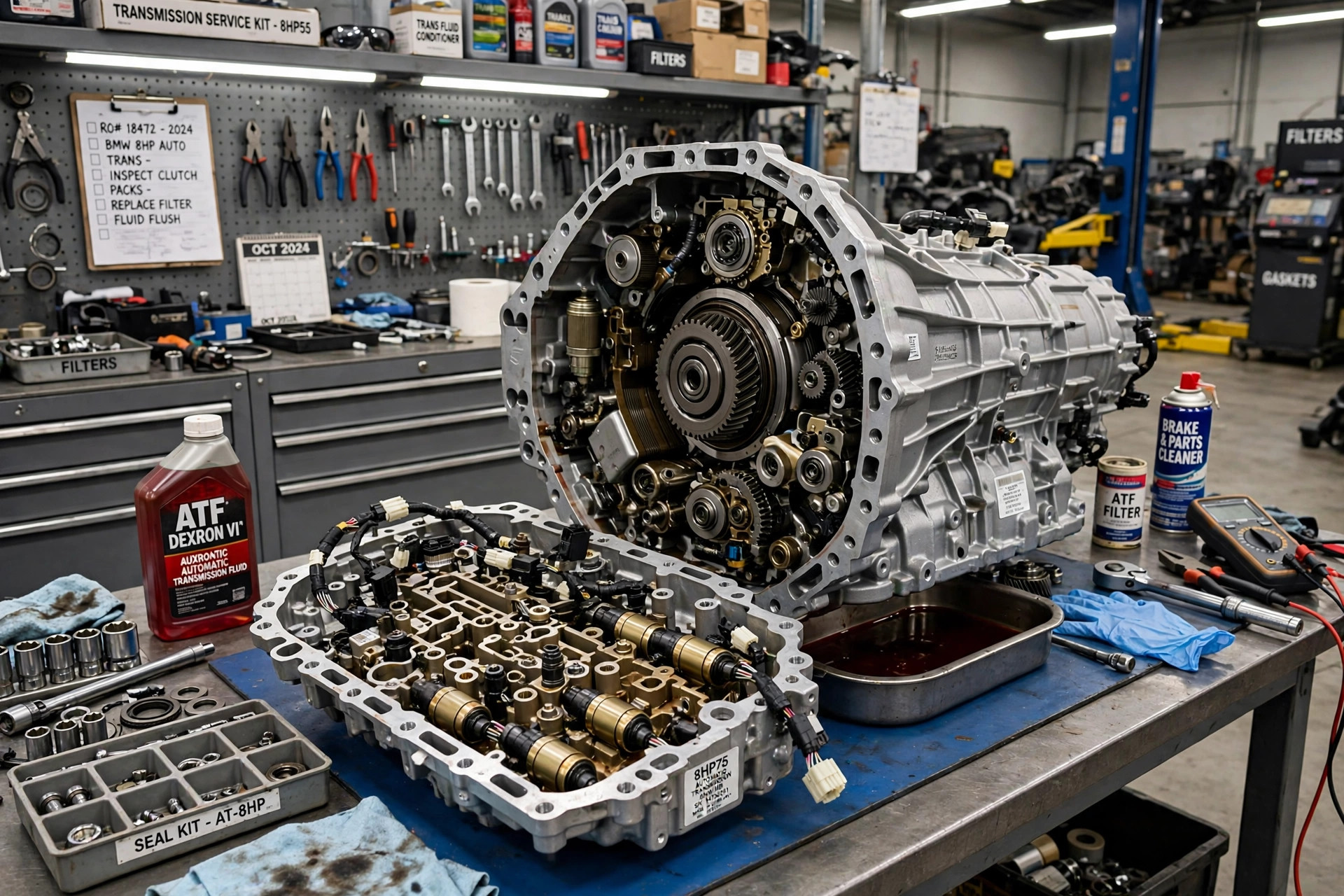
What are transmission trouble codes? Transmission OBD2 codes are diagnostic trouble codes covering your gearbox and everything that controls it — the transmission control module (TCM), shift solenoids, speed and temperature sensors, and the torque converter clutch. They occupy the P0700–P0899 range of the SAE J2012 standard. One quirk defines them: a basic engine code reader usually can’t see them, because they live in the transmission computer, not the engine computer.
Why transmission codes need a better scanner
Plug a basic code reader into a car with a transmission fault and you’ll often get P0700 and nothing else — or sometimes nothing at all. That’s because basic scanners only converse with the engine control module. Transmission faults are stored in the transmission control module, a separate computer that basic tools can’t reach. To read transmission OBD2 codes properly you need a multi-system or full-system scanner that lets you select the TCM (sometimes labeled “Automatic Transmission”) as its own module.
This matters because P0700 is an umbrella code. It means the TCM found a problem and asked the engine computer to light the check engine light — it doesn’t say what the problem is. The real diagnosis lives in TCM-specific sub-codes like P0715 (speed sensor) or P0750 (shift solenoid), which only a capable scanner can retrieve. A better scanner — or one paid scan at a shop — is often the difference between a precise fix and expensive guessing.
What the transmission code families cover
Transmission OBD2 codes live in the P0700–P0899 neighborhood of the SAE J2012 standard, with each sub-range covering a different part of the gearbox:
- P0700–P0709: transmission control system and range sensor — the TCM itself plus the PRNDL switch that tells the computer which gear you selected.
- P0710–P0729: fluid temperature and speed sensors — the inputs the TCM uses to decide when and how to shift.
- P0730–P0799: gear ratios, shifting performance, and shift solenoids — the hydraulic heart of the automatic transmission.
- P0800–P0899: clutch, pressure control, and TCM internals — including the torque converter clutch and module faults.
Common transmission OBD2 codes
These are the transmission OBD2 codes drivers actually encounter:
- P0700 — Transmission control system malfunction (the master alert; always has sub-codes behind it).
- P0705 — Transmission range sensor circuit malfunction (the PRNDL switch).
- P0715 — Input/turbine speed sensor circuit malfunction.
- P0720 — Output speed sensor circuit malfunction.
- P0730 — Incorrect gear ratio (the TCM commanded a gear the transmission couldn’t deliver).
- P0740 — Torque converter clutch circuit malfunction.
- P0750 — Shift solenoid A malfunction.
- P0760 — Shift solenoid C malfunction.
- P0780 — Shift malfunction (a general shifting-performance fault).
- P0842 — Transmission fluid pressure sensor/switch A circuit low.
P0700: the master alert, decoded
P0700 deserves its own section because it confuses more drivers than any other transmission code. Its formal definition is “Transmission Control System Malfunction,” but technicians call it a MIL request — the transmission computer asking for the malfunction indicator lamp. Think of it as a receptionist telling you “someone in the back office needs you” without saying who or why.
The causes behind a P0700 span the whole gearbox: low or burnt transmission fluid that drops hydraulic pressure, a failed shift solenoid that can’t route fluid to change gears, bad input or output speed sensors, a slipping torque converter clutch, damaged wiring or a corroded connector at the TCM, and internal wear like tired clutch packs or a failing valve body. More often than people expect, the cause is low system voltage from a weak battery, which can throw false control-module errors.
Because it’s an umbrella, the only wrong move with P0700 is treating it as the diagnosis. The right move is reading the TCM’s sub-codes, checking the fluid, and working from the specific fault — never from the alert alone.
Symptoms of transmission faults
Transmission OBD2 code symptoms are hard to ignore:
- Check engine light — sometimes flashing, sometimes joined by a dedicated transmission or gear warning.
- Limp mode — the transmission locks itself in a single gear (often 2nd or 3rd) to prevent further damage.
- Hard, delayed, or erratic shifting; shifts that slam or flare between gears.
- Slipping — engine RPM climbs without matching acceleration, or the transmission drops out of gear.
- Shuddering around the torque converter lockup point, stalling, or noticeably worse fuel economy.
Diagnosing transmission OBD2 codes step by step
Work this order before authorizing any repair:
- Read the TCM, not just the engine: use a multi-system scanner, select the transmission module, and record every sub-code plus whether each is active or historic.
- Check the fluid: with the engine warm and running on most automatics, verify the level and look at the color and smell — bright red is healthy; dark, burnt-smelling fluid is evidence, not just maintenance.
- Check the battery: load-test it and confirm charging voltage. Low voltage causes phantom transmission codes more often than most drivers believe.
- Inspect wiring and connectors: look for frayed wires, corrosion, or transmission fluid wicking up through the harness into the TCM connector.
- Watch live data: transmission fluid temperature, input vs. output speed sensor readings, and commanded vs. actual gear will usually point straight at the failing part.
- Test before replacing: solenoids can be resistance-tested and are sometimes accessible via the pan. Don’t authorize a rebuild until the simple causes are ruled out.
What transmission repairs cost
Costs vary by vehicle and region, but these ranges cover most transmission OBD2 code repairs:
- $150–$300: transmission fluid and filter service — the first step for many codes.
- $100–$250: a speed or temperature sensor, usually accessible from outside the case.
- $150–$400: a shift solenoid, plus labor if the valve body has to come out.
- $400–$1,000+: a replacement TCM, sometimes needing programming to the vehicle.
- $2,500–$4,500: a full transmission rebuild — the reason accurate sub-code diagnosis matters so much.
DIY or see a mechanic?
The driveway-friendly side: checking fluid level and condition, load-testing the battery, visual inspection of wiring and connectors, and scanning for codes with a decent multi-system tool. A fluid and filter service is DIY-able on many vehicles if you follow the fill procedure exactly.
See a mechanic for anything inside the transmission — solenoids buried in the valve body, clutch packs, torque converter work, TCM replacement and programming, and any rebuild decision. Transmission OBD2 codes reward precise diagnosis and punish parts-guessing more than almost any other system.
Transmission faults don’t always start in the gearbox. For the full map of every system, see the complete engine codes list. Lost-communication faults like U0101 point at the transmission control module itself — the computer trouble codes guide covers that side. And because harsh shifting can feel like an engine problem, the idle and speed trouble codes guide helps sort idle-side symptoms from gearbox ones.
Frequently asked questions
P0700 means “Transmission Control System Malfunction,” also called a MIL request. It’s a general alert from the transmission control module asking the engine computer to turn on the check engine light because the TCM recorded a specific fault. P0700 alone never names the real problem — a TCM-capable scanner is needed to read the sub-codes (like P0715 or P0750) that say what’s actually wrong.
Short, gentle trips are usually possible, but it’s risky. P0700 often comes with limp mode, harsh shifting, or slipping, and driving hard on a slipping transmission can turn a solenoid or sensor fix into a full rebuild. Get the sub-codes read promptly, and avoid towing or highway speeds until you know the cause.
Usually not. Basic code readers only talk to the engine computer, so they can show P0700 but can’t reach the transmission control module where the detailed sub-codes live. You need a multi-system or full-system scanner that lists transmission or TCM as a selectable module.
It depends on the sub-code: a fluid and filter service runs roughly $150–$300, a speed sensor $100–$250, and a shift solenoid $150–$400 plus labor. A replacement TCM can cost $400–$1,000+, and a full rebuild $2,500–$4,500. That’s why reading the exact sub-code first matters — P0700 alone can’t tell a $20 fix from a $4,000 one.
Have a transmission code on your scanner? Search any trouble code on the homepage to get its exact meaning, the most common causes, and what to check next.