OBD2 CODE HUB · DIESEL & DPF GUIDE
Diesel & DPF Trouble Codes
Your plain-English guide to diesel OBD2 codes — DPF soot and ash codes, failed regenerations, and what your diesel is telling you.
Diesel particulate filter codes are diagnostic trouble codes covering the systems only a diesel has — the diesel particulate filter (DPF), the regeneration cycle that cleans it, and the sensors that monitor the whole process. When the filter can’t trap or burn off soot properly, the engine computer logs codes like P2002 or P2463 and lights the check engine light, sometimes joined by a dedicated DPF warning lamp on the dash.
How the DPF and regeneration actually work
A diesel engine produces soot — tiny carbon particles — as a normal byproduct of combustion. The diesel particulate filter is a honeycomb trap in the exhaust that catches these particles before they leave the tailpipe. As the trap fills, the engine cleans itself through regeneration: raising exhaust temperatures high enough to burn the trapped soot into a small amount of harmless ash.
There are three kinds of regen. Passive regeneration happens on its own during sustained highway driving, when the exhaust is naturally hot enough. Active regeneration is commanded by the engine computer — it injects extra fuel or adjusts timing to heat the exhaust artificially, and you may notice the cooling fan running or a hot smell after you park. Forced regeneration is a workshop procedure, triggered with a scan tool while the vehicle sits parked.
Here is the catch the owner’s manual glosses over: regen burns off soot, but it cannot touch ash. Ash is the incombustible mineral residue left behind — mostly from engine oil additives — and it accumulates permanently with every regen cycle. A DPF therefore has a genuinely finite life, measured in ash capacity rather than just mileage.
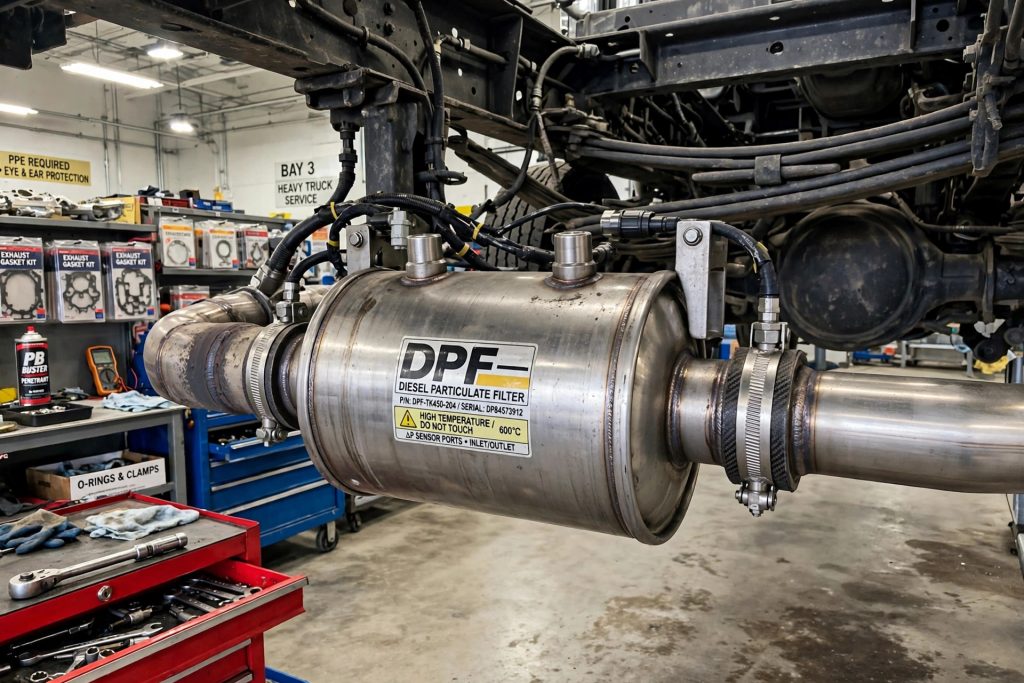
Common diesel particulate filter codes
These are the diesel particulate filter codes drivers actually encounter:
- P2002 — Diesel particulate filter efficiency below threshold, Bank 1 (the filter isn’t trapping soot as well as it should).
- P2003 — The same efficiency fault for Bank 2, on vehicles with two filters.
- P2463 — DPF soot accumulation — the filter is overloaded with soot and needs a successful regen.
- P242F — DPF ash accumulation — the filter is filling with permanent ash; cleaning or replacement is on the horizon.
- P2452 / P2453 / P2454 / P2455 — DPF differential pressure sensor circuit faults (signal low, high, or out of range).
- P244A — DPF differential pressure too low (sensor readings don’t match the expected restriction).
- P244B — DPF differential pressure too high (excessive restriction — often severe soot loading).
- P2458 — DPF regeneration duration fault (a regen ran too long or never completed).
- P2459 — DPF regeneration frequency fault (regens happening too often — the classic short-trip driving pattern).
What triggers a DPF code
A DPF code is rarely random. The usual suspects behind these diesel particulate filter codes, in rough order of frequency:
- Short-trip driving — the exhaust never stays hot long enough for a regen to finish. The single most common cause.
- Interrupted or failed regenerations — switching the engine off mid-regen, repeatedly.
- A faulty differential pressure sensor, or its rubber hoses cracked, melted, or clogged with soot.
- Engine faults making excess soot: EGR problems (P0401/P0402), turbo underboost (P0299), or leaking/worn injectors.
- Wrong engine oil — a diesel DPF needs low-ash (low-SAPS) oil; conventional oil creates far more ash.
- Low fuel level or other active fault codes that block the computer from starting a regen.
- Simple old age — ash accumulation over high mileage eventually fills any filter.
Symptoms of DPF trouble
DPF problems announce themselves clearly:
- Check engine light, often joined by a dedicated DPF warning light or a “DPF full” message.
- Limp mode or noticeably reduced power as the computer protects the engine.
- Worse fuel economy — failed regens waste fuel.
- Excessive exhaust smoke or a strong, acrid smell.
- Cooling fan running after shutdown, or a hot smell from under the car (a regen in progress).
- Regens happening constantly, or a regen that never seems to finish.
Diagnosing DPF codes step by step
Work this order before spending money on the filter itself:
- Read the live data, not just the codes: soot load percentage, ash load percentage, differential pressure readings, distance since the last regen, and how many regens have failed. A scan tool with diesel functions shows all of this.
- Fix root-cause engine faults first. A DPF code is often a symptom — EGR, turbo, and injector faults (like P0401, P0402, or P0299) make excess soot that overwhelms a healthy filter.
- Inspect the differential pressure sensor’s hoses and wiring. Cracked, melted, or soot-clogged hoses are a common, cheap fix that mimics a dead filter.
- Check the driving pattern, fuel level, and oil. Short trips, a near-empty tank, or the wrong oil can each block or sabotage regen — and they’re free to correct.
- Attempt a forced regeneration with a scan tool if soot load is high but ash is still manageable — after the root cause is fixed.
- Know when the filter is done: if ash load is past roughly 90%, or particulate mass is above about 45 grams, no regen will save the filter — it needs professional off-vehicle cleaning or replacement.
Forced regeneration: when it helps and when it doesn’t
A forced regen is a workshop procedure: a technician commands the regen with a scan tool while the vehicle sits parked, and it typically takes 30–90 minutes of high-idle running. It’s the right move when automatic regen has failed, soot load is high (think P2463), or you’ve just fixed the root cause and want to give the filter a clean slate.
It won’t always run. The computer blocks a forced regen when there are active fault codes, fuel is below about a quarter tank, DEF is low, EGR or turbo faults are present, the oil is diluted with fuel, or a safety interlock is tripped. A shop typically charges $300–$700 for the procedure.
And here is the trap: a forced regen without fixing the root cause is just a very expensive reset button. If short trips, a bad sensor, or an EGR fault caused the overload, the code will be back within weeks. Fix the cause, then regen.
Soot vs. ash: the distinction that decides your repair
Soot is burnable carbon — regen exists to remove it, and a soot-loaded filter (P2463) can often be saved. Ash is what’s left after the soot burns: incombustible minerals, mostly from engine oil additives, that no amount of heat will remove.
Every regen leaves a little more ash behind, so the filter’s ash capacity is genuinely finite — most DPFs last well past 100,000 miles, but the number depends heavily on driving pattern and oil choice. When ash load climbs past about 90%, the only fixes are professional thermal cleaning off the vehicle ($300–$600) or a new filter ($1,500–$4,000+).
The cheapest life-extension is boring but real: use the correct low-ash (low-SAPS) diesel oil, and give the car regular highway runs so regens complete instead of aborting halfway.
What DPF repairs cost
Costs vary by vehicle and region, but these ranges cover most diesel particulate filter code repairs:
- $0 — a proper highway run to let a pending regen complete, if the system is otherwise healthy.
- $100–$250 — a differential pressure sensor or replacement sensor hoses.
- $300–$700 — a forced regeneration at a shop.
- $300–$600 — professional off-vehicle DPF cleaning (thermal bake).
- $1,500–$4,000+ — DPF replacement, plus labor.
- Plus the root cause — EGR valve, turbo work, or injector service, since those faults fill the filter in the first place.
DIY or see a mechanic?
The driveway-friendly side: the highway regen run (20–30 steady minutes when the DPF light first appears), a visual check of the sensor hoses, keeping the tank above a quarter full, and switching to the correct low-ash oil at the next service.
See a mechanic for a forced regen (it needs a scan tool with the function), sensor and live-data diagnostics, any ash-overload situation, and DPF removal for cleaning or replacement. Diesel exhaust systems run extremely hot during regen — this isn’t a job to improvise.
Diesel emissions faults sit right next to the gasoline emissions world — the emissions trouble codes guide covers catalytic converters, EVAP, and codes like P0420 and P0430. Because excess soot usually starts upstream with fuel delivery, the fuel and air trouble codes guide covers injectors and lean/rich faults. And for the full map of every system on your car, see the complete engine codes list.
Diesel particulate filter codes: frequently asked questions
P2002 means “Diesel Particulate Filter Efficiency Below Threshold (Bank 1)” — the filter is not trapping soot as well as the computer expects. Usual causes: soot overload from lots of short trips, failed or interrupted regenerations, a faulty differential pressure sensor, or an engine fault (EGR, turbo, or injectors) making excess soot. P2003 is the same fault for Bank 2 on vehicles with two filters.
An amber DPF light asking for a regen is usually not an emergency — a steady 20–30 minute highway run often lets the regen complete and turns it off. But do not ignore it: if the light turns red or starts flashing, or the car goes into limp mode, drive gently straight to a shop. Weeks of ignoring it turns a free regen into a forced regen or a filter replacement.
A forced regen is a workshop procedure where a technician commands the regen with a scan tool while the vehicle is parked — it takes 30–90 minutes. It is used when automatic regen has failed or soot load is too high. The computer will block it when there are active fault codes, fuel is below about 25%, DEF is low, or there are EGR or turbo faults. A shop charges $300–$700, and without fixing the root cause it is only a temporary reset.
Most DPFs last well past 100,000 miles, but every regen leaves behind a little ash — permanent mineral residue from engine oil — that slowly fills the filter. Once ash load passes about 90%, or particulate mass climbs above roughly 45 grams, the only fixes are professional off-vehicle cleaning ($300–$600) or replacement ($1,500–$4,000+). Highway driving and the correct low-ash oil extend its life.
Have a diesel code on your scanner? Search any trouble code on the homepage to get its exact meaning, the most common causes, and what to check next.