P0430 Code: Meaning, Causes, Symptoms & Fixes
Table of Contents
In This Guide
One-line meaning: P0430 means your bank 2 catalytic converter is not cleaning exhaust gases as efficiently as it should.
What the P0430 Code Means
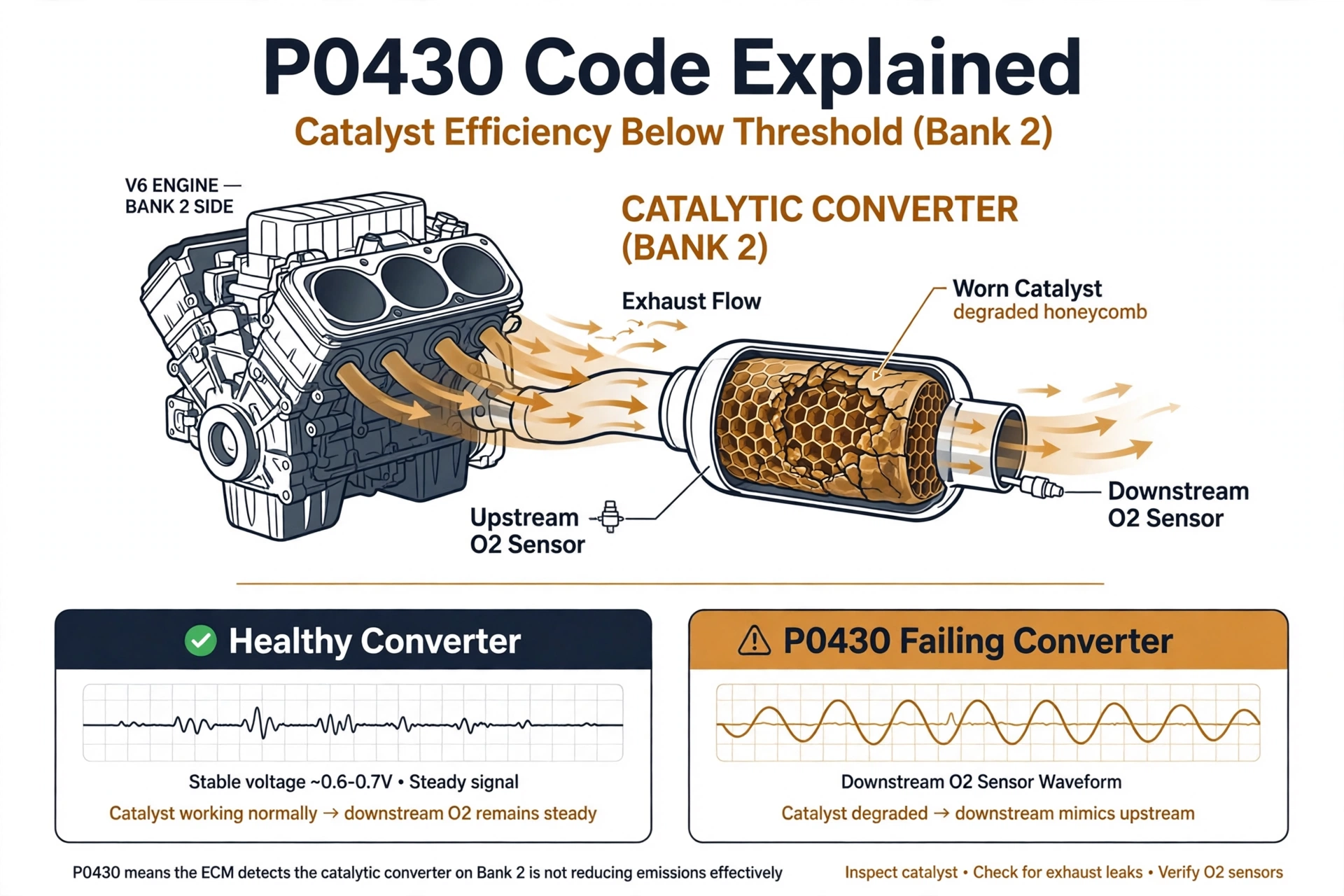
The P0430 engine code stands for “Catalyst System Efficiency Below Threshold (Bank 2).” When your car’s computer sets the engine code P0430, it has determined that the catalytic converter on bank 2 is performing below the minimum efficiency it expects.
Bank 2 is the side of the engine that does not contain cylinder number 1. On V6 and V8 engines, each bank has its own catalytic converter, and the P0430 code points specifically to the bank 2 unit. Inline 4-cylinder engines only have one bank, so they cannot set a P0430.
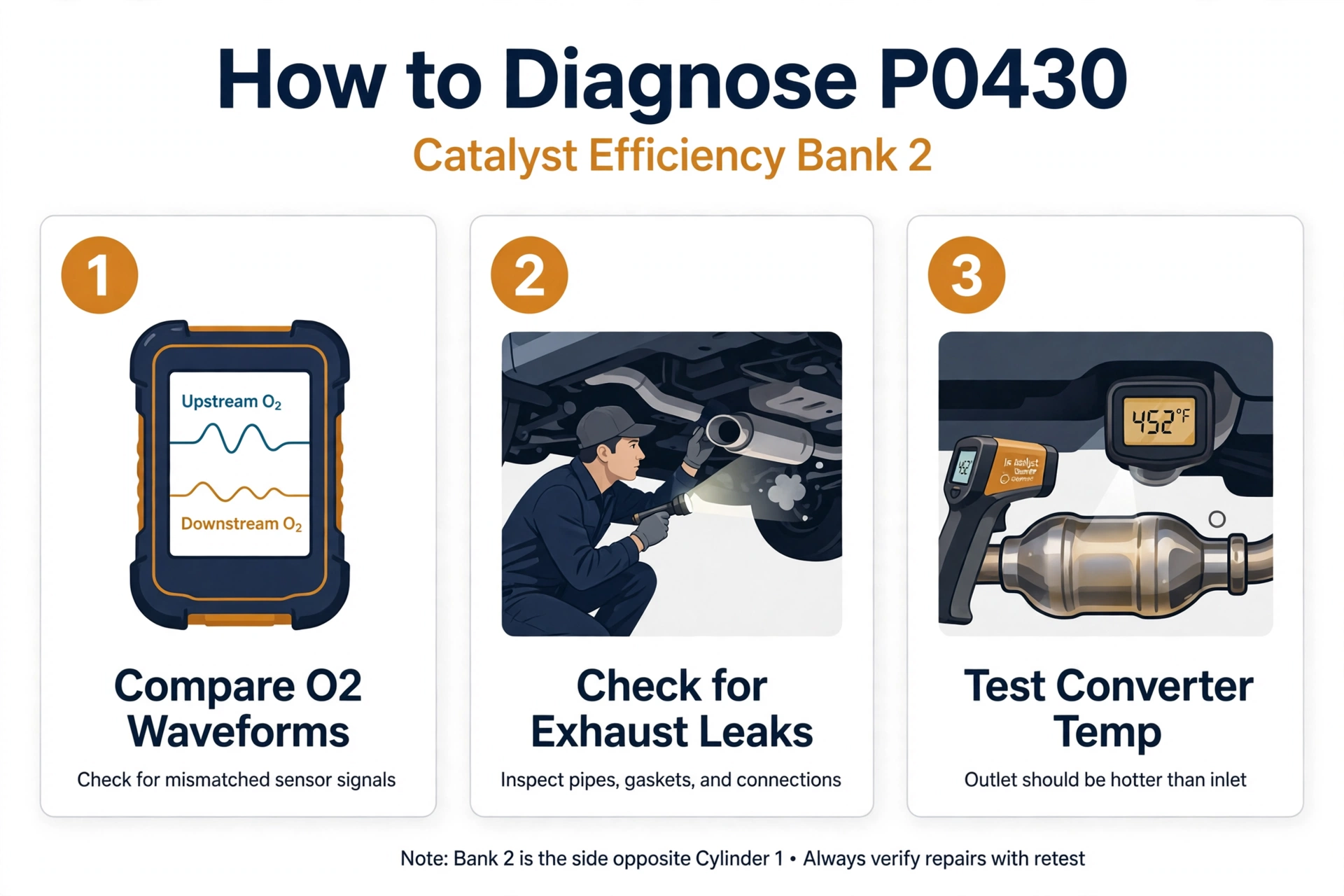
Your car’s computer monitors converter efficiency by comparing the upstream and downstream oxygen sensors on bank 2. The upstream sensor (before the converter) should switch rapidly between rich and lean. The downstream sensor (after the converter) should stay relatively steady if the converter is doing its job. When the downstream sensor starts switching almost as fast as the upstream one, the computer concludes the converter is worn out and stores the P0430 code.
A healthy catalytic converter removes more than 95 percent of harmful pollutants from the exhaust. When efficiency drops below the programmed threshold, usually around 60 to 70 percent, the P0430 code appears and the check engine light comes on.
Symptoms of the P0430 Code
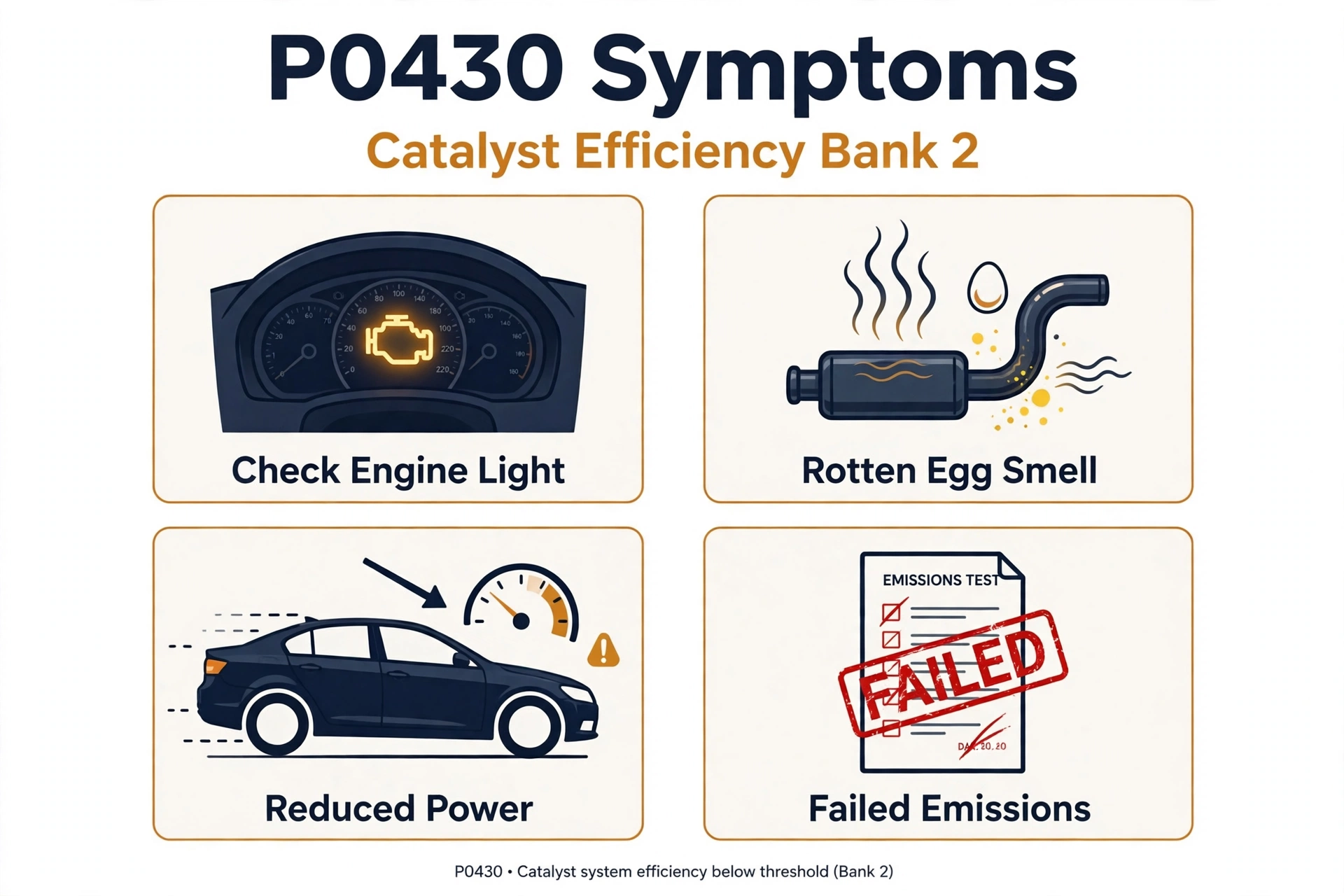
In most cases, the only symptom of a P0430 code is the check engine light. The car often drives exactly the same as before. However, some drivers notice:
- Check engine light illuminated on the dashboard, sometimes the only symptom
- Reduced fuel economy, you may find yourself filling up more often as a failing converter disrupts normal exhaust flow
- Rotten egg or sulfur smell from the exhaust, a sign the converter is not processing hydrogen sulfide properly
- Lack of power or sluggish acceleration, especially if the converter is clogged internally
- Failed emissions test, a P0430 code is an automatic failure in states with emissions inspections
- Rattling noise from underneath the car, which can mean the converter’s internal honeycomb is breaking apart
Common Causes of P0430
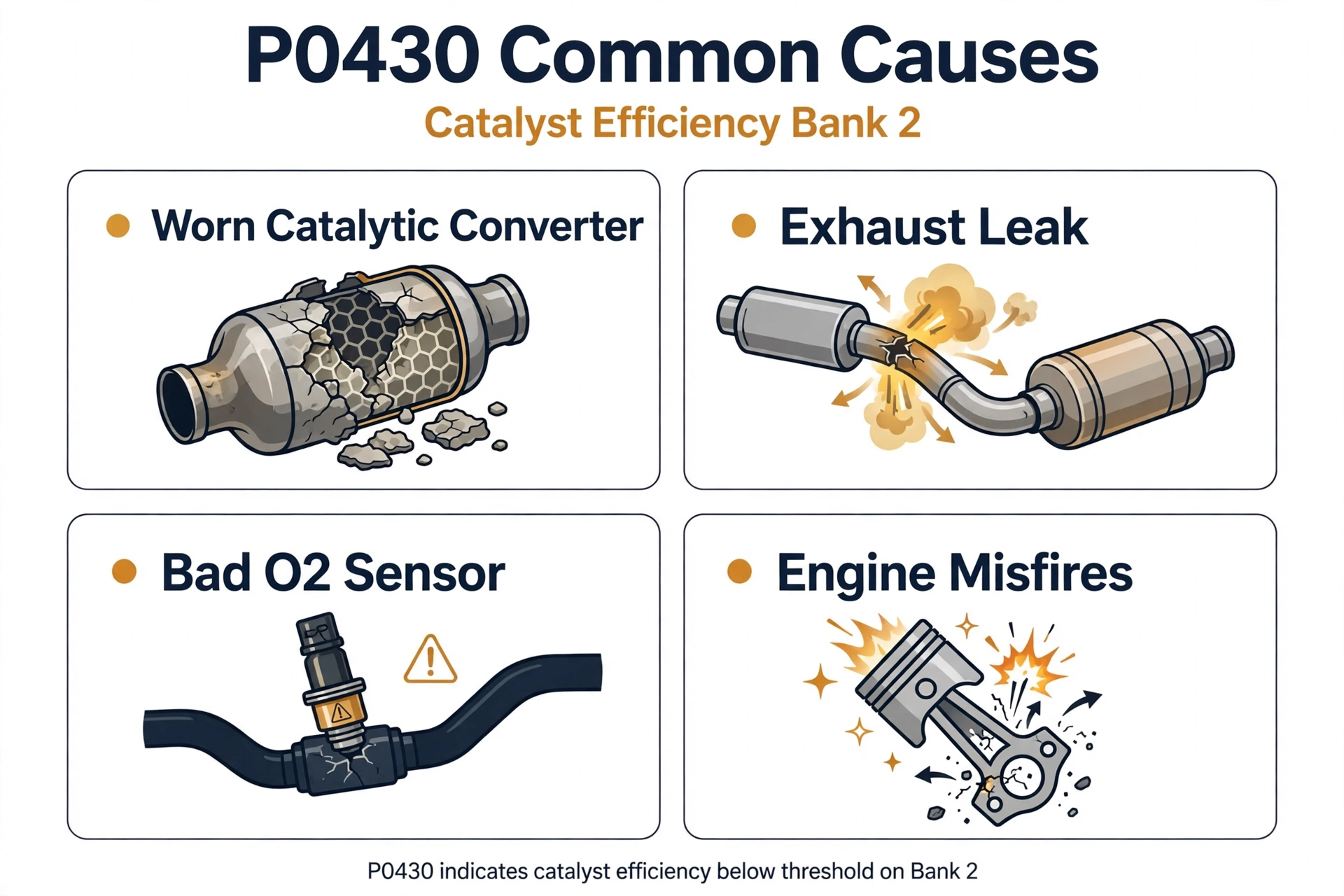
Several problems can trigger the P0430 engine code. Here are the most common, roughly in order of likelihood:
- Failing Catalytic Converter (Bank 2): The most common cause of a catalytic converter code P0430 is a worn converter. The precious metal coating inside (platinum, palladium, rhodium) degrades over time, especially after 80,000 to 120,000 miles. Oil burning, coolant leaks, or running rich accelerate this wear.
- Faulty Downstream O2 Sensor (Bank 2, Sensor 2): Can a bad O2 sensor cause a P0430 code? Yes. A lazy or failing bank 2 downstream oxygen sensor sends inaccurate readings that mimic a bad converter. The sensor may be slow to respond, have a corroded connector, or have damaged wiring. Sensors typically wear out between 60,000 and 100,000 miles.
- Exhaust Leaks: Cracks in the exhaust manifold, a failing gasket at the converter flange, or a corroded flex pipe can let outside air into the exhaust stream. This extra oxygen confuses the downstream O2 sensor and triggers the code. Vehicles in rust-belt states see this often.
- Engine Misfires: Misfiring spark plugs or bad ignition coils dump unburned fuel into the exhaust, which overheats and destroys the converter from the inside. Always fix misfire codes before condemning the converter.
- Rich or Lean Fuel Mixture: Leaking fuel injectors, high fuel pressure, vacuum leaks, or a faulty mass airflow sensor can upset the air-fuel ratio. Running rich coats the converter and ruins its efficiency.
- Oil or Coolant Contamination: An engine that burns oil or leaks coolant into the combustion chambers will poison the converter over time. Fix the underlying consumption issue or the new converter will fail too.
How to Diagnose P0430
Do this before buying parts. Replacing the converter without proper diagnosis is the most expensive mistake with this code.
- Scan for other codes first. Use an OBD2 scanner and check for companion codes. If you have misfire codes (P0300 series) or fuel trim codes (P0171, P0174), fix those first. They are often the root cause, and the P0430 may clear on its own.
- Visually inspect the exhaust. Look for rust, cracks, holes, and black soot marks around the bank 2 exhaust manifold, flex pipe, and converter flanges. Listen for hissing or ticking sounds that signal a leak, especially when the engine is cold.
- Check O2 sensor live data. With a scan tool that shows live data, compare the bank 2 upstream and downstream O2 sensor waveforms at 2,500 RPM. If the downstream mirrors the upstream, the converter is weak. If the upstream is lazy or flat, suspect the sensor, not the converter.
- Test the downstream O2 sensor. A healthy downstream sensor should read fairly steady around 0.45 volts. If it is bouncing between 0.1 and 0.9 volts like the upstream sensor, either the converter has failed or the sensor itself is bad. Swap testing or a known-good sensor comparison helps here.
- Check for converter damage. Tap the bank 2 converter (when cold) and listen for rattling inside. Look for discoloration from overheating. A rattling or discolored converter has internal damage and needs replacement.
How to Fix the P0430 Code
The right fix depends on what your diagnosis found:
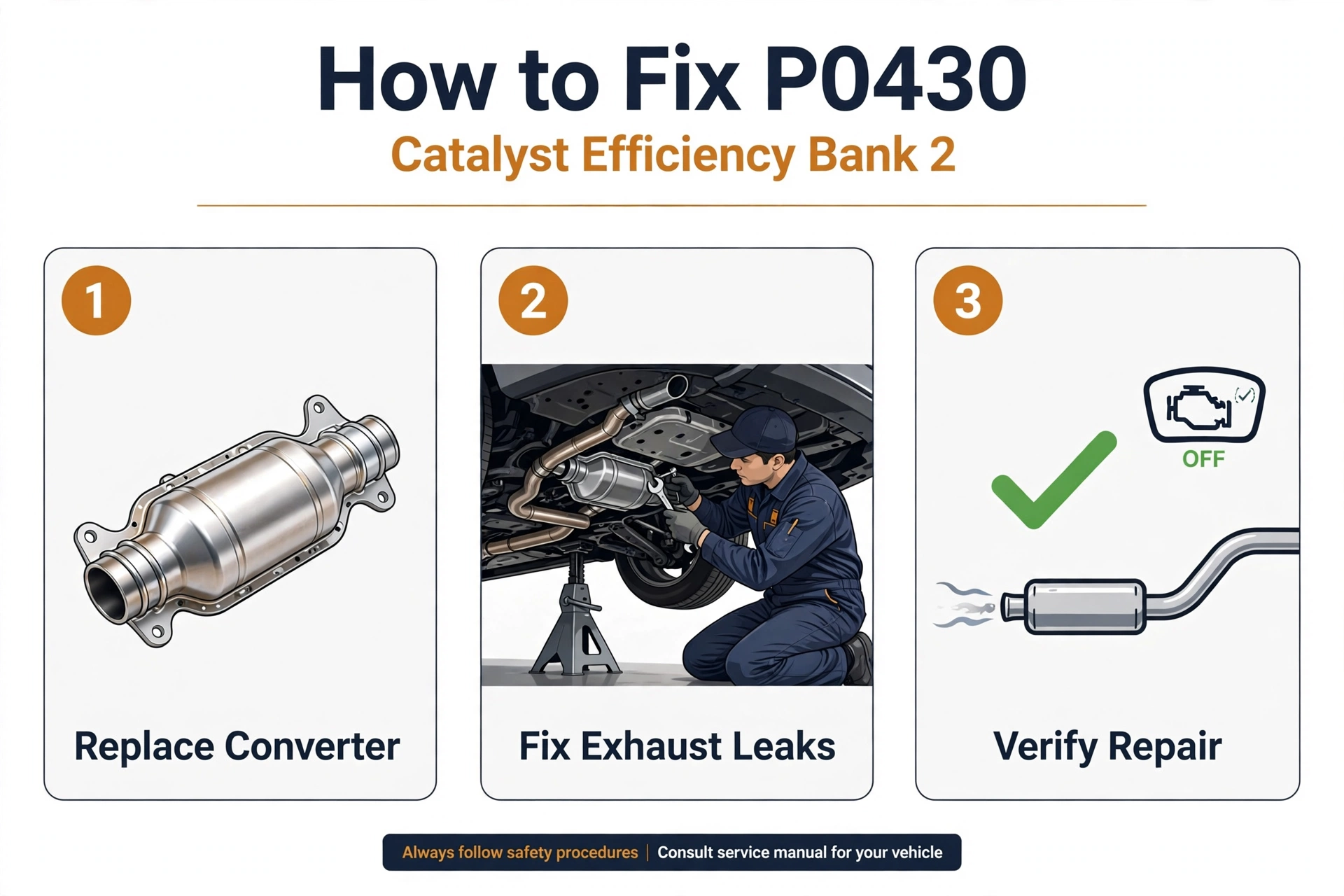
- Repair Exhaust Leaks: Weld or replace the leaking section. Exhaust leaks are often the cheapest fix and can resolve many P0430 cases. Check the manifold, gaskets, and flex pipe on bank 2.
- Replace Faulty O2 Sensors: If the bank 2 downstream O2 sensor is slow or dead, replace it. Many technicians replace O2 sensors in pairs since they age at the same rate. Always fix wiring or connector issues too.
- Fix Misfires and Fuel Problems: Replace worn spark plugs, bad ignition coils, or leaking fuel injectors. Fix vacuum leaks. These issues destroy converters, so address them before installing a new one.
- Replace the Catalytic Converter: Only replace the bank 2 converter after confirming it has actually failed. Use an OEM or OEM-equivalent unit. Cheap universal converters often trigger the code again because they do not meet the efficiency threshold.
- Address Oil Consumption: If the engine burns oil, fix the cause (worn valve seals, piston rings) or the replacement converter will fail prematurely.
P0430 Repair Costs
Repair costs for the P0430 engine code vary widely depending on the root cause:
| Repair | Cost Range |
|---|---|
| O2 sensor replacement (bank 2 downstream) | $150 – $350 |
| Exhaust leak repair (weld or gasket) | $100 – $400 |
| Spark plugs and ignition coils | $150 – $500 |
| Catalytic converter replacement (OEM, bank 2) | $1,200 – $2,500+ |
| Catalytic converter replacement (aftermarket direct-fit) | $400 – $1,000 |
| Diagnostic fee (if done at a shop) | $100 – $200 |
Labor rates vary by region, typically $80 to $150 per hour. Bank 2 converters on V-engines can be harder to access, which increases labor time.
DIY vs Mechanic Verdict
You can do this at home: O2 sensor replacement, visual exhaust inspection, scanning for companion codes, and replacing spark plugs are all solid DIY jobs with basic tools.
See a mechanic for: Catalytic converter replacement on most V6/V8 vehicles (tight access, rusted bolts, welding may be needed), smoke testing for elusive exhaust leaks, and any diagnosis that requires a professional scan tool with live data graphing.
Bottom line: Start with the DIY checks. If the diagnosis points to the converter itself, get quotes from at least two shops, and make sure they use an OEM-equivalent converter, not a cheap universal one.
Can You Drive With a P0430 Code?
Yes, you can usually drive short distances with a P0430 code if the car runs normally. It is an emissions code, not a breakdown risk. However, do not ignore it long term. A truly failed converter can clog and restrict exhaust flow, causing power loss and potential engine damage. You will also fail any emissions inspection with this code active. If you notice rattling, severe power loss, or a strong sulfur smell, get it checked promptly.
P0430 on Popular Vehicles
The engine code P0430 is common on V6 and V8 vehicles with higher mileage. Some patterns worth knowing:
- Ford F-150 (5.4L V8): The 2004-2008 F-150 shows higher-than-average P0430 rates. Exhaust manifold bolts on bank 2 are a known weak point, check for leaks before replacing the converter.
- Toyota Camry (3.5L V6): The 2007-2011 Camry V6 has elevated P0430 complaint rates. Oil consumption on these engines can poison the bank 2 converter over time.
- Nissan (VQ V6 engines): Integrated manifold converters on VQ engines make replacement more involved. Confirm the diagnosis carefully, as these converters are expensive.
- Chevrolet Silverado: Cracked exhaust manifolds are a pattern failure that mimics a bad converter. Inspect bank 2 manifold carefully.
P0430 vs P0420: What Is the Difference?
P0430 and P0420 are mirror images. P0420 means the bank 1 catalytic converter is below efficiency threshold. P0430 means the bank 2 converter is below threshold. Bank 1 is the side with cylinder 1, bank 2 is the opposite side. The causes, symptoms, diagnosis, and fixes are essentially identical, just on different banks. The two codes often appear together when both converters are aging.
Related Codes
- P0420: Catalyst System Efficiency Below Threshold (Bank 1)
- P0421: Warm Up Catalyst Efficiency Below Threshold (Bank 1)
- P0431: Warm Up Catalyst Efficiency Below Threshold (Bank 2)
- P0300: Random/Multiple Cylinder Misfire Detected
- P0171: System Too Lean (Bank 1)
- P0174: System Too Lean (Bank 2)
Video Walkthrough
Watch ScannerDanner walk through how to diagnose a catalyst efficiency code like P0430 step by step.
Frequently Asked Questions
What does the P0430 code mean?
The P0430 engine code means “Catalyst System Efficiency Below Threshold (Bank 2).” Your car’s computer has determined that the bank 2 catalytic converter is not cleaning exhaust gases as efficiently as it should, based on comparing the upstream and downstream oxygen sensor readings.
Can a bad O2 sensor cause a P0430 code?
Yes. A faulty bank 2 downstream oxygen sensor is one of the most common causes of a catalytic converter code P0430. A lazy or inaccurate sensor sends readings that mimic a failed converter. Always test the sensor before replacing the converter.
How much does it cost to fix a P0430 code?
It depends on the cause. An O2 sensor replacement runs $150 to $350. An exhaust leak repair costs $100 to $400. A full bank 2 catalytic converter replacement ranges from $400 (aftermarket) to $2,500+ (OEM). Diagnosis at a shop typically adds $100 to $200.
Can I drive with a P0430 code?
Yes, short term, if the car runs normally. P0430 is an emissions code, not an immediate breakdown risk. However, you will fail emissions testing, and a truly failed converter can eventually restrict exhaust flow. Get it diagnosed reasonably soon.
What is the difference between P0430 and P0420?
They are the same test on different banks. P0420 is bank 1 (the side with cylinder 1), P0430 is bank 2 (the opposite side). Causes, symptoms, and fixes are identical, just mirrored.
Will a P0430 code clear itself?
Sometimes, if the underlying issue was temporary (like a one-time misfire), the code may clear after several drive cycles. But if the converter is genuinely degraded or a sensor has failed, the code will return. Do not rely on it clearing itself.
Should I replace the catalytic converter for P0430?
Only after proper diagnosis confirms the converter has failed. Up to 60 percent of P0430 cases on trucks and SUVs turn out to be a worn O2 sensor, an exhaust leak, or an upstream issue like a misfire. Replacing the converter without diagnosing first is the most expensive mistake with this code.
Conclusion
The P0430 engine code points to the bank 2 catalytic converter, but the converter itself is only one of several possible causes. A methodical diagnosis, starting with companion codes, a visual exhaust inspection, and O2 sensor live data, will save you from the most expensive mistake: replacing a converter that was never bad. Fix upstream issues first, test before replacing, and use quality parts when replacement is truly needed.
About the author: Written by the OBD2 Code Hub editorial team. Our diagnostic guides are built from real OBD-II data, manufacturer service procedures, and hands-on troubleshooting experience, then reviewed for technical accuracy before publishing. We drive the same cars you do.