P0455 Code: Large EVAP Leak Detected – Meaning, Causes, Symptoms & Fixes
In This Guide
P0455: Evaporative Emission Control System Leak Detected (Large Leak).
What the P0455 Code Means
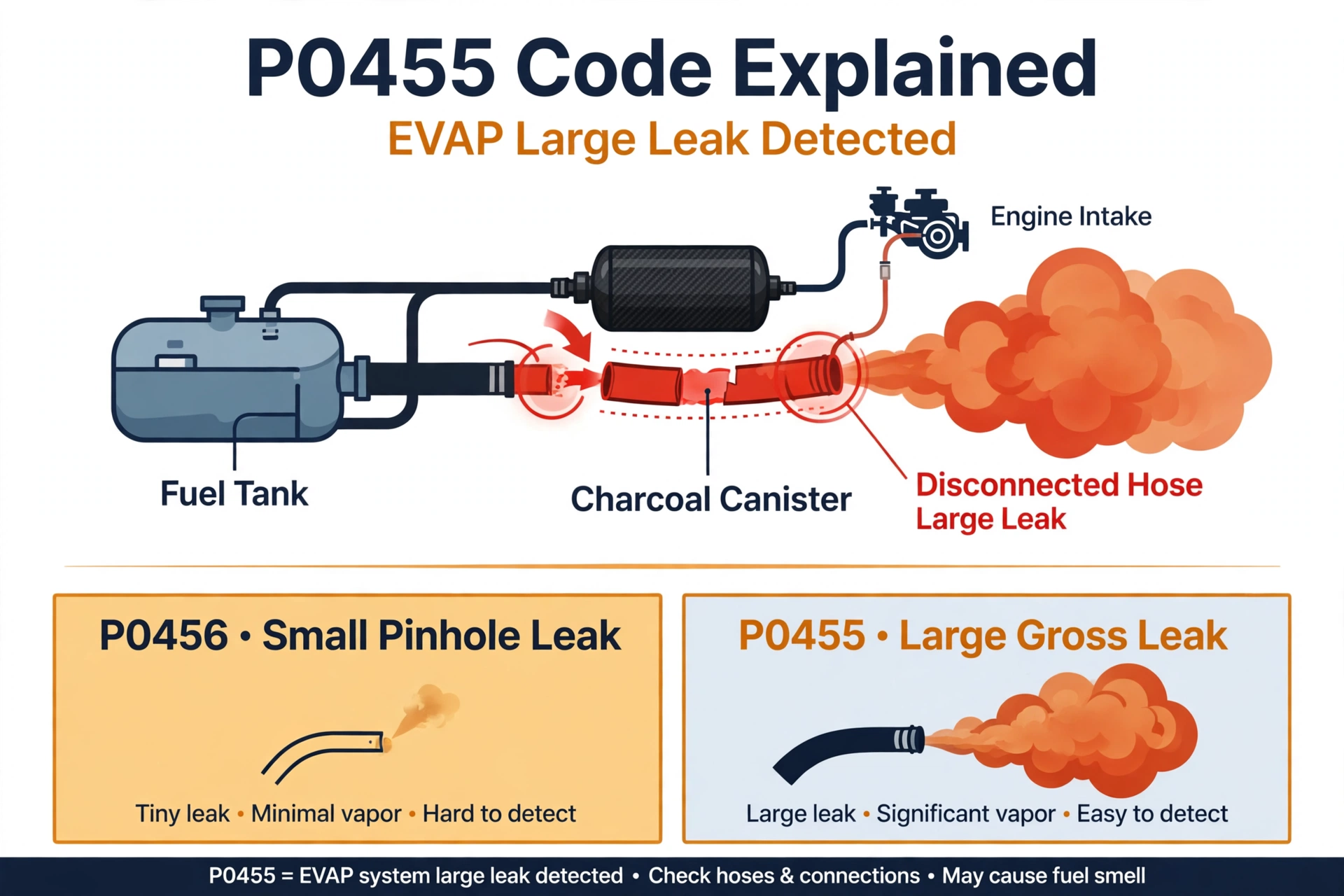
The p0455 engine code means your car’s computer has detected a large leak in the EVAP (evaporative emission control) system. To understand the p0455 code, picture what the EVAP system does: your gas tank constantly gives off fuel vapors, and instead of venting them to the atmosphere, a sealed network of hoses, valves, and a charcoal canister captures those vapors and later feeds them into the engine to be burned. Your car regularly tests this seal by closing the system and watching whether it holds pressure.
When the engine code p0455 sets, the pressure fell fast, which tells the computer the leak is a big one. Technically, the obd2 code p0455 refers to a leak of about 0.040 inches (1 mm) or larger. That sounds tiny, but in EVAP terms it is a gross leak, and it is almost always something physical and easy to find: a gas cap left loose, a hose that came off, or a valve stuck open. Unlike its small-leak cousin P0456, a P0455 rarely requires hunting, because the cause is usually visible.
Like all EVAP codes, the p0455 engine code is about emissions, not drivability. The leaking system handles vapors, not the liquid fuel your engine burns, so the engine itself runs normally. The practical consequences are a lit check engine light, vapor escaping into the air, and a guaranteed failure at emissions inspection time.
Symptoms of the P0455 Code
The check engine light code p0455 keeps its symptoms to a minimum:
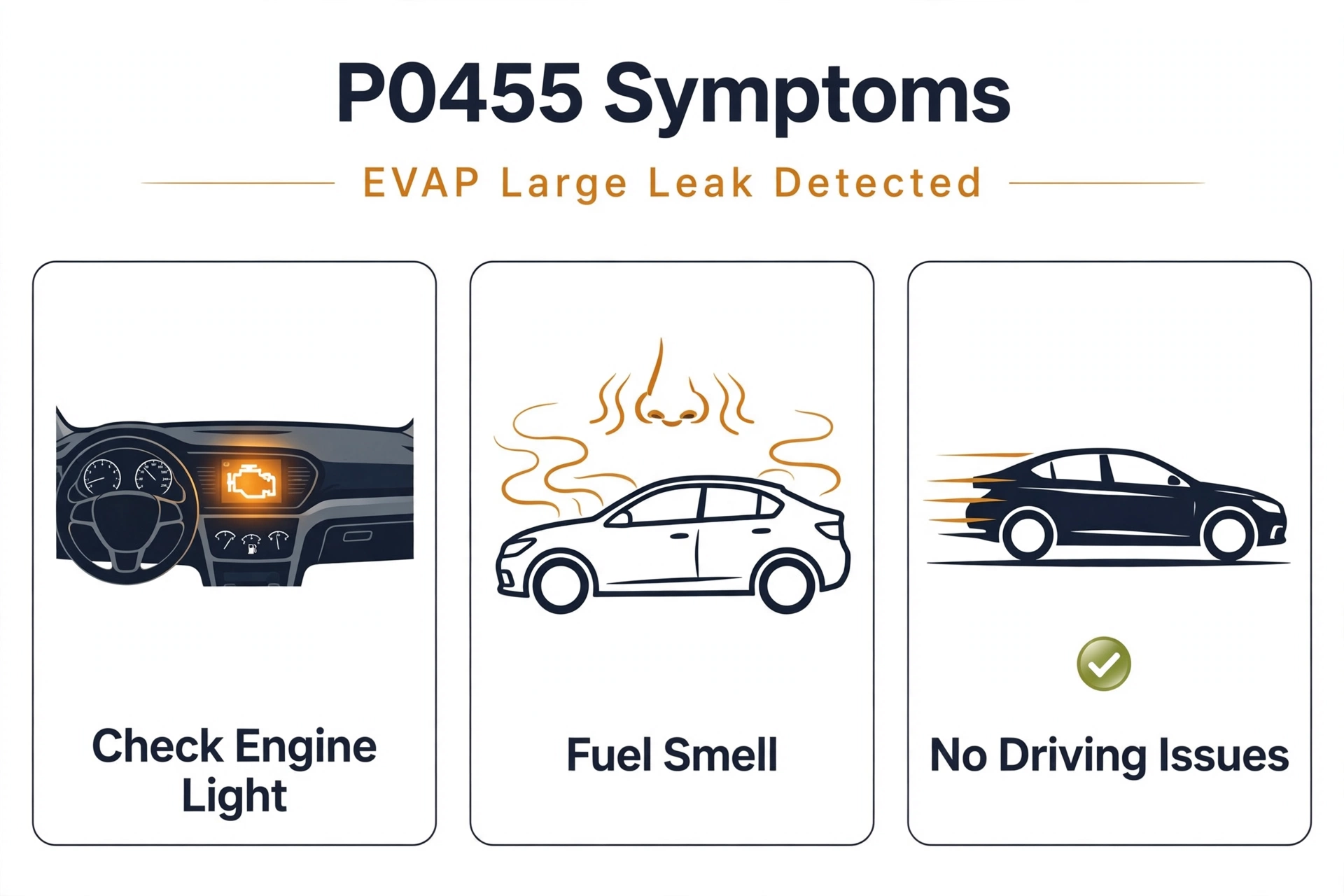
- Check engine light on solid. Often the only symptom. It may appear right after refueling if the cap was left loose.
- Fuel smell around the vehicle. With a large leak, vapors escape in noticeable amounts, so you may smell gasoline near the car, especially around the fuel filler area. This symptom is more common with the evap code p0455 than with smaller EVAP leaks.
- Slightly reduced fuel economy. The loss is small (1 to 3 percent) and most drivers never notice it.
- No drivability changes. No rough idle, no power loss, no hesitation. The engine runs exactly as before.
If your check engine code p0455 is the only code and the car drives fine, that is the normal picture for this code. The fuel smell is the one symptom worth paying attention to, since it confirms vapors are escaping.
Common Causes of P0455
The causes of the p0455 code follow a clear frequency ranking. About half of all cases are the gas cap:
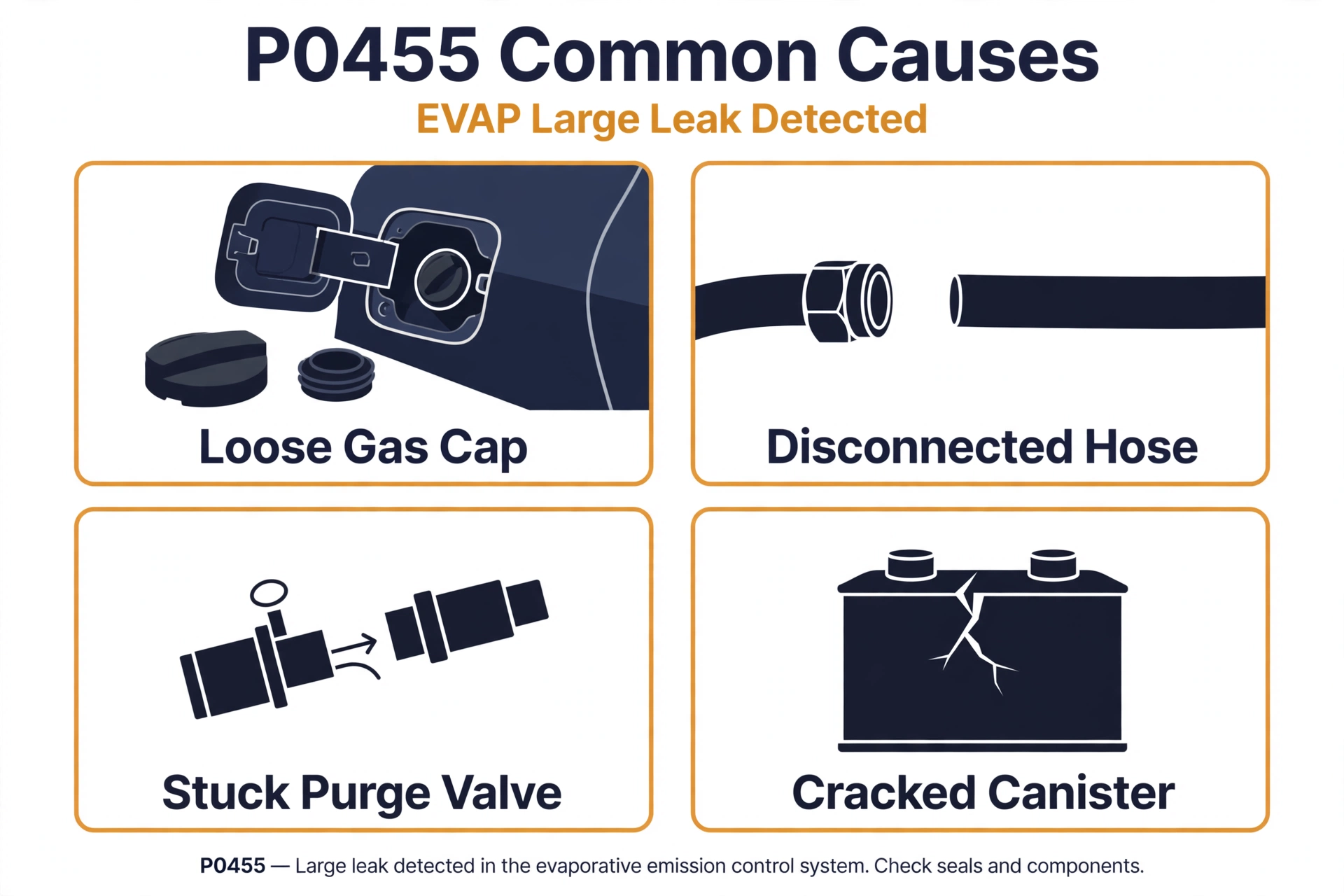
- Loose or damaged gas cap (about 50 percent of cases). The single most common cause. Left loose after fueling, cracked, or with a hardened seal, the cap is the first thing to check and the cheapest fix.
- Cracked or disconnected EVAP hose (about 25 percent). Rubber vapor lines crack from heat cycling and age, especially around the engine bay. A hose that popped off its fitting is even easier to spot.
- Failing purge valve solenoid (about 10 percent). The purge valve meters vapor from the canister to the engine. Stuck open, it lets the system bleed pressure constantly.
- Failing vent valve solenoid (about 5 percent). The vent valve admits fresh air to the canister. Stuck open, the sealed system cannot hold pressure.
- Cracked charcoal canister (about 5 percent). The plastic canister cracks from age or impact, common on high-mileage cars and in salt-belt states.
- Damaged fuel filler neck (about 3 percent). Rust or cracks in the metal pipe between the cap and the tank, common past 150,000 miles in corrosion-prone regions.
- Bad purge solenoid wiring (about 2 percent). Corroded connectors or broken wiring at the purge valve, easy to test with a multimeter.
For a code p0455 evap large leak fix, this ranking is your battle plan: start at the top and work down, and you will find it.
How to Diagnose P0455
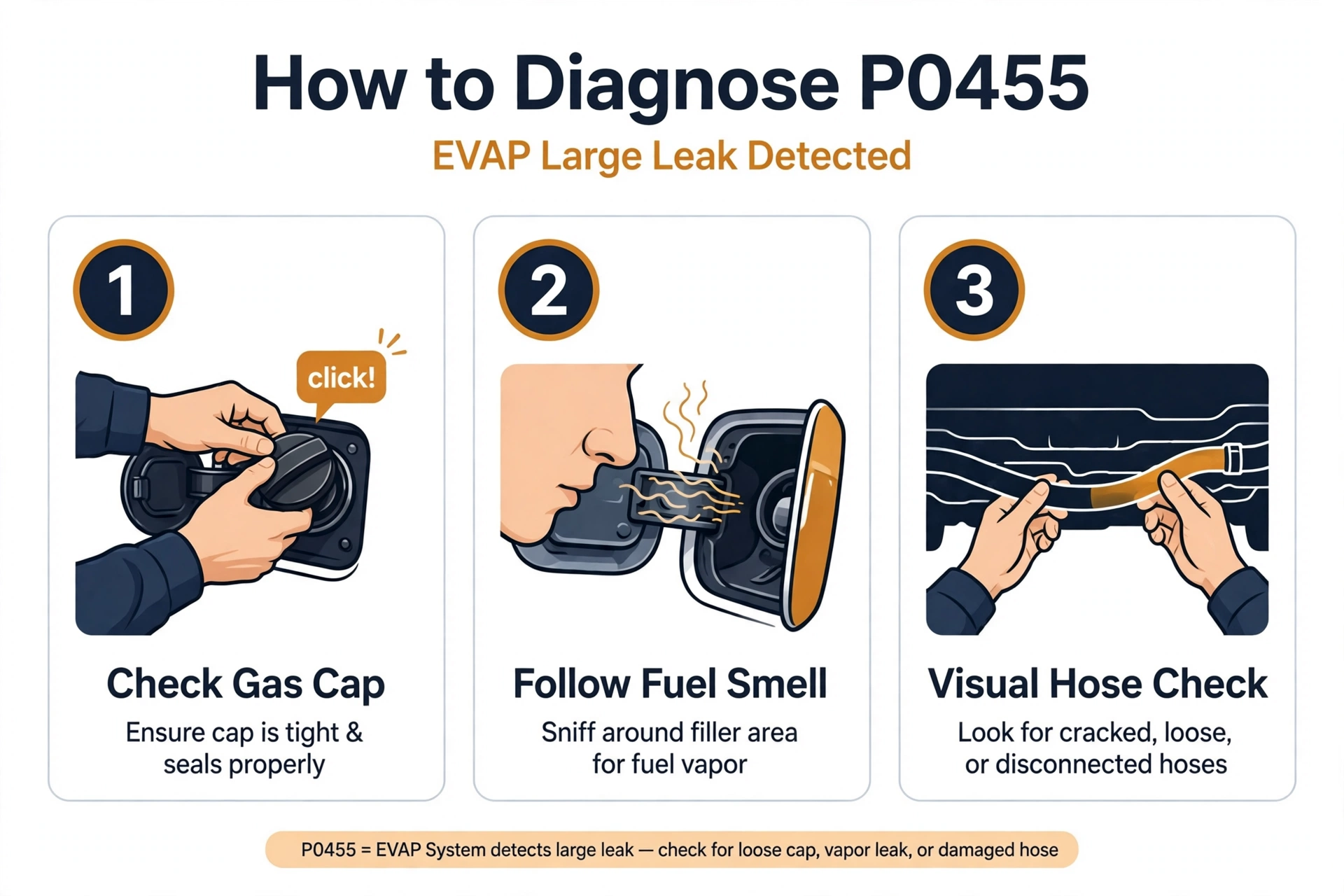
Diagnosing the p0455 engine code is refreshingly straightforward because large leaks are usually visible. Work in this order:
- Check the gas cap first. Remove it, inspect the rubber seal for cracks or debris, and reinstall it until it clicks three times. Clear the code and drive about 50 miles of mixed driving. If the p0455 code does not return, you are done at zero cost.
- Replace the gas cap if suspect. A cap older than five years, a visibly worn seal, or a cheap aftermarket cap all justify a $10 to $25 OEM replacement.
- Visually inspect EVAP hoses. Trace vapor lines from the tank to the canister to the purge valve. Look for splits, disconnected fittings, and missing clamps. Use your nose too: walk around the car and sniff near the cap, filler neck, and hoses. A large leak often announces itself by smell.
- Inspect the charcoal canister. Usually mounted near the fuel tank or on the rear chassis. Look for cracks or impact damage.
- Test the purge and vent valves. Check solenoid resistance with a multimeter and confirm each valve holds vacuum when closed and opens when energized.
- Smoke test if needed. If the visual inspection finds nothing, a smoke machine will reveal the leak in minutes. For a large leak this step is rarely necessary, which is why you should never let a shop sell you a $400 smoke test before you have tried the gas cap yourself.
How to Fix the P0455 Code
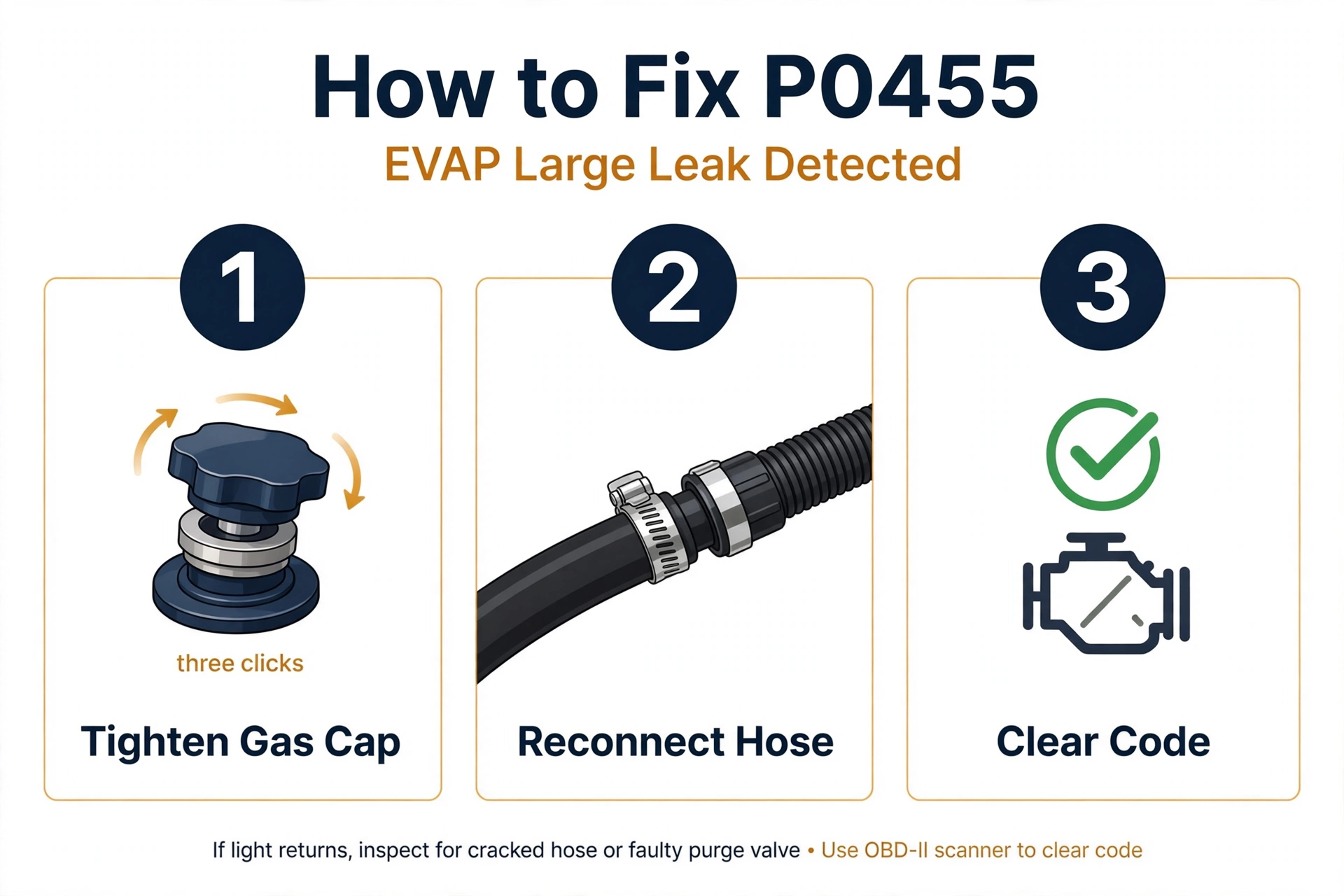
Each fix for the engine code p0455 matches its cause:
- Tighten or replace the gas cap. The ten-second fix that resolves about half of all P0455 cases.
- Reconnect or replace EVAP hoses. Push a popped hose back on and clamp it, or replace cracked sections with new hose.
- Replace a faulty purge valve. Usually a simple bolt-on part in the engine bay.
- Replace a faulty vent valve. Typically near the canister at the rear; replace with a new O-ring.
- Replace a cracked charcoal canister. Bolt-on repair, though access near the tank can be tight.
- Repair or replace the filler neck. Clean up light rust or replace a badly corroded neck.
- Repair purge valve wiring. Clean corroded connectors or repair broken wiring.
After the repair, clear the code and drive normally. The EVAP monitor needs the fuel level between roughly 15 and 85 percent and several drive cycles to re-run its self-test, so allow a few days before declaring the p0455 evap code fixed for good.
P0455 Repair Costs
The p0455 code is one of the cheapest check engine lights to fix. Realistic ranges:
| Repair | Cost Range |
|---|---|
| Gas cap replacement (OEM) | $10 – $25 |
| EVAP hose replacement | $10 – $160 |
| Purge valve solenoid replacement | $120 – $240 |
| Vent valve solenoid replacement | $140 – $280 |
| Charcoal canister replacement | $280 – $500 |
| Fuel filler neck replacement | $280 – $600 |
| Smoke test (diagnostic) | $80 – $160 |
Half of all check engine light code p0455 cases end at the gas cap for $0 to $25. Even a valve replacement at a shop usually stays under $300. One more thing worth knowing: the US federal emissions warranty covers EVAP components for 8 years or 80,000 miles, so failed solenoids and the canister itself may be covered. A loose cap and age-cracked hoses are not covered, but it is always worth checking your warranty before paying.
DIY vs Mechanic Verdict
DIY it if: the fix is the gas cap, a visible hose, or a purge valve you can reach. The cap takes seconds, hoses take minutes, and most purge valves are simple bolt-on jobs. The p0455 code is genuinely one of the easiest DIY check engine fixes.
See a mechanic if: the visual inspection finds nothing and you need a smoke test, or if the vent valve or canister sits above the fuel tank where a lift is needed for access. Do not authorize a smoke test until you have ruled out the cap and hoses yourself.
Verdict: Try the ten-second gas cap fix before calling anyone. If that fails, spend ten minutes looking at hoses. Only then consider professional help.
Can You Drive With a P0455 Code?
Yes, indefinitely from a mechanical standpoint. The check engine code p0455 does not affect how the engine runs, and it is not a safety issue. The practical downsides: you will fail any OBD-II emissions inspection with this code active, the code will not clear until the EVAP monitor completes (typically 50-plus miles of driving after the fix), and fuel vapors are escaping into the air. Drive as needed, but fix it before your inspection is due.
P0455 on Popular Vehicles
The engine light code p0455 is most often reported on Nissans, Chevys, and Toyotas. On Nissan Altimas and Rogues, the p0455 evap code frequently traces to the vent control valve, a known wear item. Chevy Silverado and Tahoe owners should check the gas cap first, then the vent valve solenoid near the tank, which collects road debris. On Toyota Camrys and Corollas, a hardened gas cap seal is the classic culprit. Jeep Wrangler owners with a persistent obd2 code p0455 should inspect the canister, which takes abuse on rough trails. Whatever you drive, the order never changes: cap, hoses, valves, smoke test.
P0455 vs P0456: What Is the Difference?
Both are EVAP leak codes; the difference is leak size. P0455 is a large or gross leak (0.040 inches or bigger), almost always something obvious like a loose cap or a disconnected hose, and it is usually found with your eyes. P0456 is a very small leak (around 0.020 inches), usually a pinhole that needs a smoke machine to find. If you have both codes, fix the large leak first, then re-test. For the small-leak guide, see our P0456 code guide and our emissions trouble codes guide.
Related Codes
- P0456: Evaporative Emission Control System Leak Detected (Very Small Leak), the small-leak counterpart to P0455.
- P0442: Evaporative Emission Control System Leak Detected (Small Leak), another EVAP system leak code.
- P0446: Evaporative Emission Control System Vent Control Circuit, the EVAP vent valve circuit code.
Video Walkthrough
Watch AutoLine Pro walk through EVAP leak diagnosis, including how to smoke test the system and tell large leaks from small ones.
Frequently Asked Questions
What does the P0455 code mean?
The p0455 code means “Evaporative Emission Control System Leak Detected (Large Leak).” Your car’s computer found a leak of about 0.040 inches or larger in the sealed EVAP system that captures fuel vapors.
What is the most common cause of P0455?
A loose or damaged gas cap causes about half of all p0455 engine code cases. Tighten it until it clicks three times, and replace it if the seal is worn.
Can I drive with a P0455 code?
Yes. The check engine light code p0455 does not affect drivability or safety. Fix it before your emissions inspection, since an active EVAP code is an automatic fail.
How much does it cost to fix P0455?
About half of cases cost $0 to $25 for the gas cap. Valve replacements run $120 to $280 at a shop, and a charcoal canister $280 to $500. Check your federal emissions warranty (8 years, 80,000 miles) before paying for solenoids or the canister.
Will P0455 fail emissions testing?
Yes, in any state with OBD-II inspections. The code must be cleared and stay cleared through a full drive cycle (typically 50-plus miles) for the EVAP monitor to report ready.
Can I just clear the P0455 code without fixing it?
Temporarily, yes, but the engine code p0455 returns within one to three drive cycles once the EVAP self-test runs again. Fix the cause first, then clear the code to confirm the repair.
Why does P0455 only appear at certain fuel levels?
The EVAP self-test only runs when the tank is roughly 15 to 85 percent full. If your evap code p0455 appears only near full or empty, the test conditions are interacting with the leak, which often points toward the vent valve.
Conclusion
The p0455 code looks alarming on a scanner, “large leak detected,” but it is usually the simplest check engine light you will ever fix. Half the time the cure is tightening the gas cap until it clicks. Work cheapest-first through hoses and valves, use your nose, and save the smoke test for last. Follow that order and a p0455 engine code is resolved for pocket change, often in under ten minutes.
About the author: Written by the OBD2 Code Hub editorial team. This guide is for informational purposes. If you are unsure about any repair, consult a qualified mechanic.