P0442 Code: Evaporative Emission Control System Leak Detected (Small Leak)
In This Guide
One-line meaning: Your car’s computer detected a small leak in the EVAP system, the sealed fuel vapor system.
What the P0442 Code Means
The P0442 engine code stands for “Evaporative Emission Control System Leak Detected (Small Leak).” When your car sets the engine code P0442, its computer ran a self-test on the EVAP system and found that it could not hold vacuum or pressure, meaning fuel vapor is escaping somewhere it should not.
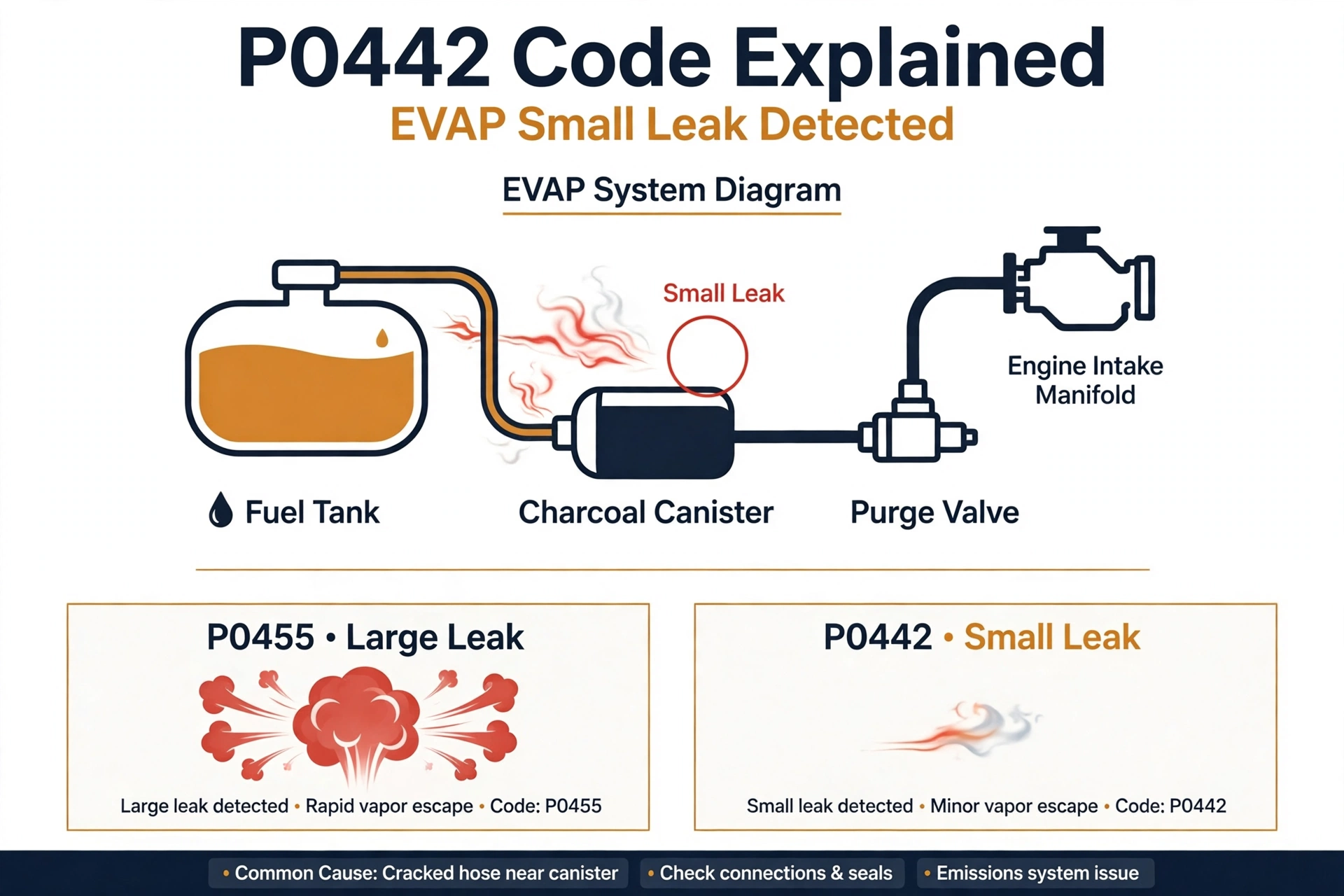
The EVAP system captures fuel vapors from the gas tank and routes them to the engine to be burned, instead of letting them escape into the atmosphere. It is a sealed system that includes the gas cap, fuel filler neck, vapor hoses, charcoal canister, purge valve, and vent valve. During a self-test, the computer seals the system and watches the fuel tank pressure sensor. If pressure drops faster than expected, it knows there is a leak.
The evap code P0442 specifically means a small leak. EVAP leak codes are sized: P0455 is a large leak, P0442 is a small leak, and P0456 is a very small leak. A small leak is often something as simple as a gas cap that was not tightened fully.
This is one of the most common check engine light codes in the United States, and the good news is that the most common cause costs nothing to check.
Symptoms of the P0442 Code
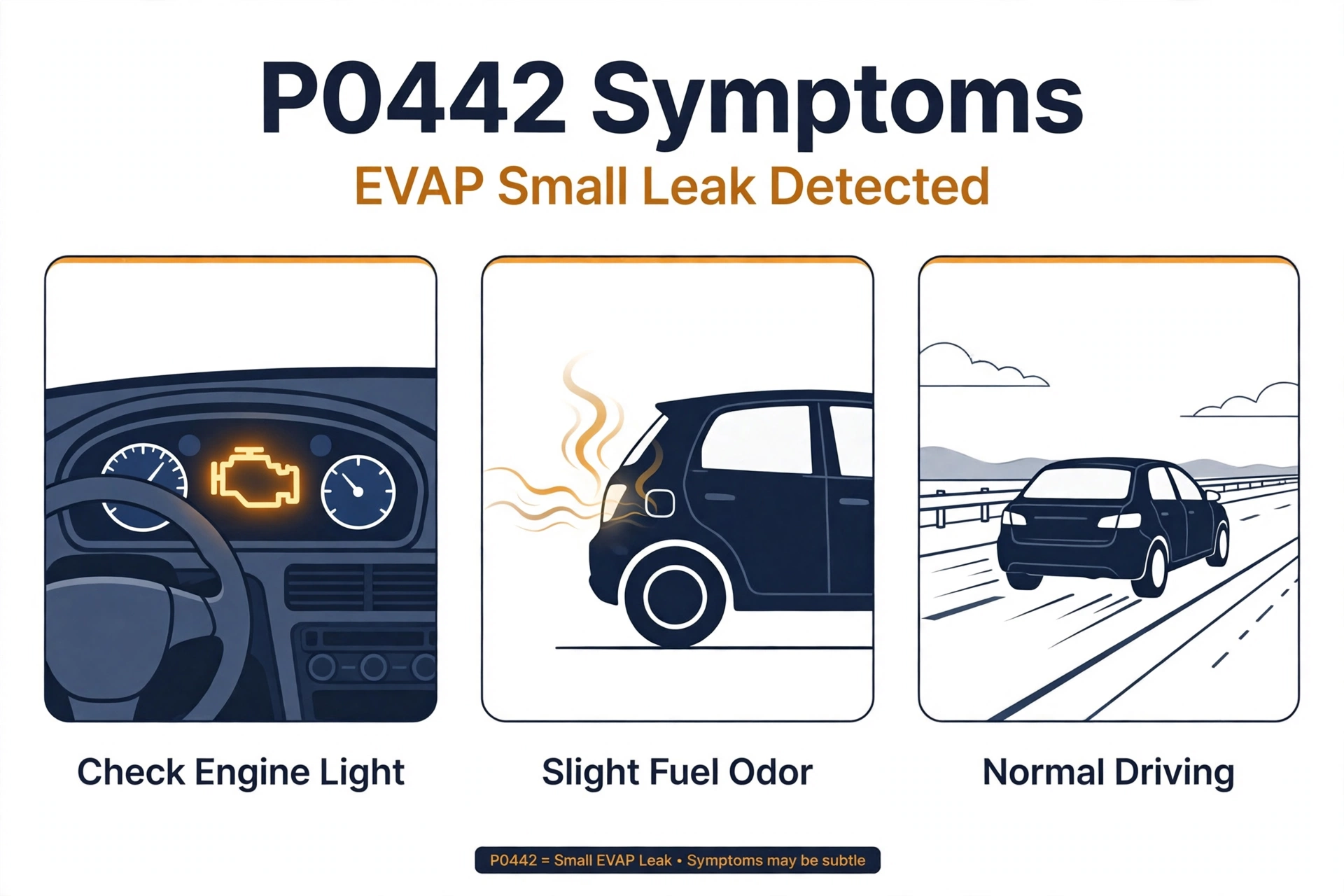
The P0442 code rarely causes any drivability symptoms. Most drivers notice only:
- Check engine light illuminated, often the only symptom
- Faint fuel smell near the vehicle, especially around the rear or after fueling
- Slight decrease in fuel efficiency in some cases, though usually not noticeable
- Failed emissions test, any stored EVAP code is an automatic failure
- “Check fuel cap” message on some vehicles, which points directly at the most common cause
You will not experience stalling, power loss, or rough running from a P0442 evap code alone. If you do have drivability symptoms, there is likely another code present.
Common Causes of P0442
Here are the most common causes of the check engine code P0442, in order of likelihood:
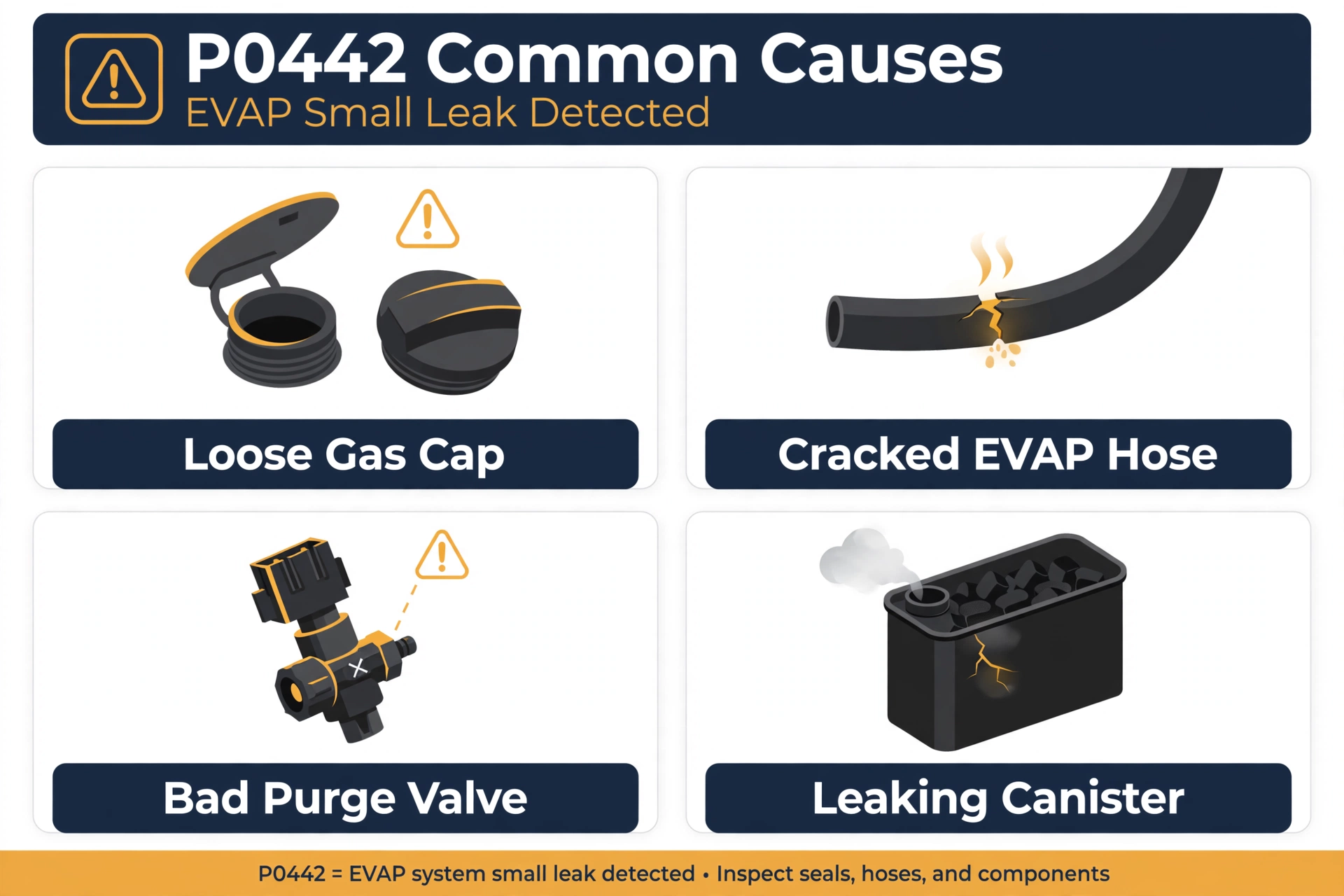
- Loose, worn, or missing gas cap: By far the most common cause. A gas cap that was not clicked fully shut, has a cracked seal, or is an ill-fitting aftermarket cap will trigger P0442. This one is free to check and takes ten seconds.
- Cracked or disconnected EVAP hoses: Rubber vapor hoses crack with age and heat, especially near the engine bay and around the fuel tank. A disconnected hose after other repair work is also common.
- Faulty purge valve (purge solenoid): The purge valve controls vapor flow from the canister to the engine. If it sticks open or closed, or its seal fails, the system cannot hold pressure during the self-test.
- Faulty vent valve (vent solenoid): The vent valve seals the system during testing. A vent valve stuck open is a classic P0442 cause, particularly on GM trucks and SUVs.
- Damaged charcoal canister: The canister stores fuel vapors. Cracks in its housing or saturated charcoal (from habitually topping off the tank) can cause leaks.
- Fuel filler neck issues: Rust or cracks in the filler neck, or a damaged seal where the gas cap seats, will leak vapor. Common on older vehicles in rust-prone regions.
- Leaking fuel tank pressure sensor or seal: Less common, but the pressure sensor seal on top of the tank can deteriorate and leak.
How to Diagnose P0442
Follow this order. Most P0442 cases are solved in the first two steps.
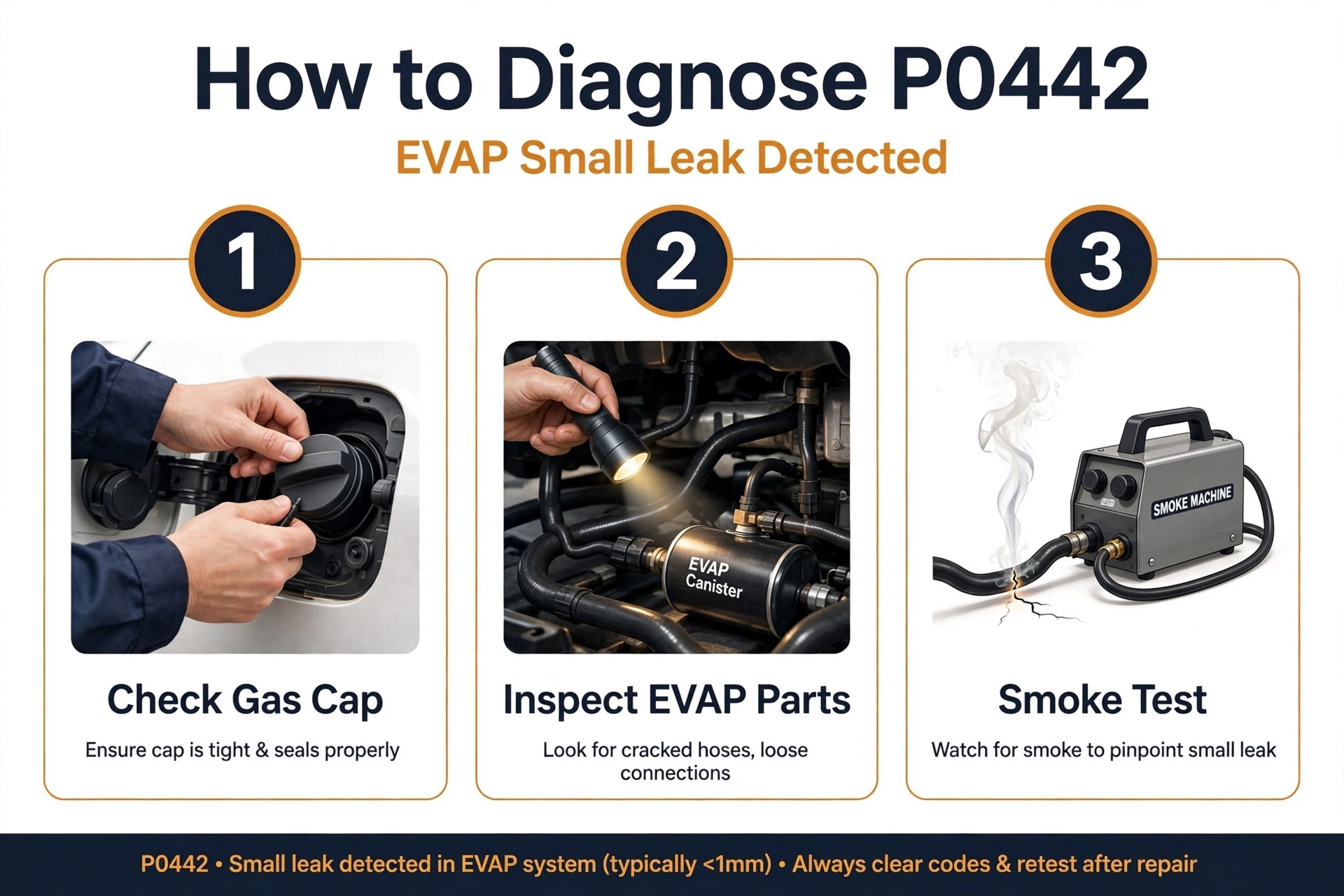
- Check the gas cap first. Remove the gas cap and inspect the rubber seal for cracks, stiffness, or debris. Make sure it clicks fully when tightened (most caps click three times). If the seal looks worn or you are unsure, just replace it. Clear the code and drive normally for a few days. The EVAP self-test only runs under specific conditions, so the code may take several drive cycles to clear on its own.
- Scan for companion codes. Use an OBD2 scanner to check for other EVAP codes. The combination narrows things down fast:
- P0442 alone: gas cap, small hose leak, or seal
- P0442 + P0455: focus on the large leak first, one bad part can set both
- P0442 + P0441 or P0443: suspect the purge valve or its circuit
- P0442 + P0446: suspect the vent valve or its circuit
- Visual inspection. Trace accessible EVAP hoses and look for cracks, especially near hot engine parts. Check the charcoal canister for cracks or charcoal pellets spilled on the ground underneath. Inspect the filler neck for rust.
- Test the purge valve. With the valve removed, blow through it. It should be closed (no airflow) when unpowered. Apply battery voltage and it should click open. A purge valve that leaks when closed needs replacement. Typical resistance is 20 to 30 ohms.
- Smoke test. If the gas cap and visible hoses check out, a smoke test is the fastest way to find a small leak. A shop introduces harmless smoke into the EVAP system and watches where it escapes. This finds leaks you cannot see, including tiny canister cracks.
How to Fix the P0442 Code
Match the fix to what your diagnosis found:
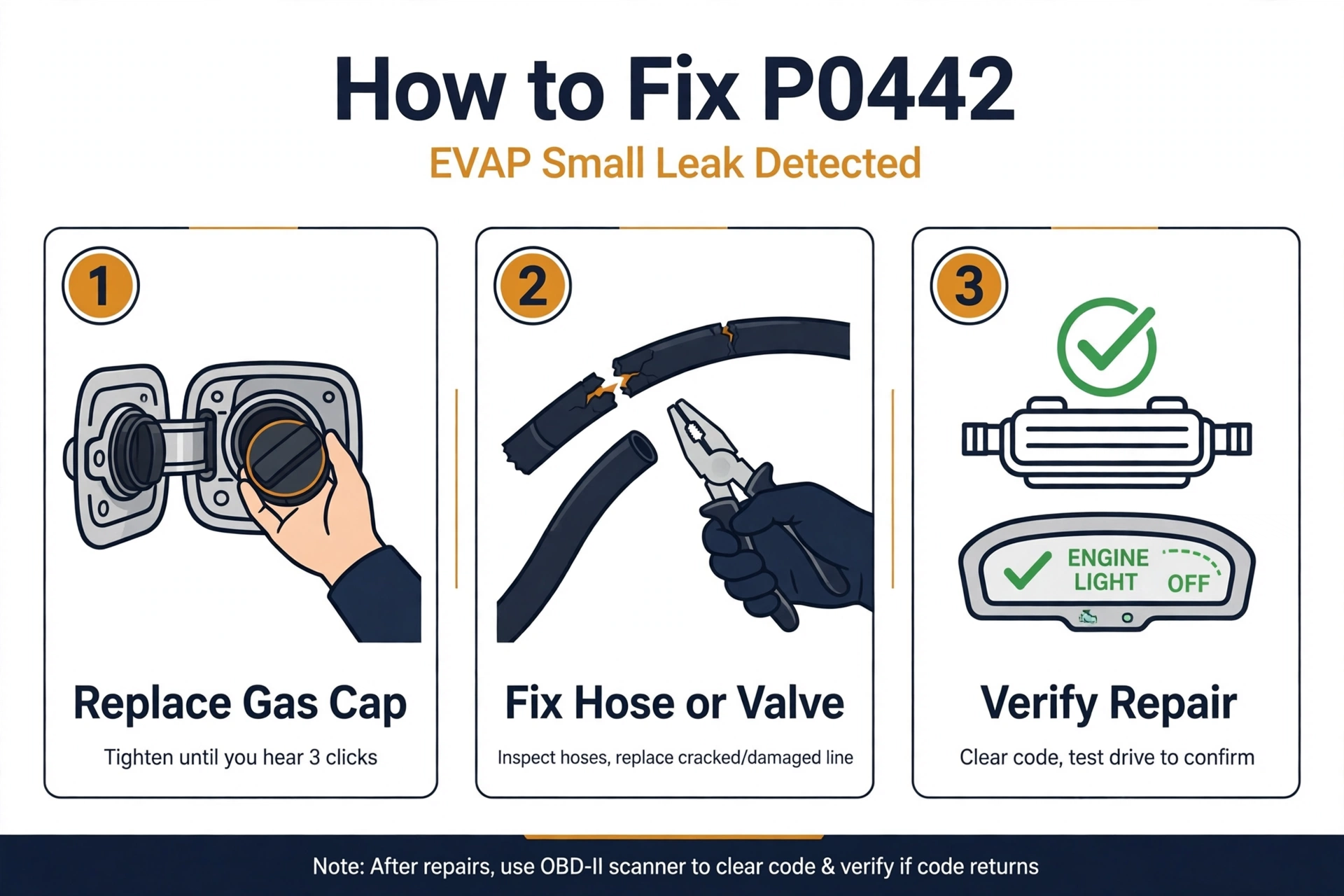
- Tighten or replace the gas cap: Tighten until it clicks fully. If the seal is worn, replace the cap. Use an OEM or quality cap, cheap aftermarket caps with poor seal tolerances are a known cause of repeat EVAP codes.
- Replace cracked EVAP hoses: Replace the specific damaged hose. This is inexpensive and often a simple DIY job with basic hand tools.
- Replace the purge valve: Usually mounted on or near the intake manifold. Disconnect the electrical connector and hoses, swap the valve, and reconnect. Clear the code afterward.
- Replace the vent valve: Often located near the charcoal canister at the rear. Same basic procedure as the purge valve.
- Replace the charcoal canister: If cracked or saturated, replace the canister. Also break the habit of topping off the fuel tank after the pump clicks, that is what saturates canisters.
- How to fix P0442 code without replacing evap canister: Good news: most P0442 cases never need a canister. Start with the gas cap, then hoses, then valves. The canister is the last resort, not the first guess. How to fix P0442 code without replacing evap canister comes down to methodical diagnosis: the vast majority of small leaks are the cap, a hose, or a valve, all far cheaper than a canister.
P0442 Repair Costs
One reason the check engine light code P0442 is less stressful than most codes: the most common fix is nearly free.
| Repair | Cost Range |
|---|---|
| Tighten gas cap | $0 |
| Replace gas cap (OEM) | $15 – $40 |
| Replace EVAP hose | $10 – $60 |
| Replace purge valve | $30 – $150 |
| Replace vent valve | $40 – $180 |
| Replace charcoal canister | $150 – $400 |
| Smoke test diagnostic (shop) | $80 – $150 |
DIY total for the common fixes: $0 to $150. Shop total including diagnosis: $100 to $400 in most cases.
DIY vs Mechanic Verdict
DIY-friendly: Gas cap check and replacement, visual hose inspection, purge valve testing and replacement, and vent valve replacement are all beginner to intermediate DIY jobs. A basic OBD2 scanner is the only special tool you need for most of it.
See a mechanic for: Smoke testing (the machine costs more than the diagnosis), fuel tank or filler neck work (fuel system safety), and any EVAP issue where you have chased the obvious causes without success.
Verdict: This is one of the most DIY-friendly codes there is. Check the gas cap first, always. If that does not solve it, work through hoses and valves before paying for a smoke test.
Can You Drive With a P0442 Code?
Yes. A P0442 code does not affect drivability, safety, or engine health. You can drive normally with it active. The reasons to fix it anyway: you will fail emissions inspection, you are wasting a small amount of fuel as vapor, and fuel vapors are flammable so a leak is worth sealing. Fix it within 30 days as a practical target, but there is no urgency.
P0442 on Popular Vehicles
The engine code P0442 shows up across all makes, but a few patterns stand out:
- GM Trucks and SUVs (Silverado, Tahoe, Yukon): Vent valve failures are a pattern. The vent solenoid near the canister sticks open with age and road debris. An updated part is available.
- Ford F-150: Gas cap and purge valve are the usual suspects. Some model years have service bulletins for EVAP issues.
- Toyota and Lexus: Gas cap seal wear and the occasional cracked filler neck collar. Toyota filler necks deserve a close look on older models.
- Jeep Wrangler: EVAP hoses near the tank crack with off-road exposure. Visual inspection underneath is worthwhile.
P0442 vs P0455 vs P0456: What Is the Difference?
These three codes are the same test with different leak sizes. P0455 means a large leak (like a missing gas cap). P0442 means a small leak. P0456 means a very small leak. The diagnostic approach is the same for all three: start with the gas cap, then hoses and valves, then smoke test. A large leak is usually easier to find because it is something obvious. A very small leak (P0456) is the hardest and almost always needs a smoke test.
Related Codes
- P0440: Evaporative Emission Control System Malfunction
- P0441: Evaporative Emission Control System Incorrect Purge Flow
- P0443: EVAP Purge Control Valve Circuit Malfunction
- P0446: EVAP Vent Control Circuit Malfunction
- P0455: EVAP System Leak Detected (Large Leak)
- P0456: EVAP System Leak Detected (Very Small Leak)
Video Walkthrough
Watch a full walkthrough of EVAP system diagnosis, covering the purge valve, charcoal canister, vent valve, and leak testing.
Frequently Asked Questions
What does the P0442 code mean?
The P0442 engine code means “Evaporative Emission Control System Leak Detected (Small Leak).” Your car’s computer sealed the EVAP system during a self-test and detected a small fuel vapor leak, most commonly from the gas cap.
Can a loose gas cap cause a P0442 code?
Yes, it is the number one cause. A gas cap that is not clicked fully shut, has a worn seal, or is a poor-fitting aftermarket cap will set the evap code P0442. Always check this first, it is free and takes seconds.
How much does it cost to fix a P0442 code?
Often $0 to $40 for a gas cap. A purge or vent valve runs $30 to $180. A charcoal canister is $150 to $400. A professional smoke test diagnosis costs $80 to $150. Most check engine code P0442 repairs total under $200.
Can I drive with a P0442 code?
Yes. P0442 does not affect drivability or safety. You will fail emissions inspection with it active, so fix it within about 30 days, but there is no urgency.
Will the P0442 code clear itself?
It can, after the gas cap is tightened and the EVAP self-test runs successfully over several drive cycles. The self-test only runs under specific fuel level and temperature conditions, so give it a few days of normal driving before assuming the fix did not work.
What is the difference between P0442 and P0455?
Both are EVAP leak codes. P0455 is a large leak (like a missing gas cap), while P0442 is a small leak. The diagnostic steps are the same, but large leaks are usually easier to find.
Do I need a smoke test for P0442?
Only if the gas cap, visible hoses, and valves all check out. A smoke test is the definitive way to find small EVAP leaks, but most P0442 cases are solved before it becomes necessary.
Conclusion
The P0442 engine code is one of the least stressful check engine lights you can get. Start with the gas cap, it solves more P0442 cases than everything else combined. Work through hoses and valves methodically, and save the smoke test for last. With the most common fix costing nothing and the typical repair under $200, this is a code you can handle with confidence.
About the author: By the OBD2 Code Hub editorial team. We write plain-English guides to every check engine light code so you can diagnose with confidence.