P0113 Code: Intake Air Temperature Sensor 1 Circuit High Input
In This Guide
One-line meaning: P0113 means your intake air temperature sensor is reporting a value that is impossibly cold, usually from an open circuit or a failed sensor.
What the P0113 Code Means
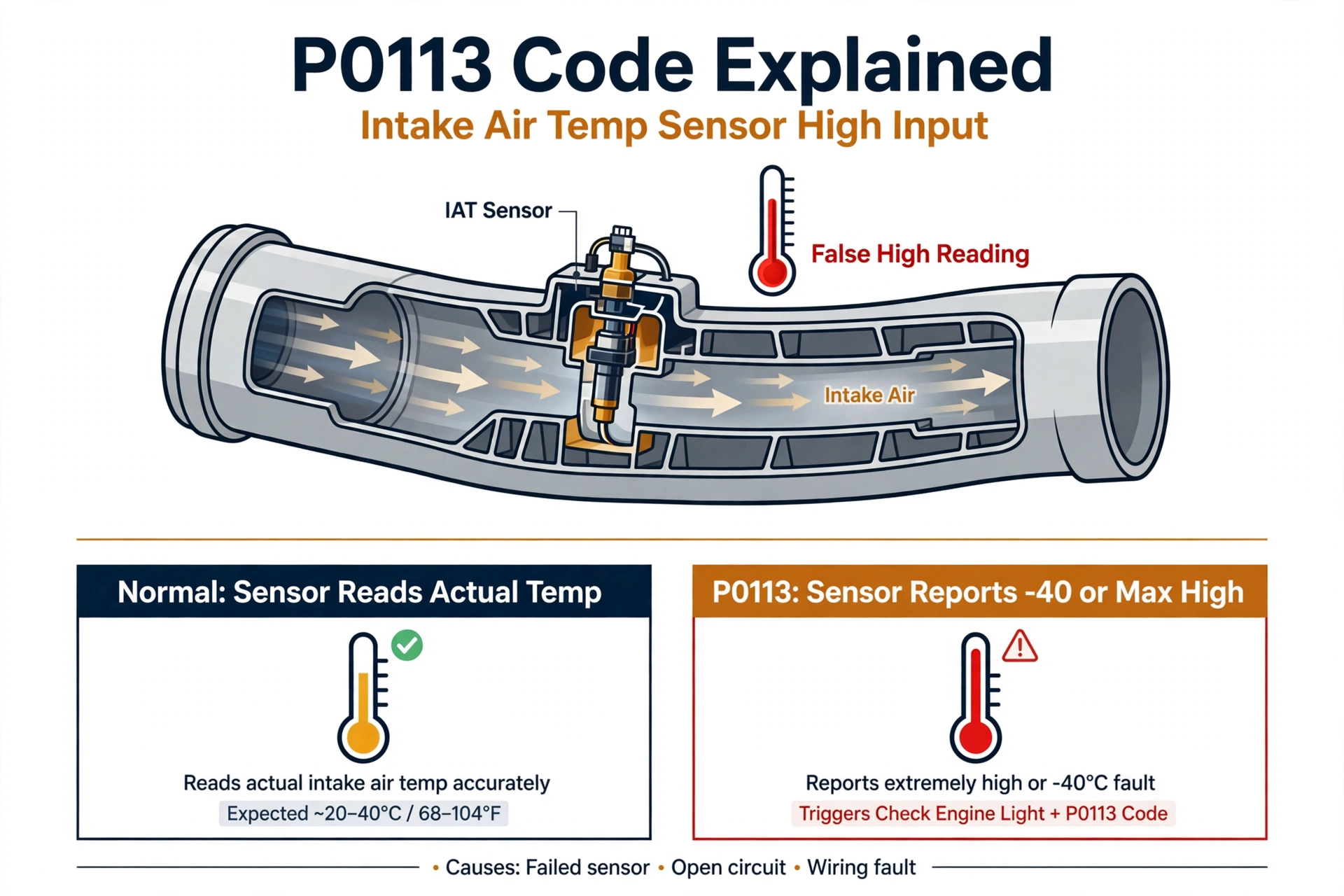
The P0113 engine code stands for “Intake Air Temperature Sensor 1 Circuit High Input.” When your car’s computer sets the engine code P0113, it is seeing a voltage from the intake air temperature (IAT) sensor that translates to an unrealistically cold temperature, far colder than any real ambient condition.
The IAT sensor is a simple thermistor whose resistance drops as temperature rises. The computer sends it a 5-volt reference signal and measures what comes back. An open circuit, a disconnected sensor, or a failed sensor reads as maximum resistance, which the computer interprets as extremely cold air, often around -40 degrees. That impossible reading is what triggers the code.
Intake air temperature matters because the computer uses it to calculate air density and set the correct fuel mixture. Cold air is denser and needs more fuel. When the sensor reports -40 degrees on a warm day, the computer adds too much fuel, hurting performance and economy.
On many vehicles the IAT sensor is built into the mass airflow (MAF) sensor housing, so a P0113 code sometimes leads to MAF-related diagnosis. On others it is a standalone sensor in the intake tube or manifold.
Symptoms of the P0113 Code
Unlike some sensor codes that hide silently, P0113 often makes itself felt:
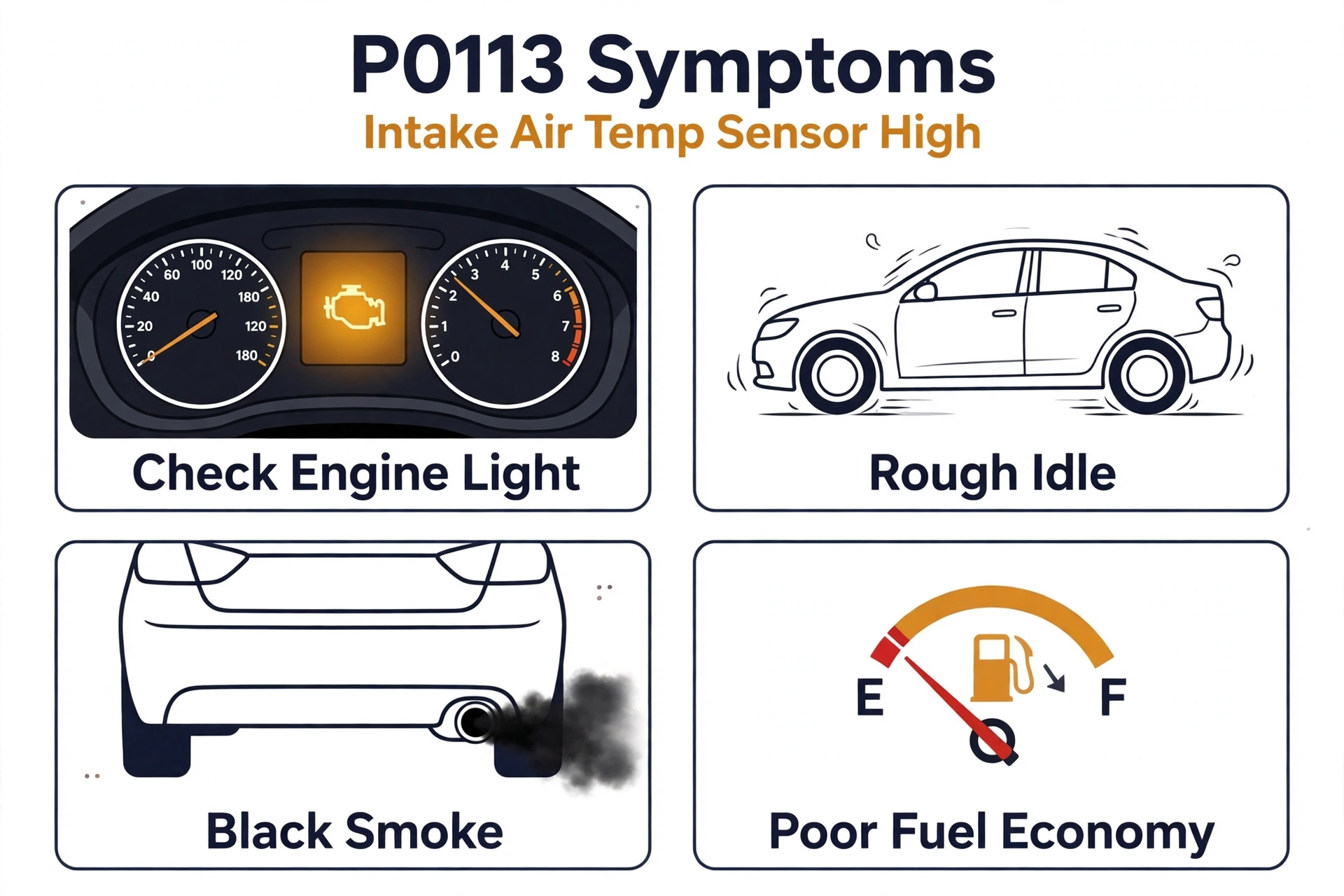
- Check engine light illuminated
- Poor fuel economy, the computer adds extra fuel for air it thinks is very cold and dense
- Rough idle or stalling, especially when cold, from the over-rich mixture
- Hesitation or lack of power on acceleration
- Hard starting in some cases
- Black smoke from the exhaust if the mixture is severely rich
If your car suddenly started running rich and the check engine light came on, P0113 is a prime suspect.
Common Causes of P0113
Here are the most common causes of the P0113 engine code, in order of likelihood:
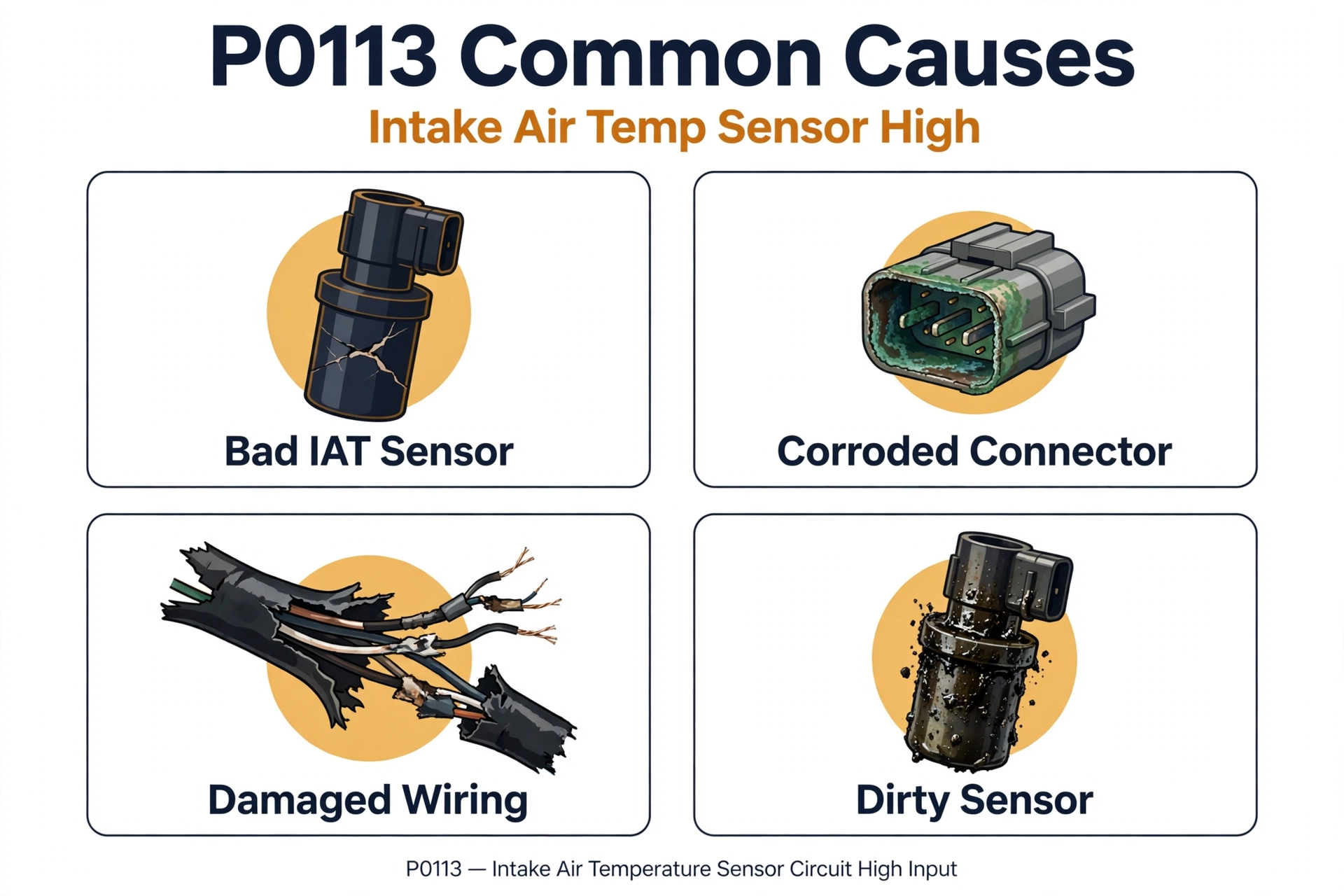
- Failed intake air temperature sensor: The thermistor inside the sensor degrades or fails open with age and heat cycling. This is the single most common cause. The sensor itself is inexpensive and easy to replace on most vehicles.
- Damaged wiring or connector: Broken wires, corroded terminals, or a loose connector in the IAT sensor circuit create an open circuit that reads as maximum cold. Rodent damage to wiring is surprisingly common. Wiggle-test the harness while watching live data.
- Sensor left disconnected: If recent work was done near the intake (air filter change, MAF cleaning, intake manifold work), the IAT connector may not have been fully reseated. Always check this before buying parts.
- Faulty MAF sensor (when IAT is integrated): On vehicles where the IAT sensor is built into the MAF housing, a failing MAF can set P0113. If the IAT reading is dead but the MAF portion tests fine, some aftermarket MAF units allow separate IAT replacement, most require the whole unit.
- ECM or ground issues: Rare, but a bad engine ground or an internal ECM reference voltage problem can skew the sensor reading. Rule out the sensor and wiring first.
- Blocked or heat-soaked air intake: A severely restricted air filter or an intake drawing hot engine-bay air will not set P0113 by itself, but extreme heat soak combined with a marginal sensor can push readings out of range.
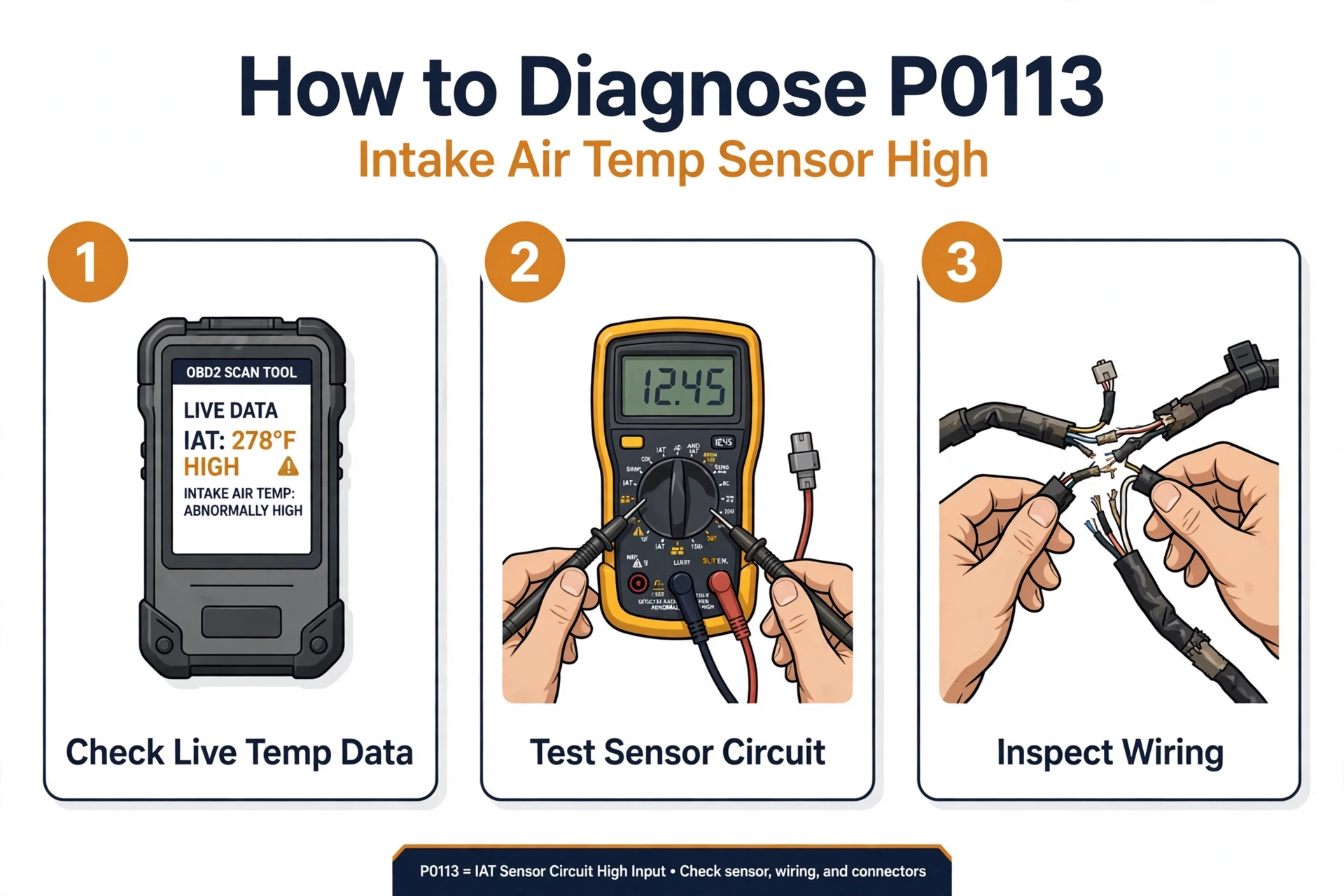
How to Diagnose P0113
This code is straightforward to diagnose with a scan tool that shows live data.
- Scan and check companion codes. Pull all codes. P0113 with MAF codes (P0101, P0102) points toward the MAF/IAT assembly. P0113 alone usually means the IAT sensor or its wiring. Note the freeze frame data, it shows the IAT reading when the code set.
- Inspect the connector and wiring. Find the IAT sensor (intake tube, airbox, or manifold). Unplug the connector and look for corrosion, bent pins, or green oxidation. Check the wiring for chafing, especially where it routes near hot or moving parts.
- Read the IAT sensor live data. With the key on and engine off, compare the IAT reading to the actual ambient temperature. A reading of -40 degrees (or the sensor’s minimum) on a normal day confirms an open circuit. If the sensor is disconnected, plug it back in and watch the reading, it should jump to near ambient.
- Test sensor resistance. Unplug the sensor and measure resistance across its terminals with a multimeter. Compare to spec (typically around 2,000-3,000 ohms at room temperature, dropping as it warms). Infinite resistance means the sensor has failed open. You can warm the sensor with your hand and watch resistance fall to confirm it responds.
- Check the MAF if combined. If the IAT is integrated into the MAF, test the MAF separately. Clean the MAF sensing elements with dedicated MAF cleaner (never touch them). If the IAT portion is dead and the MAF tests good, check whether your vehicle allows separate IAT replacement.
How to Fix the P0113 Code
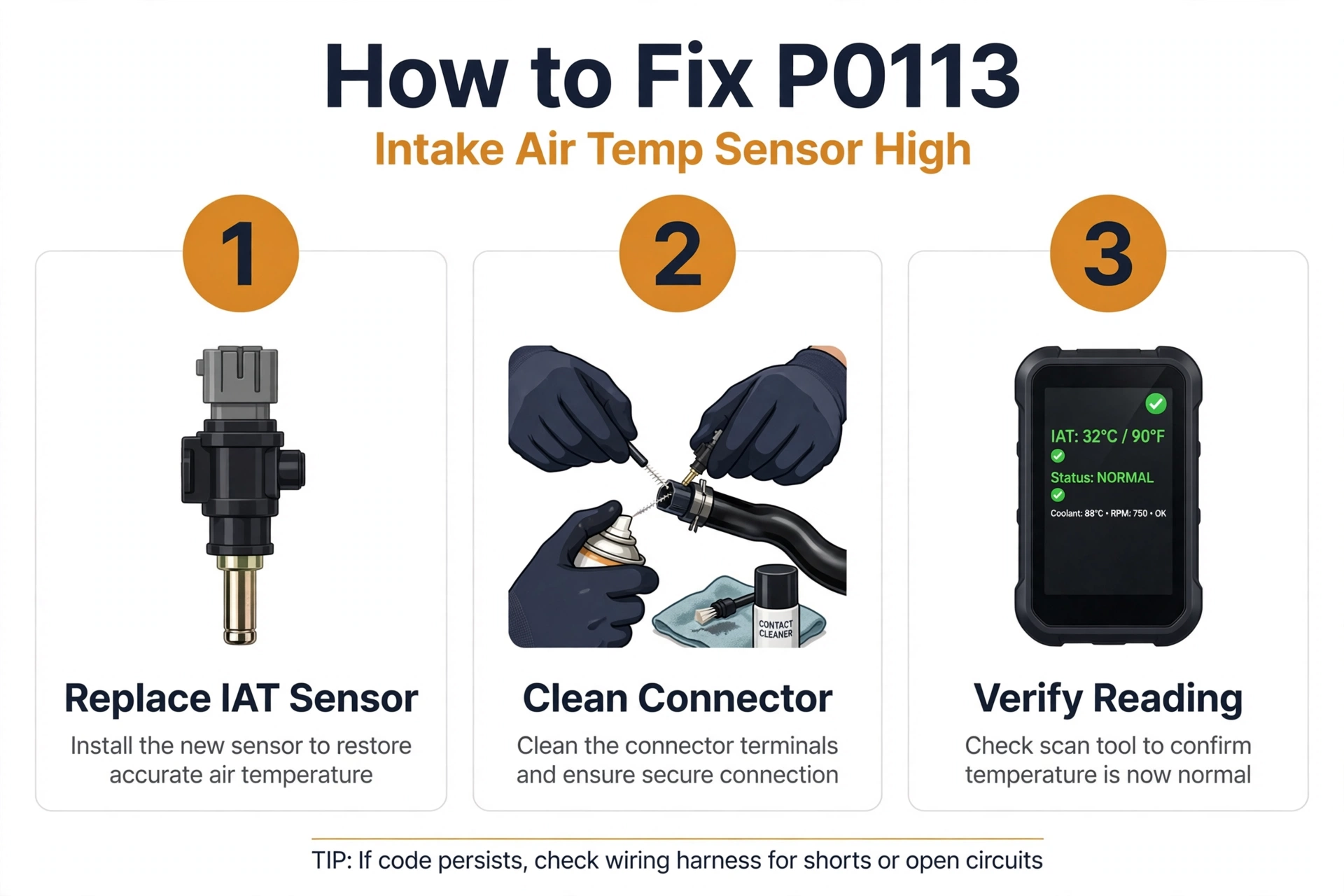
Match the fix to your diagnosis:
- Reseat or repair the connector: If the sensor was unplugged or the connector is loose, reseat it until it clicks. Clean corroded terminals with electrical contact cleaner. This free fix solves a surprising number of P0113 cases.
- Replace the IAT sensor: The most common real fix. Usually one or two screws or a simple twist-lock in the intake tube. Disconnect the battery, swap the sensor, reconnect. Clear the code and verify the live reading matches ambient.
- Repair damaged wiring: Splice in new wire where the harness is broken, using solder and heat shrink (not twist caps) for a lasting repair. Replace a damaged connector pigtail if terminals are corroded.
- Replace or clean the MAF sensor: If the IAT is integrated and the MAF is faulty, try cleaning first with MAF-specific cleaner. If cleaning does not help, replace the MAF assembly.
- Replace a clogged air filter: Not a direct cause, but a restricted filter never helps. Replace it if it is dirty, it is cheap maintenance anyway.
Here is the key money-saver: how to fix P0113 code without replacing MAF starts with identifying whether your IAT is standalone. On most vehicles it is a separate $15 to $40 sensor. Only vehicles with an integrated IAT/MAF need the more expensive assembly, and even then, try cleaning the MAF and testing the IAT separately first. Never replace a $200 MAF for a P0113 until you have confirmed the IAT portion is truly dead and not separately serviceable.
P0113 Repair Costs
| Repair | Cost Range |
|---|---|
| Reseat connector / clean terminals | $0 |
| Replace IAT sensor (standalone) | $15 – $60 |
| Replace MAF sensor (if IAT integrated) | $50 – $250 |
| Wiring repair | $20 – $100 |
| Connector pigtail replacement | $10 – $40 |
| Diagnostic fee (if done at a shop) | $100 – $200 |
A standalone IAT sensor is a $15 to $60 part and a 15-minute DIY job on most vehicles.
DIY vs Mechanic Verdict
You can do this at home: IAT sensor replacement, connector inspection and cleaning, air filter replacement, and MAF cleaning are all easy.
See a mechanic for: Wiring harness faults buried deep in the loom, ECM or ground issues, and any case where the sensor and wiring test good but the code returns.
Bottom line: This is a top-tier DIY code. The sensor is cheap, accessible, and easy to test. Start with the connector, test the sensor, and you will solve most P0113 cases in under an hour.
Can You Drive With a P0113 Code?
Short distances, yes, but do not ignore it. A P0113 code makes the engine run rich, which wastes fuel, fouls spark plugs, and can overheat and damage the catalytic converter over time. You will also fail emissions testing. Fix it within a week or two. If the car is stalling or running very rough, get it fixed sooner.
P0113 on Popular Vehicles
The P0113 engine code is common across all makes. Some patterns:
- Honda Civic and Accord (K-series): The standalone IAT sensor in the intake tube fails with age. Inexpensive and a 10-minute replacement.
- Toyota Camry and Corolla: IAT integrated into the MAF on many models. Try MAF cleaning first, it resolves many cases.
- Ford Focus and F-150: Connector issues are common, especially after air filter service. Check that the connector is fully seated before replacing anything.
- VW and Audi (2.0T): Wiring chafing near the intake is a known issue. Inspect the harness carefully.
Related Codes
- P0110: Intake Air Temperature Sensor 1 Circuit Malfunction
- P0111: Intake Air Temperature Sensor 1 Circuit Range/Performance
- P0112: Intake Air Temperature Sensor 1 Circuit Low Input
- P0101: Mass Air Flow Sensor Circuit Range/Performance
- P0171: System Too Lean (Bank 1)
- P0174: System Too Lean (Bank 2)
Video Walkthrough
Watch a step-by-step guide to diagnosing and fixing the P0113 intake air temperature sensor circuit high input code.
Frequently Asked Questions
What does the P0113 code mean?
The P0113 engine code means “Intake Air Temperature Sensor 1 Circuit High Input.” The sensor is reporting an impossibly cold temperature, usually because of an open circuit, a disconnected sensor, or a failed sensor.
Can I drive with a P0113 code?
Short distances, yes. But the engine runs rich with P0113 active, which wastes fuel and can damage the catalytic converter over time. Fix it within a week or two.
Where is the intake air temperature sensor located?
Usually in the intake tube between the air filter box and the throttle body, in the intake manifold, or integrated into the mass airflow (MAF) sensor housing. Check your vehicle’s manual for the exact location.
How much does it cost to fix a P0113 code?
A standalone IAT sensor costs $15 to $60 and takes minutes to replace. If the IAT is integrated into the MAF, a replacement MAF runs $50 to $250. Wiring repairs are $20 to $100.
Will the P0113 code clear itself?
It can clear after several drive cycles if the underlying issue is fixed (for example, after reseating a loose connector). But a failed sensor will keep setting the code until replaced.
Can cold weather cause a P0113 code?
Real cold weather will not set P0113. The code triggers on readings colder than physically possible (around -40 degrees), which indicates an electrical fault, not actual temperature.
Should I replace the MAF sensor for P0113?
Only if the IAT sensor is integrated into the MAF and the IAT portion has truly failed. On most vehicles the IAT is a separate, cheap sensor. Confirm which type your vehicle has before buying a MAF.
Conclusion
The P0113 engine code is a straightforward sensor circuit code with a cheap fix. Check the connector first, test the sensor with a multimeter, and replace it if it has failed open. On most vehicles this is a sub-$60 repair you can finish in under an hour. Do not ignore it, though: running rich will cost you at the pump and can damage your catalytic converter.
By the OBD2 Code Hub editorial team. We write plain-English guides to every check engine light code so you can diagnose with confidence.