P0174 Code: Meaning, Causes, Symptoms & Fixes
In This Guide
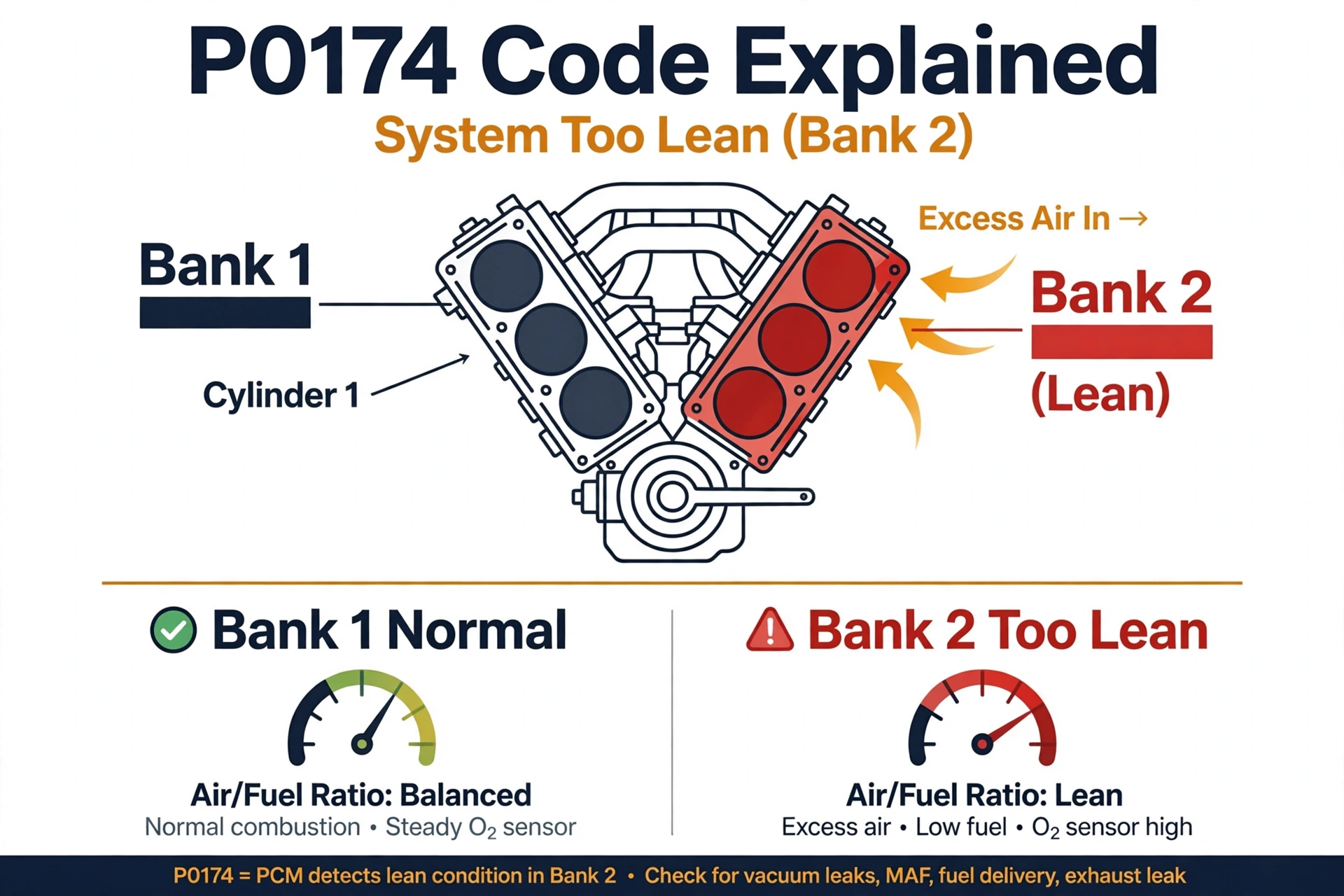
One-line meaning: Your car’s computer has detected that the air-fuel mixture on bank 2 is too lean, meaning there is too much air or too little fuel on the side of the engine opposite cylinder 1.
What the P0174 Code Means
The p0174 code means “System Too Lean (Bank 2).” Your engine computer constantly adjusts the air-fuel mixture toward the ideal ratio of about 14.7 parts air to 1 part fuel. It makes these adjustments using feedback from the oxygen sensors, in small corrections called fuel trims. When the mixture on bank 2 stays lean even after the computer has added the maximum allowed fuel correction, roughly 25 percent, it stores the engine code p0174 and turns on the check engine light.
Bank 2 is the side of the engine opposite cylinder 1. On most transverse-mounted V6 engines, bank 2 is the side closest to the firewall, which can make its sensors and hoses harder to reach. On a 4-cylinder engine there is only one bank, so you will never see a p0174 code on a 4-cylinder, only P0171.
P0174 is the mirror image of P0171. The two codes describe the identical fault on opposite banks, and in the real world they appear together more often than alone. When you see both, that is actually helpful, because a fault affecting both banks almost always has one shared cause, like a dirty mass airflow sensor or low fuel pressure, rather than two separate failures.
Like its twin, the p0174 code is a symptom code, not a parts code. It tells you the mixture is lean on bank 2, but not which part failed. The most expensive mistake drivers make is replacing the bank 2 oxygen sensor first. In the large majority of cases the sensor is fine and just reporting
what it sees. The real problem is usually unmetered air entering through a vacuum leak or a contaminated MAF sensor.
Symptoms of the P0174 Code
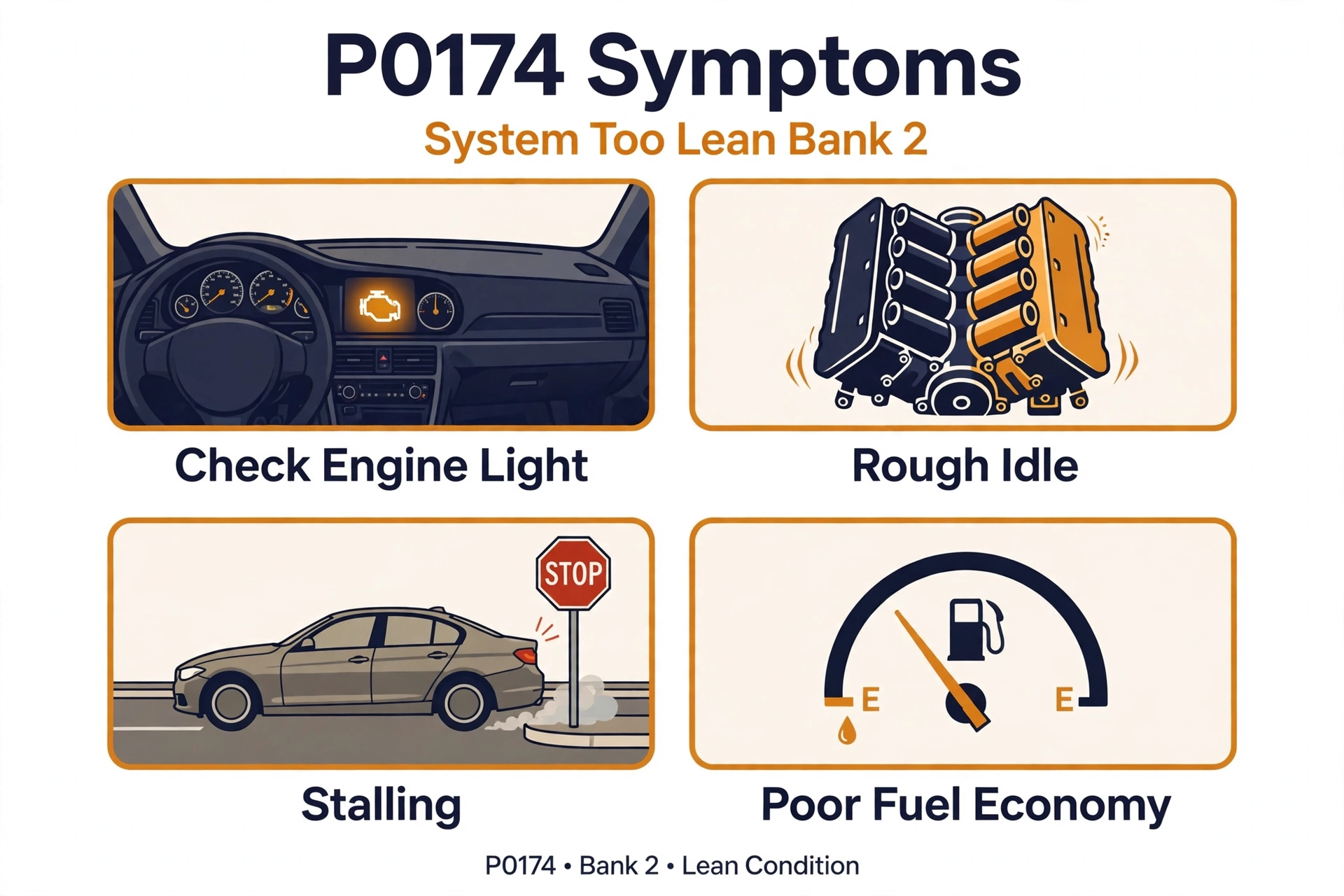
The check engine light is often the only symptom, especially early on. But a lean condition on bank 2 produces the same drivability complaints as any lean code:
- Check engine light on. Usually solid. A flashing light means misfires are occurring, which is your signal to stop driving.
- Rough or high idle. The engine may shake at stoplights or idle faster than normal as the computer struggles to stabilize the mixture.
- Hesitation under load. Stumbling or lag when accelerating, merging, or climbing hills.
- Reduced fuel economy. The computer dumps in extra fuel compensating for the lean reading, so mileage drops even though the code says “lean.”
- Stalling at stops. In worse cases the engine may die when you come to a stop.
- Misfires. A lean mixture can cause misfire codes (P0300 series) to appear alongside the p0174 code.
- Whistling or hissing. Air being sucked through a vacuum leak makes a distinct whistle from the engine bay.
- Power loss at speed. Fuel delivery problems show up as weakness at higher speeds and loads.
Common Causes of P0174
These are the most common causes of the engine code p0174, starting with the most frequent:
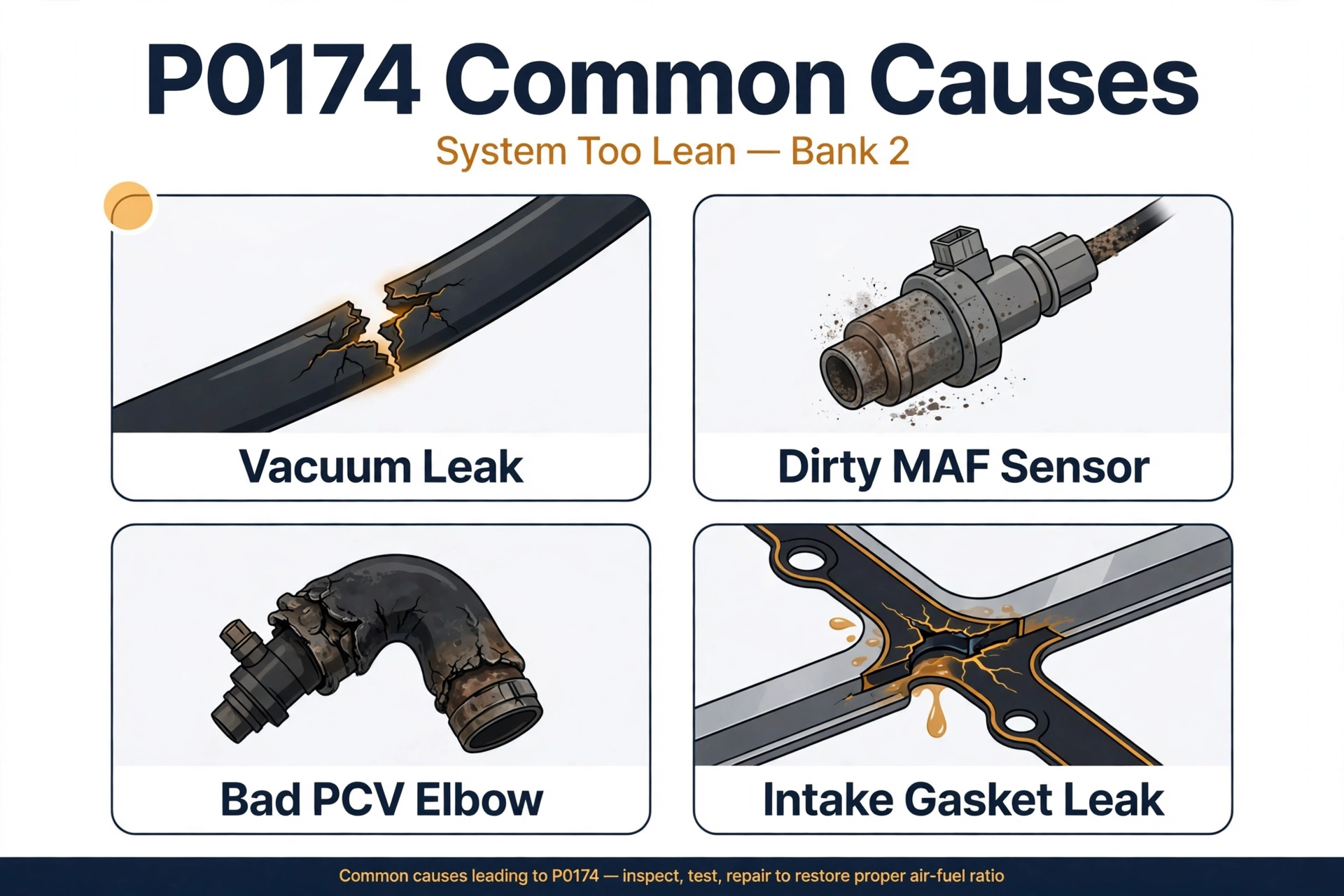
- Vacuum leak after the MAF sensor (most common). A torn intake boot, cracked vacuum hose, or leaking intake manifold gasket lets in air the MAF never measured. Because this air enters downstream of the sensor, the computer under-fuels. This is the number one real-world cause.
- Dirty or faulty MAF sensor. A contaminated sensing wire under-reports total airflow, so the computer injects too little fuel for both banks. Over-oiled aftermarket air filters are a known contaminator. A MAF problem is the prime suspect whenever P0171 and P0174 appear together.
- Leaking PCV valve or collapsed PCV hose. A stuck-open PCV valve admits extra air. On Ford 4.6L and 5.4L V8 trucks, the rubber PCV elbow at the back of the intake manifold rots and cracks, and this single part is the most reported cause of the p0174 code on Ford forums.
- Bank 2 upstream oxygen sensor faulty. A slow or biased sensor can falsely report lean. But multiple sources warn not to replace it first, it is rarely the root cause. It becomes a suspect mainly when P0174 appears alone without P0171.
- Low fuel pressure. A weak fuel pump, clogged fuel filter, or faulty pressure regulator starves the engine. This usually affects both banks, but a marginal pump can set one bank’s code first.
- Clogged or leaking fuel injector on bank 2. A bank-localized cause worth checking when only P0174 appears. If both P0171 and P0174 are present, bank-specific causes like a single injector are unlikely, look at shared causes instead.
- Exhaust leak before the bank 2 upstream O2 sensor. Outside air entering the exhaust makes the sensor falsely report lean. The engine itself is fine, the reading is corrupted.
- Leaking brake booster. The booster is a large vacuum consumer. A leak there leans the whole mixture.
- Intake manifold gasket or isolator bolt leaks. Ford issued a technical service bulletin for 1999-2003 Windstar models covering leaking lower-to-upper intake isolator bolts and port gaskets, explicitly instructing technicians not to replace the PCM, MAF, or O2 sensors for this fault.
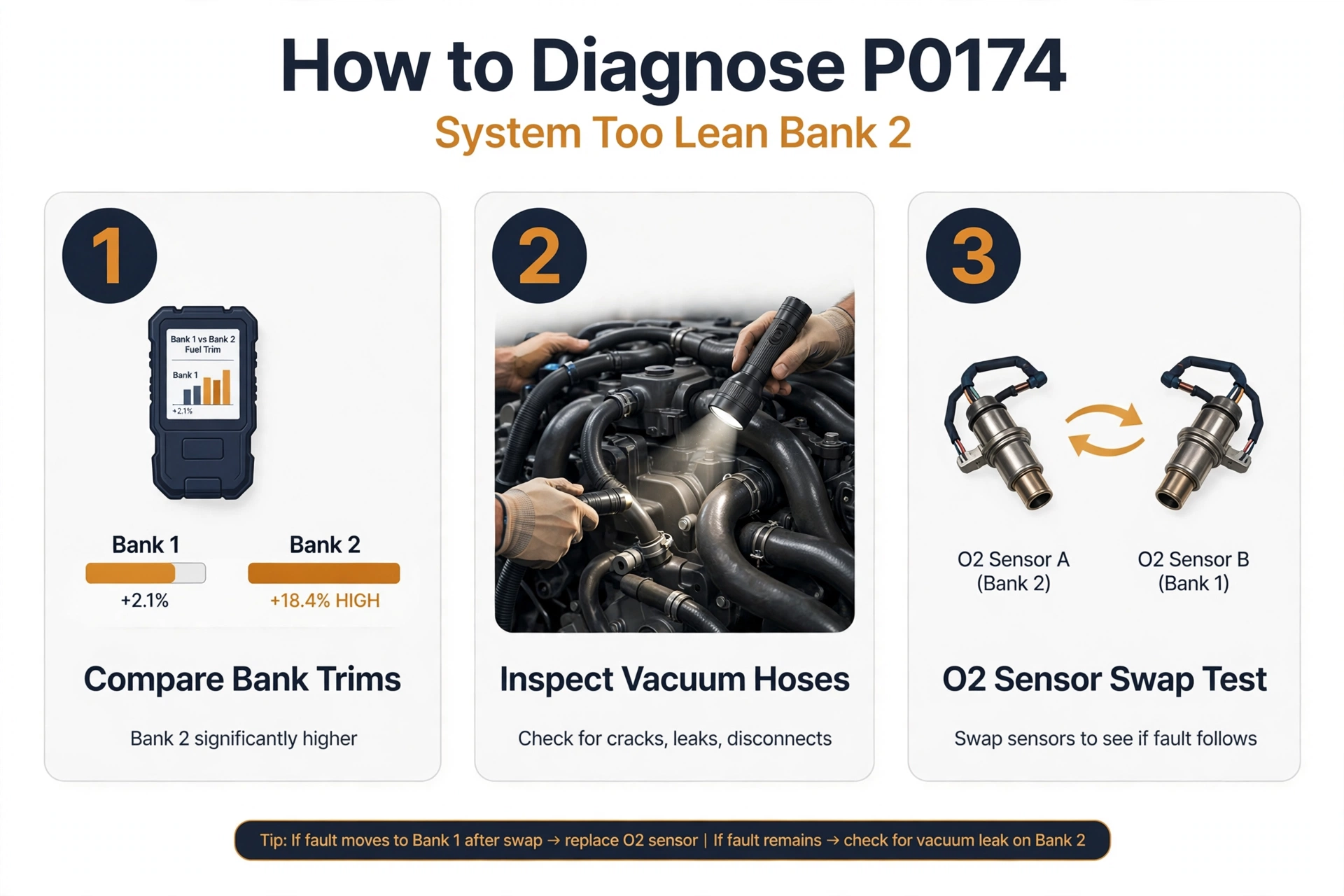
How to Diagnose P0174 (Do This Before Buying Parts)
- Read every code and the freeze frame. Note whether P0171 is also present. P0171 and p0174 together means one shared cause, which actually simplifies diagnosis. Only P0174 means the fault is likely local to bank 2. Compare bank 1 vs bank 2 fuel trims, and check for companions like P0101 (MAF), P0300 (misfires), or P0420 (converter damage).
- Visual inspection. Check vacuum hoses, the intake boot between the MAF and throttle body, the PCV valve and hoses, intake manifold gasket edges, and wiring connectors. On Ford trucks, squeeze the PCV elbow at the rear of the intake, it cracks exactly where you cannot see it.
- Smoke test or spray test. Have a shop run a smoke test of the intake, or spray carb cleaner around vacuum lines and the intake gasket with the engine idling. An RPM change or a sudden fuel-trim drop marks the leak. Listen for hissing.
- Clean and inspect the MAF sensor. Use dedicated MAF cleaner only, check that the air filter is clean and the airbox seals properly. Recheck trims after cleaning.
- Test fuel pressure and the O2 sensor. Check rail pressure against spec. Monitor the bank 2 upstream O2 sensor’s voltage switching with a scan tool, a slow or flat response means a worn sensor. Here is a trick the top sites never mention: the O2 swap test. When only P0174 is present, swap the bank 1 and bank 2 upstream sensors, clear the codes, and drive. If the code jumps to P0171, the sensor was bad. If P0174 returns, the sensor is fine and the cause is elsewhere.
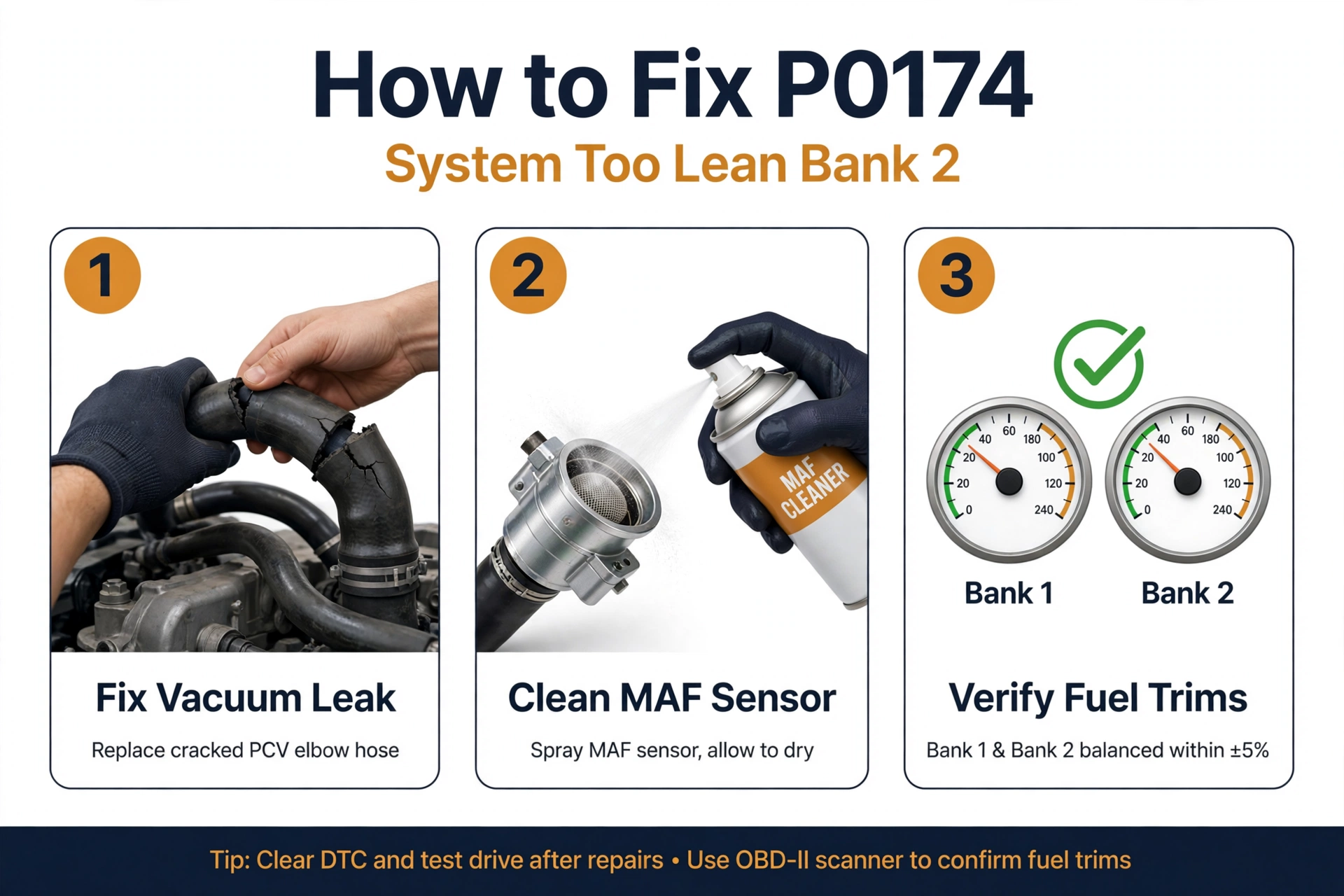
- Repair, clear, and verify. Fix the confirmed fault, clear the code, run a full drive cycle, and confirm fuel trims return to normal on both banks.
How to Fix the P0174 Code
Match the fix to your diagnosis:
- Repair vacuum leaks. Replace torn intake boots, cracked hoses, and bad gaskets. Tighten every clamp between the MAF and the throttle body.
- Clean the MAF sensor. A $10 can of dedicated cleaner resolves a large share of p0174 code cases. Replace the sensor only if live data shows erratic readings after cleaning.
- Replace the PCV valve and hoses. On Ford V8s, replace the rotting rear PCV elbow, it is the classic fix.
- Replace intake manifold gaskets. Labor-heavy on V engines, but the gasket set is inexpensive.
- Replace the bank 2 upstream O2 sensor. Only after confirming it is actually bad, ideally with the swap test described above.
- Service the fuel system. Replace the fuel filter, test and replace a weak pump or faulty regulator, clean or replace clogged injectors.
P0174 Repair Costs
The p0174 code has one of the widest repair cost ranges of any check engine code, because the cause can be a $10 hose or a $1,000 fuel pump. This is exactly the information most top-ranking pages fail to provide. Here is the real breakdown:
| Repair | Cost Range |
|---|---|
| MAF sensor cleaning (DIY) | $10 – $20 |
| Vacuum hose repair (DIY / shop) | $20 – $300 |
| PCV valve and hose replacement | $10 – $150 |
| MAF sensor replacement (shop) | $250 – $470 |
| Intake manifold gasket replacement | $200 – $800 |
| Bank 2 upstream O2 sensor (shop) | $150 – $650 |
| Fuel filter replacement | $50 – $200 |
| Fuel pump replacement | $400 – $1,700 |
| Fuel injector set replacement | $500 – $1,200 |
| Professional diagnostic fee | $80 – $150 |
A professional diagnosis typically costs $80 to $150 and is often credited toward the repair at the same shop. The pattern is clear: the most common causes (vacuum leak, PCV elbow, MAF cleaning) are the cheapest fixes, while the parts people guess at first (O2 sensor, fuel pump) cost far more. Testing before buying is what keeps a p0174 code repair under $150 instead of over $1,000.
DIY vs Mechanic Verdict
DIY it if: the cause is a vacuum hose, the PCV valve or elbow, or a dirty MAF sensor. Even beginners can handle the spray test, the visual inspection, and MAF cleaning. The Ford PCV elbow is famously a 30-minute, $20 DIY repair.
See a mechanic if: you need a smoke test, the intake manifold must come off for gaskets, or fuel pressure testing points to the pump. Also see a pro if the O2 swap test is inconclusive.
Verdict: P0174 is very DIY-friendly when the cause is air-related, which it usually is. Start with the visual inspection and the spray test. If both banks are lean, clean the MAF sensor before spending another dollar.
Can You Drive With a P0174 Code?
Short trips are generally fine, and the car is not unsafe to drive with a solid check engine light. But do not ignore the engine code p0174 for weeks. A lean mixture burns hotter, and sustained hot running damages the catalytic converter first, then risks piston and valve damage over months. A flashing check engine light, stumbling, or stalling means stop driving and fix it now.
Get it diagnosed within a few days. The converter is the real long-term risk, and a $150 hose today beats a $1,500 converter in six months.
P0174 on Popular Vehicles
- Ford F-150, Expedition, Explorer (4.6L / 5.4L V8). This is the single most common p0174 code vehicle family in the US. The code p0171 p0174 system too lean bank 1 and bank 2 pairing is the signature. Check the rotting PCV hose elbow at the back of the intake manifold first, then the intake manifold gaskets. Ford technicians recommend cleaning the MAF and disconnecting the battery for a PCM relearn after the repair.
- Ford Ranger and Explorer (4.0L V6). Same P0171 plus P0174 pairing, same PCV and intake gasket suspects on a smaller engine.
- GM trucks (Silverado, Tahoe) and SUVs (Acadia, Trailblazer). Vacuum leaks and intake manifold gaskets dominate the p0174 code reports here. The diagnostic path is the same: spray test, smoke test, then gaskets.
- BMW 3-Series, Jaguar XK8, Honda, Dodge. P0174 appears across all brands. BMW owners note it can appear in cold weather, when dense cold air leans the mixture past the computer’s correction limit.
P0174 vs P0171
These two codes are the same fault on opposite banks. Bank 2 sits opposite cylinder 1 (P0174), while bank 1 is the cylinder 1 side (P0171). Both codes together means look at shared causes. When p0171 and p0174 set at the same time, the fault affects the whole engine. Suspect the MAF sensor, fuel pressure, or a leak in the shared intake tract. Only P0174 means look at bank 2. Suspect the bank 2 upstream O2 sensor, a bank 2 injector, or an exhaust leak ahead of that bank’s sensor.
Our P0171 code guide covers the bank 1 side with the same depth.
Related Codes
- P0171 (System Too Lean Bank 1): the twin code, most often seen together with P0174.
- P0170 / P0173 (Fuel Trim Malfunction Bank 1 / 2): same fault family.
- P0300-P0306 (Misfires): lean-induced misfires follow the lean condition, fix the lean first.
- P0101 (MAF Performance): co-set with lean codes, points at the MAF.
- P0420 (Catalyst Efficiency): long-term lean running overheats the converter.
Video Walkthrough
Watch this diagnostic walkthrough from 1A Auto (USA) covering both P0171 and P0174, from the simple checks to the deeper tests, on a real vehicle.
Frequently Asked Questions
What does the P0174 code mean?
The p0174 code means your engine is running too lean on bank 2, which is the side of the engine opposite cylinder 1. There is too much air or too little fuel in the mixture, so the computer maxed out its fuel correction trying to compensate and stored the code. It is the bank 2 counterpart of P0171.
What is the difference between P0171 and P0174?
They are the same fault on opposite sides of the engine. P0171 is bank 1 and the p0174 code is bank 2. When both appear together, the cause is usually shared, like a dirty MAF sensor or low fuel pressure. When only P0174 appears, suspect something local to bank 2, like its upstream O2 sensor or an exhaust leak near that sensor.
What is the most common cause of P0174?
Vacuum leaks are the most common cause of the p0174 code by a wide margin, especially leaks after the MAF sensor such as a torn intake boot or cracked vacuum hoses. A dirty MAF sensor is second. On Ford trucks with 4.6L or 5.4L V8 engines, the rotting PCV hose elbow at the back of the intake is the classic culprit.
Can I drive with a P0174 code?
Short trips are generally fine and the car is not unsafe, but do not ignore the p0174 code for weeks. A lean mixture burns hotter, and over time that heat can damage the catalytic converter and internal engine parts. Get it diagnosed within a few days to avoid turning a cheap hose repair into an expensive converter replacement.
How much does it cost to fix a P0174 code?
Cheap fixes for the p0174 code run 10 to 150 dollars DIY, like cleaning the MAF sensor or replacing a vacuum hose. Mid-range shop repairs like an O2 sensor or intake gasket run 150 to 800 dollars. Fuel system failures like a pump or injector set run 400 to over 1,200 dollars. A professional diagnosis costs 80 to 150 dollars.
Why do P0171 and P0174 appear together so often?
Because most lean causes affect the whole engine. A dirty MAF sensor misreads total airflow, low fuel pressure starves every cylinder, and a shared intake leak feeds unmetered air to both banks. Both codes setting at once actually makes diagnosis easier, since it rules out bank-specific parts like a single O2 sensor.
How can I prevent P0174 from coming back?
Replace the engine air filter on schedule and keep the airbox sealed. Avoid over-oiled aftermarket air filters, since the oil contaminates the MAF sensor. Inspect vacuum hoses and the intake boot for cracks periodically, especially the hard-to-see PCV elbow on Ford V8s, and replace the fuel filter at the recommended interval.
Conclusion
The p0174 code is P0171’s twin, and it responds to the same diagnostic logic. Start by noting whether P0171 is present too. Both banks lean means one shared cause, usually the MAF sensor, fuel pressure, or a vacuum leak. Only bank 2 lean means look local: the bank 2 O2 sensor, its injector, or an exhaust leak near that sensor.
Do not replace the oxygen sensor first, and do not ignore the code. A $20 PCV elbow or a $10 can of MAF cleaner resolves most cases. Fix it promptly, verify with a drive cycle, and the engine code p0174 will stay off.
About the author: Written by the OBD2 Code Hub editorial team. Our diagnostic guides are built from real OBD-II data, manufacturer service procedures, and hands-on troubleshooting experience, then reviewed for technical accuracy before publishing. We drive the same cars you do.