P0171 Code: System Too Lean (Bank 1)
In This Guide
One-line meaning: Your car’s computer has detected that the air-fuel mixture on bank 1 is too lean, meaning there is too much air or too little fuel reaching the engine.
What the P0171 Code Means
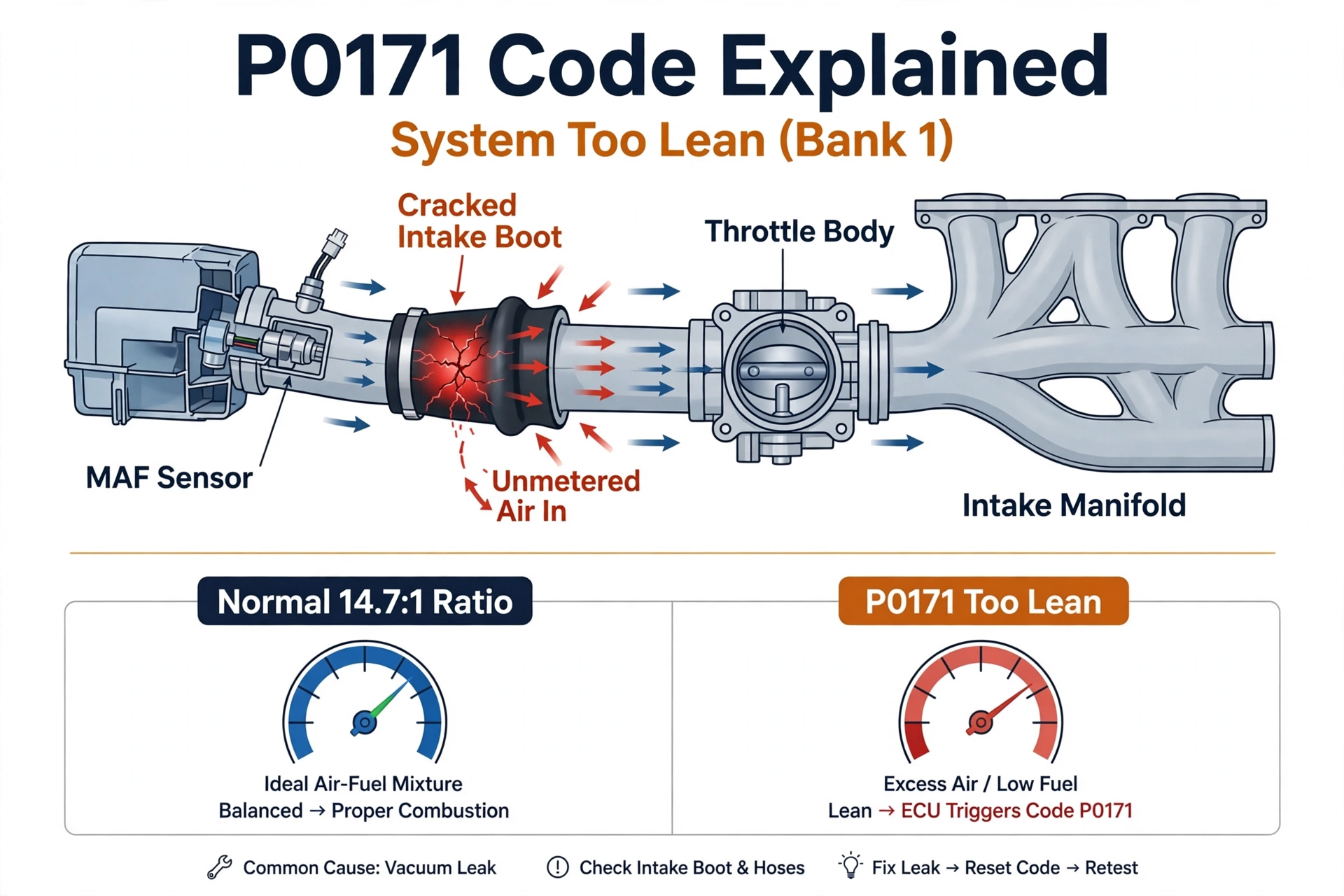
The p0171 code is one of the most searched check engine light codes in the United States, and for good reason. Its full definition is “System Too Lean (Bank 1).” In plain English, the engine computer (PCM) has detected that the air-fuel mixture entering the engine on bank 1 is too lean, which means there is too much air relative to fuel.
Your engine is designed to run on a precise mixture of about 14.7 parts air to 1 part fuel. For instance, the computer constantly fine-tunes this mixture using data from the oxygen sensors, making small corrections called fuel trims. When something goes wrong, like unmetered air sneaking in through a cracked hose, the computer adds more and more fuel to compensate. When those corrections exceed roughly 25 percent and still cannot fix the mixture, the computer gives up and stores the code p0171.
Bank 1 is the side of the engine that contains cylinder number 1. On a 4-cylinder engine there is only one bank, so any lean condition shows up as p0171 system too lean bank 1. On a V6 or V8, bank 1 is one side and bank 2 is the other, which is why you sometimes see P0171 and P0174 together.
The tricky part about the obd2 code p0171 is that it is a symptom code, not a parts code. For example, it tells you the mixture is lean, but it does not tell you which part failed. That is why so many drivers waste money replacing the oxygen sensor first, when the real culprit is usually a $30 cracked intake boot or a dirty sensor that just needs an $8 can of cleaner.
Symptoms of the P0171 Code
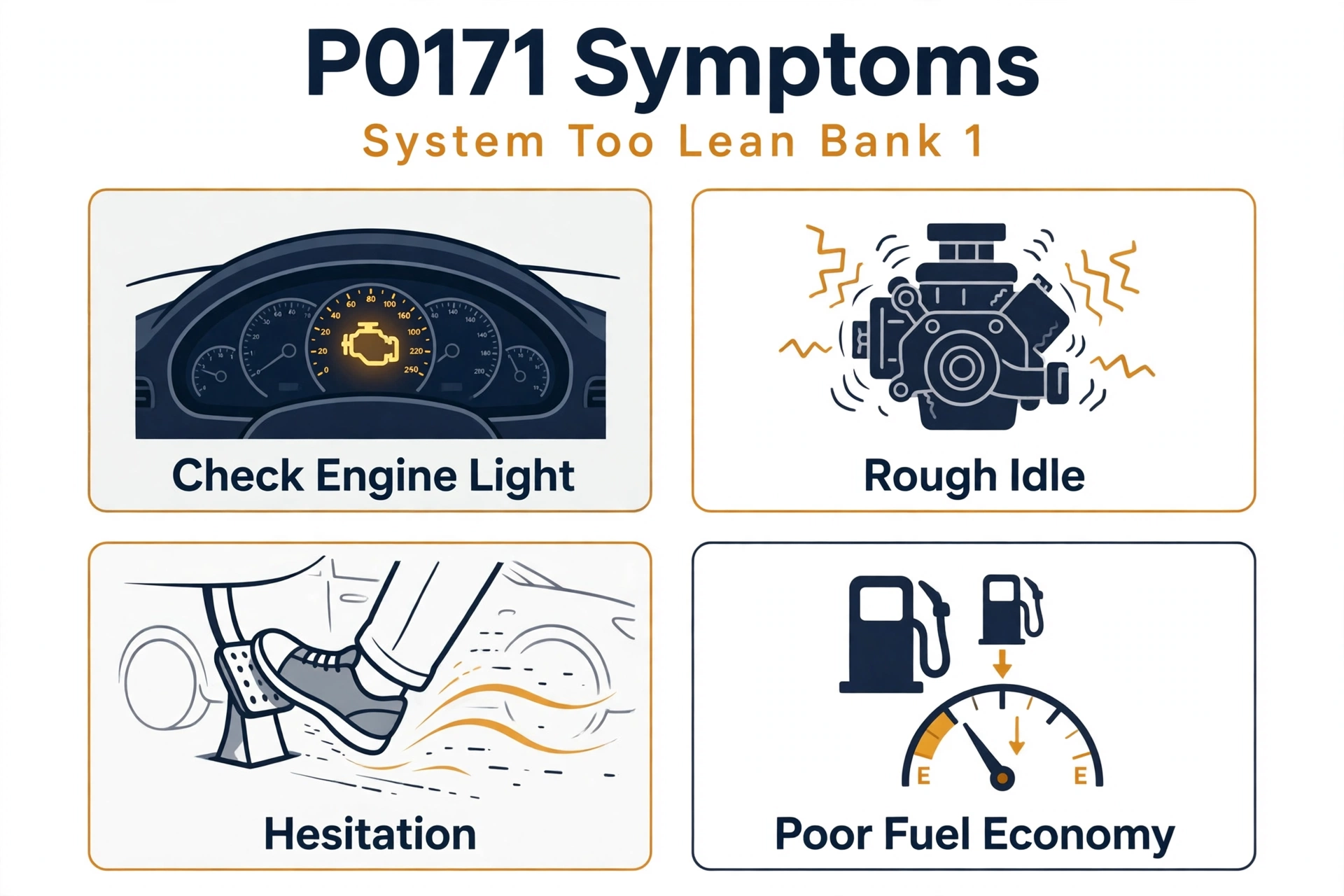
In many cases, the check engine light is the only symptom you will notice, especially in the early stages. The car may drive exactly the same as before. But as the lean condition gets worse, these symptoms of the p0171 code start showing up:
- Check engine light stays on. The light is solid in most cases. It only flashes if engine misfires develop alongside the lean condition, which is a sign to stop driving and get it checked immediately.
- Rough or uneven idle. The engine may shake or vibrate at stoplights, and in bad cases it can stall when you come to a stop.
- Hesitation when accelerating. The car stumbles or hesitates when you press the gas, especially from a stop or at light throttle.
- Lack of power under load. Weak acceleration going uphill or when merging onto the highway.
- Hard starting. The engine may crank longer than normal before starting, particularly on cold mornings.
- Engine knock or pinging. A lean mixture burns hotter and can cause detonation (pinging) under load, which you hear as a rattling sound when accelerating.
- Worse fuel economy. This surprises people, but the computer burns extra fuel trying to compensate for the lean condition, so your mileage drops.
- Hissing or whistling noise. If you hear a whistle from the engine bay, that is air being sucked through a vacuum leak, and it is practically pointing at the problem.
If you are seeing a check engine light code p0171 along with misfire codes (P0300 series), treat it as more urgent. A lean mixture that is severe enough to cause misfires is also hot enough to start damaging the catalytic converter.
Common Causes of P0171
These are the most common causes of the engine code p0171, roughly in order of how often they show up in real repair shops:
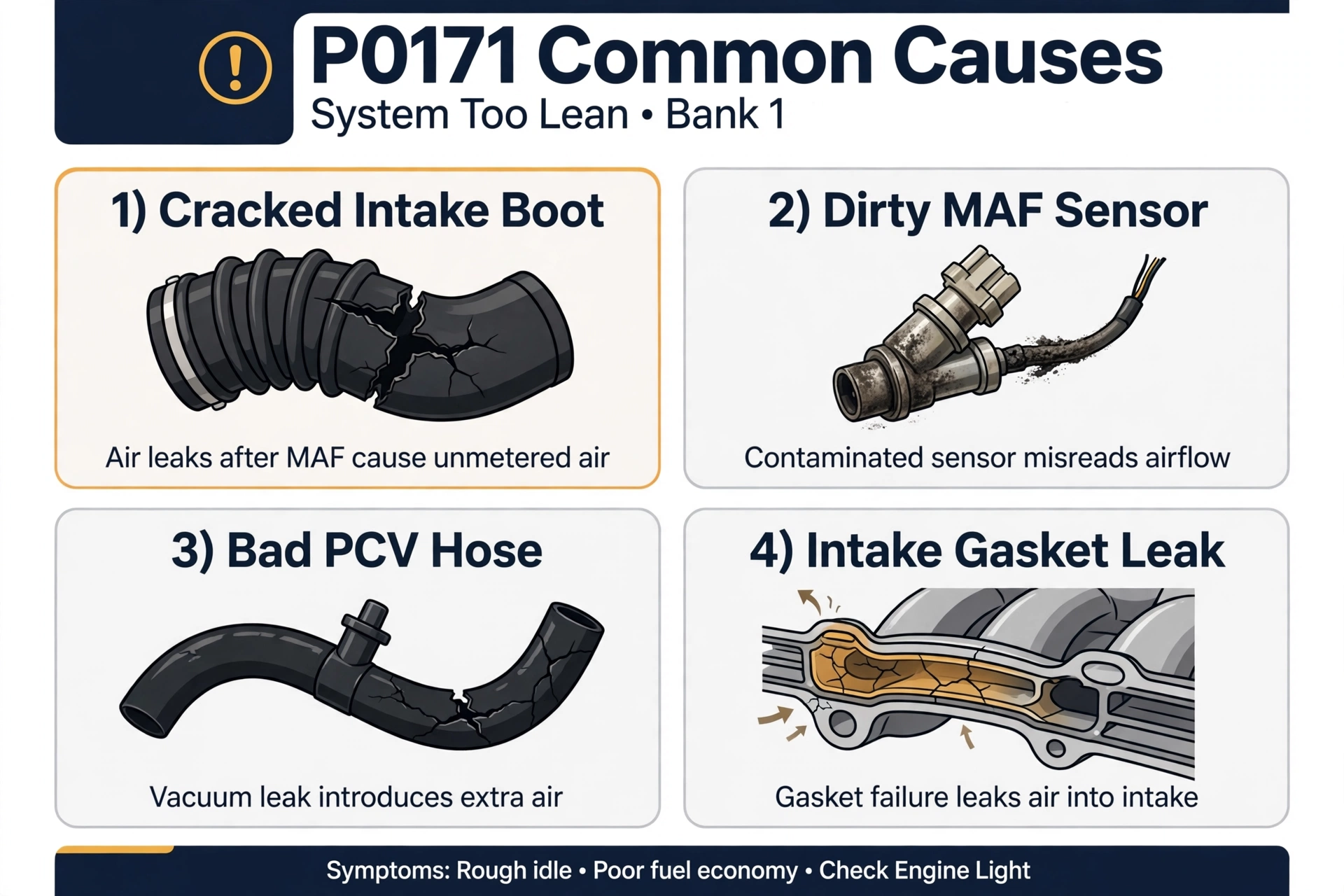
- Vacuum or intake air leak (the number one cause): A cracked intake boot between the mass airflow sensor and the throttle body, a torn vacuum hose, or a loose clamp lets in air the computer never measured. This unmetered air leans out the mixture. On many cars the rubber intake boot cracks on its corrugated ridges where you cannot see the damage until you remove it and flex it.
- Dirty or failing MAF sensor: The mass airflow sensor measures incoming air. When its sensing wire gets contaminated with oil vapor or dirt, it under-reports the airflow, so the computer injects too little fuel. Over-oiled aftermarket air filters are a notorious cause of MAF contamination.
- Faulty PCV valve or cracked PCV hose: A stuck PCV valve or a brittle, cracked PCV hose pulls extra air into the intake. This is a cheap part that causes an expensive-looking code.
- Intake manifold gasket leak: On high-mileage engines the gasket between the intake manifold and the cylinder head hardens and leaks, especially when the engine is cold. Several manufacturers have issued technical service bulletins for this exact problem.
- Low fuel pressure: A weak fuel pump, a clogged fuel filter, or a faulty fuel pressure regulator starves the engine of fuel. Unlike a vacuum leak, low fuel pressure usually causes a lean condition at all engine speeds, not just at idle.
- Clogged fuel injectors: Injectors that are restricted by deposits deliver less fuel than the computer commands, leaning out the mixture on one or more cylinders.
- Exhaust leak before the upstream oxygen sensor: A crack in the exhaust manifold or a bad gasket lets outside air into the exhaust stream. The oxygen sensor reads this extra oxygen and falsely reports a lean condition, even though the actual mixture in the cylinders is fine.
- EVAP purge valve stuck open: The purge valve is supposed to meter fuel vapor from the charcoal canister into the intake at controlled times. When it sticks open, it dumps vapor inconsistently and confuses the fuel trims.
- Faulty upstream oxygen sensor (rare): A lazy or biased O2 sensor can report a false lean signal. But this is the classic misdiagnosis for the p0171 engine code. Replace the sensor only after every other cause has been ruled out, or you will likely waste $150 and still have the code.
How to Diagnose P0171 (Do This Before Buying Parts)
Follow these steps in order. Skipping ahead to parts replacement is how a $30 fix turns into a $500 guessing game.
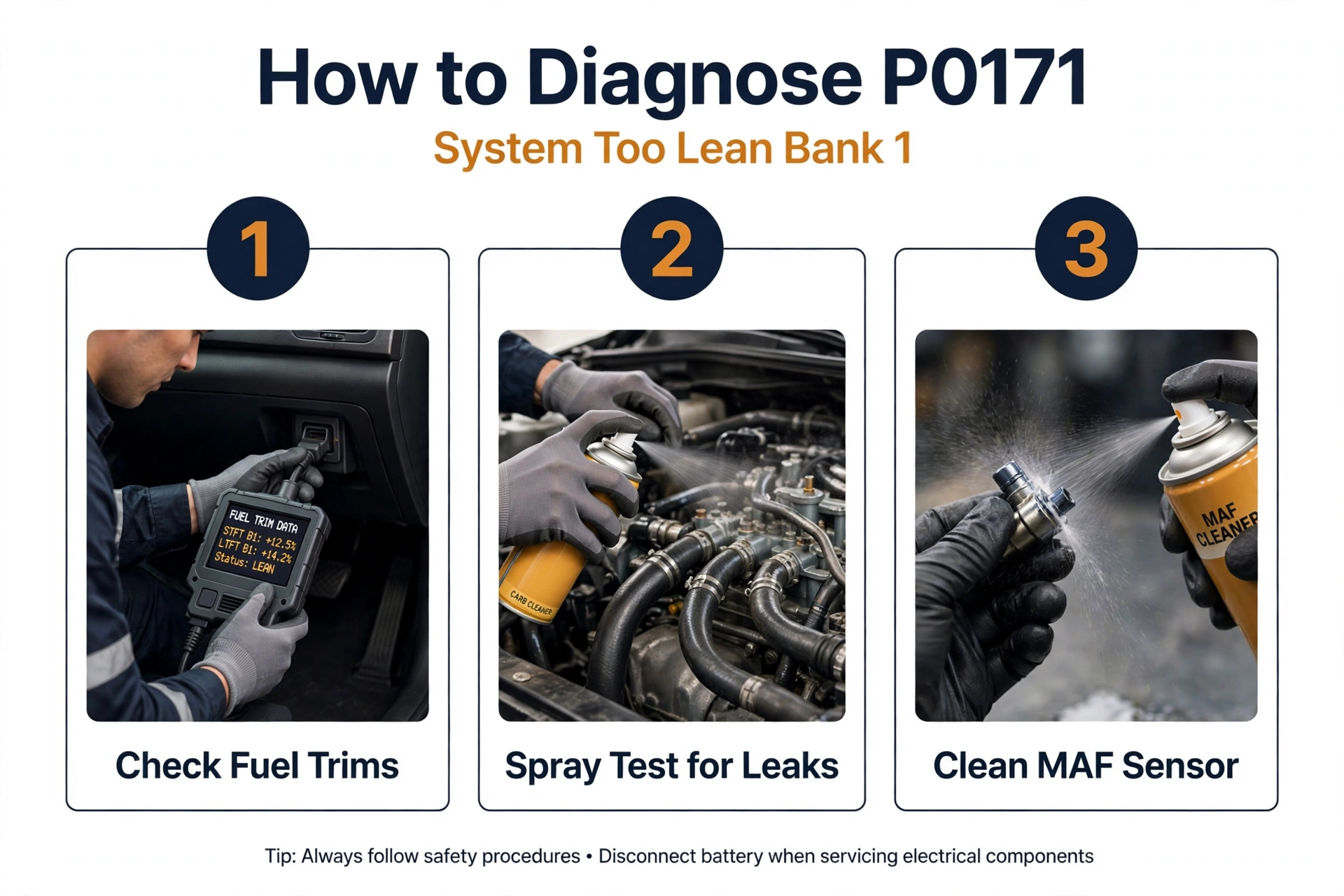
- Read all stored codes. Do not just read the dtc p0171 and stop. Companion codes redirect the entire diagnosis. If you also see P0174, both banks are lean, which points to one large shared cause like the MAF or fuel pressure. P0101 points straight at the MAF sensor. P0300 means the lean condition is causing misfires, which raises the urgency. P0420 suggests the lean condition may already be damaging the catalytic converter.
- Check freeze frame data. Your scanner captured engine conditions the moment the check engine code p0171 set. Look at RPM, engine load, coolant temperature, and fuel trims. High trims at low RPM point to a vacuum leak. Lean at high RPM and load points to fuel delivery. A code that set when the engine was cold suggests a gasket that seals once everything expands with heat.
- Compare fuel trims at idle and at 2,500 RPM. This is the single most revealing test for a p0171 code. Watch short-term and long-term fuel trims (STFT/LTFT) at idle, then hold the engine at 2,500 RPM. If trims are high at idle but improve at higher RPM, you have a vacuum leak. Trims that stay high at all RPM point to the MAF sensor or fuel delivery instead. When trims look normal at idle but go lean under load, the fuel pump is the likely culprit. The code typically sets when total trim correction exceeds about 25 percent.
- Hunt for the vacuum leak. With the engine idling, spray short bursts of carb cleaner around the intake boot, vacuum hoses, PCV connections, brake booster line, and intake manifold gasket area. If the RPM rises or the fuel trims suddenly drop at one spot, you found the leak. A smoke machine test works even better for small leaks, and most shops charge $80 to $150 for it.
- Clean the MAF sensor. Remove the sensor and spray it with dedicated MAF sensor cleaner only. Never use brake cleaner or carb cleaner on it, those chemicals destroy the sensing element. Let it dry completely, reinstall, clear the code, and recheck the trims. This $8 fix resolves a surprising number of obd p0171 cases.
- Test fuel pressure and the oxygen sensor. Connect a fuel pressure gauge and compare against spec at idle and under snap throttle. A drop of 10 PSI or more under load means a weak pump. Check for an exhaust leak before the upstream O2 sensor (a ticking sound on cold start that fades as the engine warms is the classic sign). Test the O2 sensor voltage swing last, it should cycle between roughly 0.1 and 0.9 volts. Only replace the sensor if it is genuinely slow or flat.
How to Fix the P0171 Code
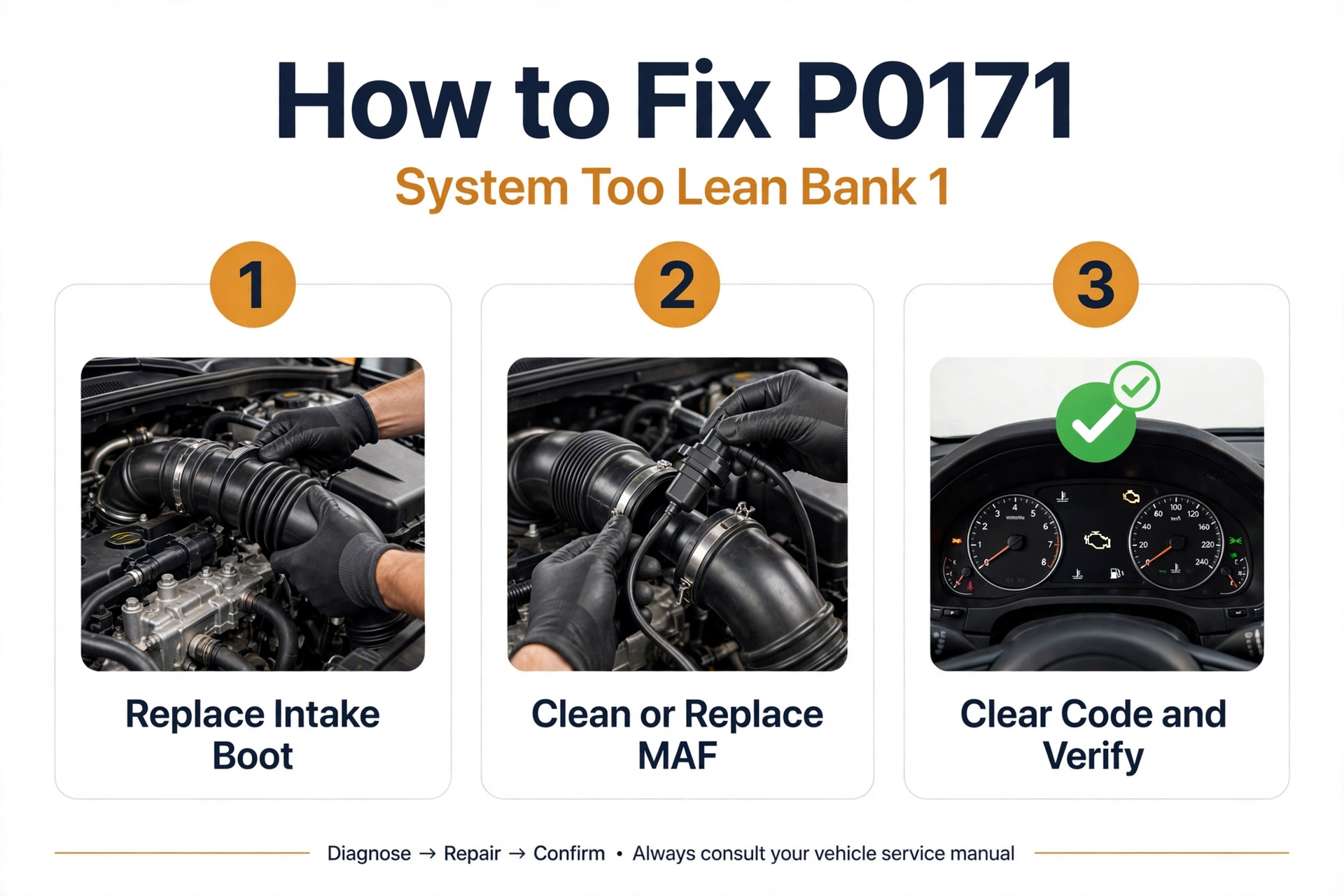
The right fix depends on what your diagnosis found. Here are the fixes for the p0171 code, matched to their causes:
- Repair the intake boot and clamps: Replace a cracked accordion hose between the MAF and throttle body and tighten every clamp. This is the most common actual fix, and the part usually costs $20 to $80.
- Replace vacuum hoses: Swap out any cracked, brittle, or disconnected vacuum lines. Trace every small hose, the tiny ones crack first.
- Replace the PCV valve or hose: A $10 to $40 part and often a ten-minute job. If the hose is oil-soaked and spongy, replace the hose too, not just the valve.
- Clean or replace the MAF sensor: Start with the $8 cleaner. If live data still shows erratic airflow readings after cleaning, replace the sensor.
- Replace the intake manifold gasket: On V6 and V8 engines this means removing the intake, so it is labor-heavy, but the gasket set itself is cheap.
- Repair the exhaust leak: Replace the manifold gasket or repair the cracked section before the upstream O2 sensor so the sensor reads correctly again.
- Service the fuel system: Replace a clogged fuel filter, a faulty pressure regulator, or a weak fuel pump. The pump usually requires dropping the fuel tank, which is why labor is the big cost here.
- Replace the EVAP purge valve or the O2 sensor: Swap a stuck-open purge valve if testing confirms it. Replace the upstream oxygen sensor only after all other causes are ruled out.
P0171 Repair Costs
Repair costs for the p0171 code range from under $10 to over $1,000, which is exactly why diagnosing before buying parts matters so much. Here is what each repair typically costs in the US:
| Repair | Cost Range |
|---|---|
| MAF sensor cleaning (DIY) | $8 – $12 |
| Vacuum hose / clamp replacement | $5 – $100 |
| Intake boot replacement | $20 – $160 |
| PCV valve / hose replacement | $10 – $100 |
| MAF sensor replacement | $110 – $350 |
| Smoke test (shop diagnosis) | $80 – $150 |
| Intake manifold gasket replacement | $230 – $800 |
| Upstream O2 sensor replacement | $120 – $450 |
| Fuel filter replacement | $80 – $220 |
| Fuel pump replacement | $300 – $1,200 |
| Fuel injector service / replacement | $350 – $600 |
A professional diagnostic fee runs $100 to $200 and is often waived or credited if you have the repair done at the same shop. Notice the pattern: the most common fixes (intake boot, vacuum hoses, PCV, MAF cleaning) are all under $160, while the parts people guess at first (O2 sensor, fuel pump) cost far more. Testing fuel trims before spending money is what separates a $30 repair from a $500 mistake.
DIY vs Mechanic Verdict
DIY it if: the cause is a cracked intake boot, a vacuum hose, the PCV valve, or a dirty MAF sensor. These are all beginner-friendly jobs needing only basic hand tools. The carb cleaner spray test and MAF cleaning are well within any DIYer’s ability, and the parts are cheap.
See a mechanic if: the diagnosis points to the intake manifold gasket (intake removal on a V6/V8), a fuel pump (tank drop), or if fuel trim readings confuse you. Also see a pro if the code keeps returning after you have fixed the obvious causes, a smoke test will find leaks you cannot see or hear.
Verdict: P0171 is one of the most DIY-friendly check engine codes. Roughly 7 out of 10 cases are fixed with an intake boot, a hose, a PCV valve, or a can of MAF cleaner. Start with the visual inspection and the spray test before spending money, and you will usually solve it in your driveway.
Can You Drive With a P0171 Code?
For short, gentle trips, yes, if the check engine light is solid and the car drives normally. The engine light code p0171 by itself does not make the car unsafe.
But there are clear stop-driving signs: a flashing check engine light, noticeable stumbling or stalling, or misfire codes appearing alongside P0171. A flashing light means raw fuel is reaching the catalytic converter, which can overheat and melt the converter’s internals in a single drive.
Even when the car feels fine, do not ignore a p0171 check engine code for weeks. A lean mixture burns hotter than normal, and that sustained extra heat slowly damages the catalytic converter and can contribute to piston and valve wear. What starts as a $30 intake boot becomes an $800-plus converter job if you wait long enough. Get it diagnosed within a few days.
P0171 on Popular Vehicles
The p0171 code shows up across all brands, but certain vehicles have well-known pattern failures. If your car is on this list, check the noted item first.
- Toyota (Camry, Corolla, RAV4, Tacoma): The p0171 toyota search is one of the highest-volume lean-code queries for a reason, and toyota p0171 covers the same demand from the other word order. On 2002-2011 models with the 2AZ-FE engine, the accordion intake hose cracks on its corrugated ridges where the damage hides until you remove the hose and flex it. A toyota dtc p0171, also written as dtc p0171 toyota in scan tool readouts, on a 2003-2008 Corolla or Matrix with the 1ZZ-FE engine may be covered by Toyota TSB EG045-07 for leaking intake manifold gaskets in freezing weather. For a p0171 toyota corolla specifically, check the intake gasket first in winter. Drivers searching p0171 code toyota should know the V6 Camry, Avalon, and Sienna with the 1MZ-FE often trace the code p0171 toyota to the upper intake manifold gasket after 100,000 miles, and you will usually see P0174 with it. Toyota obd ii p0171 cases on Tacomas and 4Runners: inspect the intake boot at the throttle body and the PCV hose on the valve cover.
- Ford (F-150, Explorer, Escape): A p0171 ford code on 4.6L and 5.4L V8 trucks is frequently the plastic PCV line cracking from heat, a $20 to $50 DIY fix. Note that on these V8s, bank 1 is the passenger side. The ford p0171 code also appears with TSBs for leaking gaskets between the upper and lower intake manifolds. For a p0171 code ford diagnosis, check the rubber vacuum elbow at the back of the intake manifold, it rots where you cannot see it. A p0171 ford f150 with the 3.5L EcoBoost may have charge-pipe or intercooler boot leaks that need boost pressure testing. Ford diagnostic code p0171 and ford engine code p0171 on late-90s models were covered by a TSB for MAF contamination causing P0171 and P0174 together. The p0171 engine code ford pattern on the Escape often traces to the same PCV hose issue.
- Chevrolet / GM (Silverado, Cruze, Malibu): The p0171 chevy code is extremely common. On a chevrolet cruze p0171 or p0171 chevy cruze, check the PCV system and the valve cover, the integrated PCV diaphragm fails and leans the mixture. For p0171 code chevy and code p0171 chevy on trucks with the 5.3L V8, MAF contamination is the prime suspect, especially with an over-oiled aftermarket air filter. A chevy p0171 code on the 3.1L/3.4L V6 may be the documented lower intake manifold gasket failure. The p0171 chevrolet pattern on the 2.4L Ecotec (Equinox, Malibu) usually means cracked PCV system hoses. Chevrolet dtc p0171:00 and gm p0171 00 are the same fault seen through GM’s enhanced diagnostics.
- Honda (Civic, Accord, CR-V): A p0171 honda code on K-series engines often comes from intake manifold or IACV gasket failures and brittle PCV hoses at the back of the engine. The VTEC solenoid spool valve gasket is an often-overlooked vacuum leak source. Note: many older Hondas use a MAP sensor instead of a MAF, so MAF cleaner does nothing on those models.
- Nissan and Subaru: The p0171 nissan code on a 2004 Maxima was covered by a service bulletin prescribing air/fuel sensor replacement. A subaru forester lean code p0171 usually traces to a cracked intake boot at the throttle body on EJ25 engines. On turbo WRX/STI models, P0171 subaru cases need intercooler pipe pressure testing rather than the spray test.
P0171 vs P0174
P0171 and P0174 are twin codes. Together, P0171 and p0174 describe the exact same fault, a lean air-fuel mixture, on opposite banks of the engine. Bank 1 is the side with cylinder 1, while bank 2 is the other side.
On a 4-cylinder engine there is only one bank, so you will only ever see P0171. On a V6 or V8, the distinction is diagnostically useful. When you see the code p0171 p0174 system too lean bank 1 and bank 2 together, both banks are lean, which almost always points to one large shared cause: a big intake leak, a dirty MAF sensor, or low fuel pressure. It is good news, in a way, because one shared cause means one repair.
When only P0171 appears on a V engine, the cause is likely local to bank 1: an exhaust leak on that side, a bank-1 injector issue, or that bank’s upstream O2 sensor. Our P0174 code guide covers the bank 2 side in the same detail.
Related Codes
If your scan showed more than just the eobd p0171, these related codes change the diagnosis:
- P0174 (System Too Lean Bank 2): the twin code. Both banks lean means one shared cause.
- P0172 / P0175 (System Too Rich): the rich counterparts. A car that swings between lean and rich codes may have a failing MAF or fuel pressure regulator.
- P0300-P0308 (Misfires): a severe lean condition causes misfires. Fix the lean condition first, the misfires usually follow it away.
- P0101 (MAF Sensor Range/Performance): points directly at the mass airflow sensor.
- P0420 (Catalyst Efficiency): a long-ignored lean condition can overheat and kill the catalytic converter.
- P0442 / P0455 (EVAP Leaks): check the purge valve, a stuck-open purge valve causes both EVAP and lean codes.
Video Walkthrough
Watch the video above for a visual walkthrough of P0171 causes and diagnosis before you read on.
Frequently Asked Questions
What does the P0171 code mean?
P0171 means your engine is running too lean on bank 1, which is the side of the engine that has cylinder 1. Lean means there is too much air or too little fuel in the mixture. Your engine computer watches the oxygen sensor and keeps adding fuel to compensate, and when it runs out of adjustment room, it stores the p0171 code and turns on the check engine light.
What is the most common cause of a P0171 code?
An air leak after the mass airflow sensor is the most common cause of the p0171 code. A cracked intake boot, a loose clamp, or a brittle vacuum hose lets in air the sensor never measured, so the computer injects too little fuel. The telltale sign is fuel trims that read high at idle but improve when you rev the engine to 2,500 RPM. A dirty MAF sensor is the second most common cause.
Can I still drive with a P0171 code?
Short, gentle trips are generally acceptable if the light is solid and the car drives normally. Park it and get it fixed if the check engine light is flashing, the engine is stumbling or stalling, or misfire codes appear with it. Driving for weeks with a lean condition can overheat and destroy the catalytic converter, turning a cheap fix into a bill of 800 dollars or more.
How much does it cost to fix a P0171 code?
The cheapest fix for a p0171 code is a can of MAF cleaner at about 8 dollars, and most vacuum leaks or PCV parts cost under 100 dollars as a DIY repair. A replacement MAF sensor runs roughly 110 to 350 dollars, an intake manifold gasket job about 230 to 800 dollars, and a fuel pump replacement 300 to 1,200 dollars. A professional diagnosis typically costs 100 to 200 dollars.
What is the difference between P0171 and P0174?
P0171 means bank 1 is running lean and P0174 means bank 2 is running lean. On a 4-cylinder engine there is only one bank, so you will only ever see the p0171 code. On a V6 or V8, getting both codes at the same time almost always points to one large shared cause, like a big intake leak or a dirty MAF sensor. Getting only P0171 on a V engine points to a bank-1-specific source.
Will the P0171 code clear itself?
Sometimes the p0171 code goes off on its own if the lean condition was brief, like a hose that sealed up when the engine warmed. But the code comes back whenever the condition returns, and clearing it with a scanner without fixing the cause only buys time. If the light turns off by itself, the underlying leak or sensor problem is still developing and will come back worse.
How can I prevent a P0171 code?
Replace cracked, brittle rubber hoses and the intake boot before they fail, since heat cycling is what kills them. Keep the air filter clean and avoid over-oiling aftermarket filters, because excess oil coats the MAF sensor and corrupts its readings. Replace the PCV valve at its service interval and keep fuel filters fresh so injectors and the fuel pump stay healthy.
Conclusion
The p0171 code looks intimidating. However, it is one of the most DIY-friendly check engine codes you will encounter. In most cases the fix is a cracked intake boot, a vacuum hose, a PCV valve, or a can of MAF cleaner, all cheap parts and simple jobs. The key is diagnosing before buying: compare your fuel trims at idle and at 2,500 RPM, hunt the vacuum leak with the spray test, and clean the MAF sensor before you spend real money.
Do not fall for the classic trap of replacing the oxygen sensor first. And do not ignore the code for weeks, because the extra heat from a lean mixture is exactly what kills catalytic converters. Fix the code p0171 promptly, verify your fuel trims return to normal, and your check engine light will stay off.
About the author: Written by the OBD2 Code Hub editorial team. Our diagnostic guides are built from real OBD-II data, manufacturer service procedures, and hands-on troubleshooting experience, then reviewed for technical accuracy before publishing. We drive the same cars you do.